Quick answer: The closest thing to an official answer is the DHS STEM Designated Degree Program List. It includes every program in four whole families: engineering, biological and biomedical sciences, mathematics and statistics, and physical sciences (chemistry, physics, geology, astronomy). It also includes selected programs from 18 related families, such as computer science, IT, data science, business analytics, actuarial science, environmental science and research psychology. Not on the list: general psychology, general economics, nursing, communication disorders, general business and finance.
"Is my major STEM?" sounds like a yes-or-no question. It usually is, as long as you know where to look. Families often ask because a scholarship, a summer program or a college application mentions STEM, and nobody explains what actually counts.
There is no single definition used by every school and agency. The one most people end up checking is the DHS STEM Designated Degree Program List, which the Department of Homeland Security keeps for one specific purpose: deciding which international students qualify for a 24-month extension of their work training after graduation. Because it lists exact program codes, it's also the clearest public list there is.
This guide uses that list (all 540 program codes in the July 22, 2024 edition), the New York Fed's pay data by major, and Bureau of Labor Statistics data on STEM jobs. Every number is linked to its source.
What majors are considered STEM?
On the DHS STEM Designated Degree Program List, a major counts as STEM if its program code falls in one of four whole families, or matches one of the specific codes DHS picked from 18 related families.
Always STEM (every program in these four families):
- Engineering: every engineering major, from mechanical and civil to biomedical and nuclear.
- Biological and biomedical sciences: biology, biochemistry, neuroscience, genetics, microbiology, physiology and more.
- Mathematics and statistics: math, applied math, statistics.
- Physical sciences: chemistry, physics, astronomy, geology and atmospheric science.
STEM only for the listed programs (selected codes from 18 related families): computer and information sciences (including computer science, IT, cybersecurity and artificial intelligence), data science and analytics, engineering technology, environmental science and natural resources, agricultural and animal sciences, research psychology, quantitative economics, some health sciences (such as clinical laboratory science and pharmaceutical sciences), and a few business programs (actuarial science, business statistics, management science).
Is my major STEM? A quick lookup table
Here's how common majors line up against the DHS list. "Depends" means some versions of the major are listed and others aren't, so you need the program's code (see how to check below).
| Major | Counts as STEM on the DHS list? | Why |
|---|---|---|
| Engineering (any kind) | Yes | The whole engineering family (CIP 14) is on the list. |
| Biology, biochemistry, neuroscience | Yes | The whole biological sciences family (CIP 26) is on the list. |
| Math and statistics | Yes | The whole family (CIP 27) is on the list. |
| Chemistry, physics, geology, astronomy | Yes | The whole physical sciences family (CIP 40) is on the list. |
| Computer science, IT, cybersecurity | Yes | Computer Science (11.0701), Information Technology (11.0103) and information assurance/security (11.1003) are listed. |
| Data science and business analytics | Yes | Data Science, General (30.7001) and Business Analytics (30.7102) are listed. |
| Actuarial science | Yes | Actuarial Science (52.1304) is listed. |
| Environmental science | Yes | Environmental Science (03.0104) is listed. |
| Food science, animal science | Yes | Food Science (01.1001) and Animal Sciences (01.0901) are listed. |
| Aviation science | Yes | Aeronautics/Aviation/Aerospace Science and Technology (49.0101) is listed. |
| Psychology | Depends | Research psychology fields (such as experimental, cognitive, and industrial-organizational psychology) are listed. General psychology is not. |
| Economics | Depends | Econometrics and Quantitative Economics (45.0603) and Mathematical Economics (30.4901) are listed. General economics is not. |
| Kinesiology | Depends | Exercise Physiology and Kinesiology (26.0908) is listed. Kinesiology programs coded outside the biological sciences are not. |
| Architecture | Mostly no | Landscape architecture (04.0601) and architectural and building sciences (04.0902) are listed. A standard architecture degree is not. |
| Nursing | No | Nursing programs are not on the list. |
| Communication sciences and disorders | No | Not on the list, even though the coursework is science-heavy. |
| Finance, general business, marketing | No | Finance, General (52.0801) is not listed. Financial Analytics (30.7104) and Financial Mathematics (27.0305) are. |
Is psychology a STEM major?
It depends on the program. A general psychology major is not on the DHS list. But a dozen research-focused psychology programs are, including Experimental Psychology (42.2704), Cognitive Psychology and Psycholinguistics (42.2701), Behavioral Neuroscience (42.2706), Psychometrics and Quantitative Psychology (42.2708) and Industrial and Organizational Psychology (42.2804). Cognitive Science (30.2501) and Biopsychology (30.1001) are listed too.
So two students can both say they "majored in psychology" and only one of them has a STEM degree on paper. If the STEM label matters to your teen, look for a B.S. track built around research methods and neuroscience, and confirm the program code. If your teen is drawn to the brain side of psychology, psychology vs. neuroscience is worth a look, since neuroscience is always STEM.
Is economics a STEM major?
Only certain economics programs. General economics is not on the DHS list. Econometrics and Quantitative Economics (45.0603), Mathematical Economics (30.4901), Economics and Computer Science (30.3901) and Environmental/Natural Resource Economics (03.0204, the one field DHS added in its July 2024 update) are.
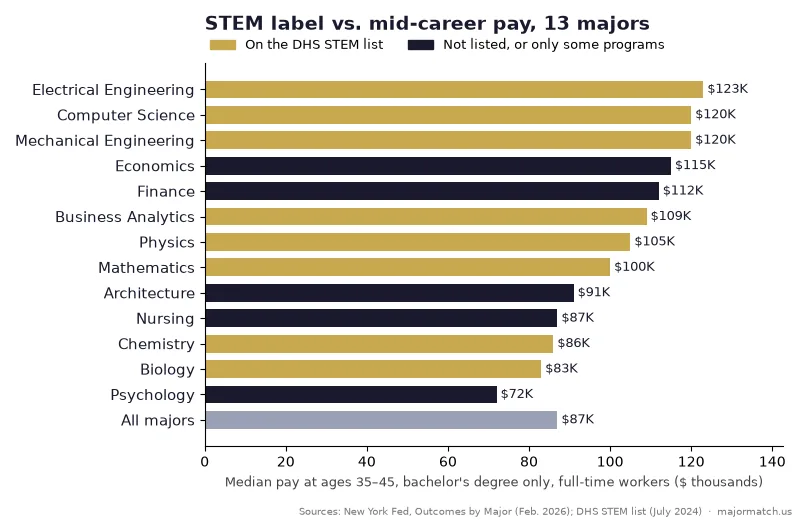
Here's the twist: economics doesn't need the label to pay well. In the New York Fed data, economics majors earn $72,000 early in their careers and $115,000 at mid-career, more than biology, chemistry or physics, which are always STEM.
Is nursing a STEM major? What about other health majors?
No. Nursing is not on the DHS STEM list, and neither is communication sciences and disorders (the speech-language pathology track), even though both are heavy on biology and anatomy. Health programs make the list only when they are lab or research focused, such as Clinical Laboratory Science/Medical Technology (51.1005), Pharmaceutical Sciences (51.2010) and Medical Informatics (51.2706).
Nursing is a good example of why the label shouldn't drive the decision. Recent nursing grads have 2.1% unemployment, about half the all-majors rate of 4.2%, per the New York Fed. Kinesiology is a split case: Exercise Physiology and Kinesiology (26.0908) sits inside the biological sciences family and counts, while kinesiology and exercise science programs coded elsewhere do not.
Are any business majors STEM?
A few, and they are all the math-heavy ones. Actuarial science (52.1304), business statistics (52.1302) and management science (52.1301) are on the list, and so are business analytics (30.7102) and financial analytics (30.7104). Finance, General (52.0801), marketing and general business administration are not.
Some business schools now offer "STEM-designated" versions of finance or management degrees by building the program around analytics and coding them under a listed code. That's the program code doing the work, not the department name, so check it.
Is architecture a STEM major?
Mostly no. A standard architecture degree is not on the DHS list. Landscape Architecture (04.0601) and Architectural and Building Sciences/Technology (04.0902) are, and architectural engineering is STEM because it sits in the engineering family. If your teen loves building design and wants the STEM label, architectural engineering or construction science programs are the routes to compare.
Do STEM majors make more money?
On average, yes. STEM jobs pay a lot more. The Bureau of Labor Statistics counts about 10.9 million STEM jobs in 2025 with a median wage of $106,360, compared with $49,050 for non-STEM jobs, and projects STEM employment to grow 7.4% from 2025 to 2035, more than double the 3.2% for everything else.
But the STEM label on a major is a weak predictor on its own. Look at the New York Fed numbers below (median pay for full-time workers with only a bachelor's degree). Biology and chemistry are always STEM, yet start out below economics and finance, and 51.1% of recent biology grads work in jobs that don't need a degree, compared with 33.1% for economics. Many biology majors go on to grad school, which this table doesn't capture.
| Major | On the DHS STEM list? | Early career (22–27) | Mid-career (35–45) | Recent-grad unemployment | Recent-grad underemployment |
|---|---|---|---|---|---|
| Electrical Engineering | Yes | $82,000 | $123,000 | 3.2% | 21.1% |
| Computer Science | Yes | $87,000 | $120,000 | 7.0% | 19.1% |
| Mechanical Engineering | Yes | $80,000 | $120,000 | 4.4% | 20.1% |
| Economics | Depends on the program | $72,000 | $115,000 | 3.5% | 33.1% |
| Finance | No (general finance) | $70,000 | $112,000 | 2.8% | 27.8% |
| Business Analytics | Yes | $72,000 | $109,000 | 5.0% | 28.7% |
| Physics | Yes | $67,000 | $105,000 | 6.6% | 29.1% |
| Mathematics | Yes | $70,000 | $100,000 | 5.8% | 26.2% |
| Architecture | Mostly no | $60,000 | $91,000 | 6.8% | 25.7% |
| Nursing | No | $70,000 | $87,000 | 2.1% | 12.8% |
| Chemistry | Yes | $50,000 | $86,000 | 4.3% | 42.8% |
| Biology | Yes | $45,000 | $83,000 | 4.3% | 51.1% |
| Psychology | Depends on the program | $45,000 | $72,000 | 5.0% | 48.3% |
| All majors | — | $58,000 | $87,000 | 4.2% | 39.4% |
"On the DHS STEM list?" reflects the usual program for that major. Pay figures are the New York Fed's medians for full-time workers with a bachelor's degree only; early career is ages 22 to 27 and mid-career is 35 to 45.
STEM or not, which major fits your teen?
Take the free adaptive assessment (about 10 to 20 minutes) to see your top 3 major matches, scored with our own proprietary scoring method. The full Pathfinder report is $29 if you want the deeper plan.
Take the assessment →Who decides what counts as STEM?
Different groups use different lists, which is why you'll see conflicting answers online:
- Department of Homeland Security: the DHS STEM Designated Degree Program List, used for the 24-month STEM extension of optional practical training for international students. It's built on the Department of Education's Classification of Instructional Programs (CIP) codes, and new fields can be nominated each year.
- Bureau of Labor Statistics: defines STEM by job, not major, covering computer and math, engineering and architecture, and life and physical science occupations, plus related managers, postsecondary teachers and technical sales roles.
- Colleges and scholarship programs: each sets its own rules. Many follow the DHS list or the CIP code families, and some include social sciences. When a scholarship or program says "STEM majors," read its eligibility list rather than assuming.
How do you check if a specific college program is STEM?
Find the program's six-digit CIP code, then look for it on the DHS list. Three ways to get the code:
- Search the college's website for the program name plus "CIP code." Many schools publish them on the program page or in the catalog.
- Ask the admissions office or the registrar. International student offices know their schools' STEM-designated programs well, because the designation matters for their students.
- Compare the code with the DHS STEM Designated Degree Program List (a PDF you can search by code or name).
Same major name, different codes is common, especially for psychology, economics, kinesiology and business programs. The code is what counts.
Should your teen pick a major because it's STEM?
Only if the work itself is a fit. The label matters most for international students (that 24-month work extension), for STEM-only scholarships and programs, and for families who want a quantitative degree as a safety net. For most U.S. students, the bigger question is whether they'll do well in, and stick with, the coursework.
A few honest signals: students who like math and lab work usually do fine in STEM (see our list of majors for students who are good at math). Students who dread calculus aren't locked out of good pay either; see high-paying majors without heavy math. And if you're weighing STEM against the humanities, our STEM vs. liberal arts salary breakdown covers the long-run pay gap.
If you're not sure which side your teen falls on, take the assessment. It looks at your teen's interests and strengths with our proprietary scoring and returns their top 3 major matches, STEM or not, so the label stops being the deciding factor.
Frequently asked questions
Is psychology considered a STEM major?
General psychology is not on the federal DHS STEM list. Research-focused psychology programs are, including experimental, cognitive, quantitative, behavioral neuroscience and industrial-organizational psychology. Check the program's CIP code to know for sure.
Is economics a STEM major?
General economics is not on the DHS STEM list. Econometrics and quantitative economics (CIP 45.0603), mathematical economics (30.4901), economics and computer science (30.3901) and environmental/natural resource economics (03.0204) are.
Is nursing a STEM major?
No. Nursing is not on the DHS STEM Designated Degree Program List, though lab-focused health programs such as clinical laboratory science and pharmaceutical sciences are.
Is actuarial science a STEM major?
Yes. Actuarial Science (CIP 52.1304) is on the DHS STEM list, along with business statistics, management science, business analytics and financial analytics.
Is computer science STEM?
Yes. Computer Science (CIP 11.0701) is on the DHS STEM list, as are information technology, cybersecurity (information assurance), artificial intelligence and data science.
How many majors are on the STEM list?
The DHS STEM Designated Degree Program List (last updated July 22, 2024) contains 540 six-digit program codes. It covers all of engineering, biological sciences, math and statistics, and physical sciences, plus selected programs from 18 related fields.
Sources
- U.S. Department of Homeland Security, DHS STEM Designated Degree Program List (last updated July 22, 2024)
- Federal Register, Update to the Department of Homeland Security STEM Designated Degree Program List (July 23, 2024)
- U.S. Bureau of Labor Statistics, Employment Projections Table 1.11: Employment in STEM occupations, 2025 and projected 2035
- Federal Reserve Bank of New York, The Labor Market for Recent College Graduates: Outcomes by Major (released Feb. 4, 2026; 2024 American Community Survey data)
- U.S. Department of Education, National Center for Education Statistics, Classification of Instructional Programs (CIP)