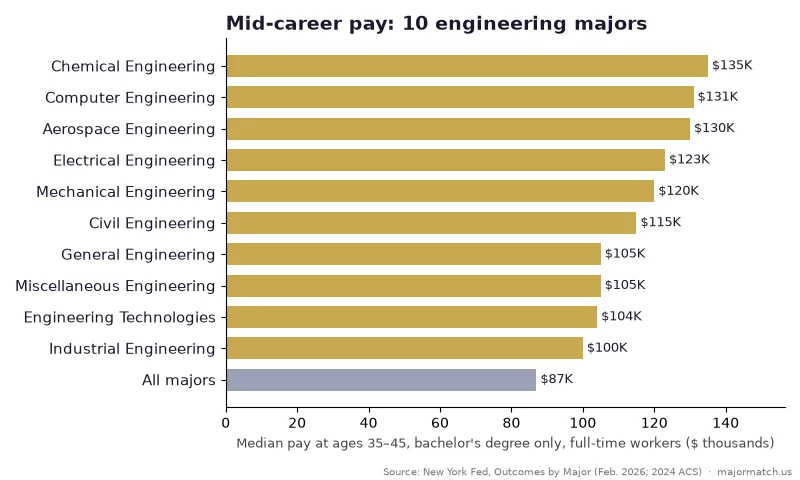
Quick answer: By mid-career pay for bachelor's-only workers, the top engineering majors are chemical engineering ($135,000), computer engineering ($131,000), aerospace engineering ($130,000) and electrical engineering ($123,000), per New York Fed data. Lowest recent-grad unemployment: engineering technologies (1.7%), aerospace (2.2%) and civil (2.3%); highest: computer engineering (7.8%). Fastest projected job growth from 2025 to 2035 (BLS): industrial engineers (12%) and mechanical engineers (11%), against 3% for all jobs.
"Engineering" isn't one major. It's a family of about a dozen, and families shopping for colleges usually find that out the first time an application asks them to pick one. Chemical or mechanical? Civil or electrical? The salary lists online mostly say "engineering pays well" and stop there.
This guide compares the engineering majors against each other. It uses the New York Fed's Outcomes by Major table (median pay for bachelor's-only workers early and mid-career, plus recent-grad unemployment and underemployment) and the Bureau of Labor Statistics' Occupational Outlook Handbook (pay, projected growth and yearly openings for each engineering career).
Every number below is linked to its source. Where the data can't separate two majors, we say so rather than guess.
Which engineering major is best?
The honest answer is that it depends on which of these three things matters most to your family, because no major wins all three:
- Highest pay: Chemical Engineering ($135,000 at mid-career), Computer Engineering ($131,000) and Aerospace Engineering ($130,000).
- Easiest first job: Engineering Technologies (1.7% recent-grad unemployment), Aerospace Engineering (2.2%) and Civil Engineering (2.3%).
- Most jobs and openings: industrial engineering (12% projected growth, about 23,100 openings a year) and mechanical engineering (11%, about 17,800 a year), per BLS. Civil engineering is right behind with about 22,700 openings a year.
If you want one all-round pick, Mechanical Engineering and Civil Engineering come closest: both pay well above the all-majors median, both have recent-grad unemployment near or below the all-majors average, and both feed large, growing job markets. Aerospace engineering also scores well on all three, but it's a smaller field, so there are far fewer openings each year.
Which engineering majors pay the most?
Here are the 10 engineering majors the New York Fed tracks, sorted by mid-career pay. Pay figures are medians for full-time workers with a bachelor's degree only, so grad degrees don't inflate them. Unemployment and underemployment are for recent grads aged 22 to 27. Underemployment means working a job that typically doesn't require a college degree.
| Engineering major | Early career (22–27) | Mid-career (35–45) | Recent-grad unemployment | Recent-grad underemployment | Share with a grad degree |
|---|---|---|---|---|---|
| Chemical Engineering | $85,000 | $135,000 | 4.7% | 17.9% | 48% |
| Computer Engineering | $90,000 | $131,000 | 7.8% | 15.8% | 39% |
| Aerospace Engineering | $85,000 | $130,000 | 2.2% | 14.7% | 46% |
| Electrical Engineering | $82,000 | $123,000 | 3.2% | 21.1% | 48% |
| Mechanical Engineering | $80,000 | $120,000 | 4.4% | 20.1% | 39% |
| Civil Engineering | $75,000 | $115,000 | 2.3% | 15.6% | 37% |
| General Engineering | $75,000 | $105,000 | 4.5% | 31.1% | 37% |
| Miscellaneous Engineering | $75,000 | $105,000 | 3.7% | 26.4% | 46% |
| Engineering Technologies | $65,000 | $104,000 | 1.7% | 44.4% | 28% |
| Industrial Engineering | $83,000 | $100,000 | 4.2% | 31.7% | 41% |
| Computer Science (for comparison) | $87,000 | $120,000 | 7.0% | 19.1% | 33% |
| All majors | $58,000 | $87,000 | 4.2% | 39.4% | 39% |
Source: Federal Reserve Bank of New York, The Labor Market for Recent College Graduates, Outcomes by Major (released Feb. 4, 2026; 2024 ACS data). "Miscellaneous engineering" groups smaller majors such as biomedical, environmental and materials engineering. Tap a major to open its free loan-vs-upside calculator.
Every engineering major clears the all-majors mid-career median of $87,000, and the lowest early-career figure on the list ($65,000 for engineering technologies) is still $7,000 above the all-majors starting median. The real spread is between the top and bottom of the family: $35,000 a year at mid-career separates chemical engineering from industrial engineering.
Notice that industrial engineering starts high ($83,000) but grows the least by mid-career ($100,000). The data can't say exactly why, but BLS notes that some industrial engineers advance to management positions, and that demand is driven by companies trying to cut costs through better production processes, supply chains and automation.
If cost is part of the decision, run your own numbers in the degree loan vs. lifetime upside calculator.
Which engineering careers have the most job growth through 2035?
Majors are the path; careers are where the paychecks come from. These are the main engineering careers in the BLS Occupational Outlook Handbook, with May 2025 median pay, projected growth from 2025 to 2035 and average openings per year. Openings include jobs that open up when engineers retire or change fields, so they matter more than the growth rate for a student looking for a first job.
| Engineering career | Median pay (May 2025) | Projected growth, 2025–35 | Openings per year | Jobs in 2025 | Usual major |
|---|---|---|---|---|---|
| Industrial engineers | $102,440 | 12% | 23,100 | 365,100 | Industrial engineering |
| Mechanical engineers | $104,110 | 11% | 17,800 | 298,500 | Mechanical engineering |
| Computer hardware engineers | $161,740 | 9% | 4,100 | 76,100 | Computer or electrical engineering |
| Aerospace engineers | $134,960 | 8% | 3,800 | 68,700 | Aerospace (or mechanical) engineering |
| Electrical and electronics engineers | $125,040 | 8% | 16,300 | 297,900 | Electrical engineering |
| Bioengineers and biomedical engineers | $109,370 | 8% | 1,200 | 23,800 | Biomedical engineering |
| Materials engineers | $112,860 | 8% | 1,300 | 23,800 | Materials science and engineering |
| Civil engineers | $100,840 | 6% | 22,700 | 380,600 | Civil engineering |
| Environmental engineers | $107,110 | 6% | 2,300 | 39,100 | Environmental or civil engineering |
| Chemical engineers | $125,040 | 5% | 1,100 | 21,900 | Chemical engineering |
| Petroleum engineers | $144,910 | 2% | 1,000 | 18,500 | Petroleum (or chemical, mechanical) engineering |
| Nuclear engineers | $133,970 | Little or no change (0%) | 800 | 16,600 | Nuclear engineering |
| All occupations | $50,980 | 3% | — | — | — |
Source: U.S. Bureau of Labor Statistics, Occupational Outlook Handbook (pages last modified Aug. 27, 2026). Each career name links to its BLS profile.
Two patterns stand out. The biggest engineering careers by far are civil, industrial, mechanical and electrical engineering, each with about 300,000 to 380,000 jobs and 16,000 or more openings a year. The highest-paid careers, like petroleum, nuclear and computer hardware engineering, are much smaller. Petroleum and nuclear engineering are also barely growing, so a student betting on them is betting on a narrow market.
Which of these majors fits your teen?
Take the free adaptive assessment (about 10–20 minutes) to see your top 3 major matches, scored with our own proprietary scoring method. The full Pathfinder report is $29 if you want the deeper plan.
Take the assessment →Which engineering majors have the highest and lowest unemployment?
For recent grads (ages 22 to 27), the New York Fed data shows:
- Lowest: engineering technologies 1.7%, aerospace engineering 2.2%, civil engineering 2.3% and electrical engineering 3.2%.
- Highest: computer engineering 7.8%, chemical engineering 4.7% and general engineering 4.5%.
The all-majors rate for recent grads is 4.2%, so most engineering majors sit near or below average. Computer engineering is the outlier, and it lines up with computer science at 7.0%. Entry-level tech hiring has been tough for both, even though BLS still projects growth for computer hardware engineers (9%) and software developers (10%).
Underemployment tells a different story from unemployment. Engineering technologies has the lowest unemployment on the list but the highest underemployment (44.4%), and general and industrial engineering are above 30%. Aerospace (14.7%), civil (15.6%) and computer engineering (15.8%) grads are the least likely to land in jobs that don't need their degree. For the same comparison across every major, see our ranking of college majors with the highest and lowest unemployment.
Which engineering major is the worst for the job market right now?
No engineering major is a bad bet on this data, but the weakest spot right now is computer engineering's entry-level market. At 7.8%, its recent-grad unemployment is the highest of the 10 engineering majors and above the 4.2% all-majors rate. It also has the highest early-career pay ($90,000), so grads who land a job do very well. That combination usually means fewer entry-level openings and more competition for them.
On the career side, petroleum (2%) and nuclear engineering (little or no change) have the slowest projected growth in the BLS data. They pay very well, but there are only about 1,000 and 800 openings a year nationwide. A student who loves energy can keep options open with a chemical or mechanical engineering degree, which feeds into both fields.
If you want to compare computer engineering with its closest cousins, our computer science vs. software engineering vs. IT breakdown and computer engineering career guide cover the details.
Engineering or computer science: which has better job prospects?
On pay, they're close. Computer science grads earn a median $87,000 early and $120,000 mid-career, the same mid-career figure as mechanical engineering and below chemical, computer, aerospace and electrical engineering. On entry-level unemployment, most engineering majors currently do better: computer science sits at 7.0%, while civil, aerospace and electrical engineering are all under 3.5%.
The size of the market is where computer science wins. BLS counts about 1.7 million software developer jobs and about 106,100 openings a year for software developers, QA analysts and testers combined. That's more openings than all 12 engineering careers in the table above put together. So the trade-off is roughly this: computer science has the bigger market and more competition at the entry level, while engineering has smaller, steadier markets tied to physical industries like construction, manufacturing and energy.
Are engineering degrees safe from AI?
Nobody can promise how AI will change any job, so be wary of confident lists. What the BLS projections show is that the large, hands-on engineering fields are still growing faster than average: mechanical engineering 11%, industrial 12%, civil 6%. BLS ties mechanical engineering demand partly to automation, since factories adding complex machinery need engineers to integrate it.
Engineering work also comes with things software can't easily take over: licensing, physical sites and legal sign-off. BLS notes that civil engineers usually must be licensed if they provide services directly to the public, and that a licensed professional engineer (PE) may oversee other engineers, approve design plans and sign off on projects. Industrial engineering demand, BLS adds, comes partly from companies that want expertise on automation. For the wider picture across all majors, see our list of college majors that hold up under automation.
What are all the engineering majors?
Most universities offer some version of these. The first group covers the large majors the New York Fed tracks separately; the second covers smaller, specialized majors:
- Large majors: mechanical, civil, electrical, computer, chemical, aerospace and industrial engineering, plus general engineering and engineering technology.
- Specialized majors: biomedical engineering, environmental engineering, materials science and engineering, nuclear, petroleum, agricultural, mining and architectural engineering.
Specialized majors can be great, but they lock in a field early. If your teen is interested in, say, biomedical engineering but isn't sure, a mechanical, electrical or chemical engineering degree with a biomedical minor or electives keeps more doors open, since those majors feed the specialized careers too.
Is engineering technology a good alternative to an engineering degree?
It can be. BLS describes engineering technology programs (in its mechanical engineering profile) as focusing less on theory and more on practical application, often with internships and co-ops. In the New York Fed data, engineering technology grads have the lowest unemployment of any engineering major (1.7%) and still earn $104,000 at mid-career.
The trade-off is underemployment: 44.4% of recent engineering technology grads work in jobs that don't typically require a degree, the highest share on the list. And licensing can be harder, because a PE license usually requires a degree from an accredited engineering program. If your teen likes hands-on work more than calculus, engineering technology is worth a look, and so is our guide to two-year degrees that pay well, since many engineering technicians start with an associate's degree.
How should a teen choose an engineering major?
Start with the problems, not the paycheck. Every engineering major pays well, so the bigger risk is a student who is bored by the work. A quick way to sort the main majors:
- Machines, engines, robots: mechanical or aerospace engineering.
- Bridges, roads, water systems: civil engineering or environmental engineering.
- Circuits, power, chips: electrical engineering or computer engineering.
- Chemistry, energy, materials: chemical engineering or materials engineering.
- Making systems run better (factories, hospitals, supply chains): industrial engineering.
Then check the trade-offs in the two tables above. Many universities start engineering students in a shared first year of math, physics and intro design, so check whether the colleges on your list let students pick a specific engineering major after year one. Our free assessment helps with the first step: it scores your teen's strengths and interests with our proprietary scoring and returns their top 3 major matches, so you can see whether engineering is a real fit before the applications go out. For careers across the whole engineering family, see what you can do with an engineering degree.
Frequently asked questions
What is the highest-paying engineering major?
Chemical engineering, with a median of $135,000 at mid-career for bachelor's-only workers, per the New York Fed. Computer engineering ($131,000) and aerospace engineering ($130,000) are close behind. Computer engineering has the highest early-career pay at $90,000.
Which engineering major has the lowest unemployment?
Among recent grads aged 22 to 27, engineering technologies has the lowest rate (1.7%), followed by aerospace (2.2%) and civil engineering (2.3%), per the New York Fed. The all-majors rate is 4.2%.
Which engineering field has the most job openings?
Industrial engineering, with about 23,100 openings a year projected from 2025 to 2035, followed by civil engineering (about 22,700), mechanical engineering (about 17,800) and electrical and electronics engineering (about 16,300), according to the Bureau of Labor Statistics.
Is computer engineering a good major right now?
It pays very well ($90,000 early career, $131,000 mid-career), but recent computer engineering grads have 7.8% unemployment, the highest of the 10 engineering majors in the New York Fed data. Strong long-run pay and a competitive entry-level market are both true right now, so internships matter a lot.
Do you need a master's degree to be an engineer?
No. BLS lists a bachelor's degree as the typical entry-level education for every engineering career in this guide. A master's can help with research roles or management, and a Ph.D. is usually needed for engineering faculty and some research jobs.
Which engineering degree is the most versatile?
Mechanical engineering is often called the broadest, and BLS describes it as one of the broadest engineering fields. Mechanical, electrical and chemical engineering also feed into many specialized careers, such as aerospace, biomedical, materials and energy work.
Sources
- Federal Reserve Bank of New York, The Labor Market for Recent College Graduates: Outcomes by Major (released Feb. 4, 2026; 2024 American Community Survey data)
- U.S. Bureau of Labor Statistics, Occupational Outlook Handbook: Industrial engineers
- U.S. Bureau of Labor Statistics, Occupational Outlook Handbook: Mechanical engineers
- U.S. Bureau of Labor Statistics, Occupational Outlook Handbook: Computer hardware engineers
- U.S. Bureau of Labor Statistics, Occupational Outlook Handbook: Aerospace engineers
- U.S. Bureau of Labor Statistics, Occupational Outlook Handbook: Electrical and electronics engineers
- U.S. Bureau of Labor Statistics, Occupational Outlook Handbook: Bioengineers and Biomedical Engineers
- U.S. Bureau of Labor Statistics, Occupational Outlook Handbook: Materials engineers
- U.S. Bureau of Labor Statistics, Occupational Outlook Handbook: Civil engineers
- U.S. Bureau of Labor Statistics, Occupational Outlook Handbook: Environmental engineers
- U.S. Bureau of Labor Statistics, Occupational Outlook Handbook: Chemical engineers
- U.S. Bureau of Labor Statistics, Occupational Outlook Handbook: Petroleum engineers
- U.S. Bureau of Labor Statistics, Occupational Outlook Handbook: Nuclear engineers
- U.S. Bureau of Labor Statistics, Occupational Outlook Handbook: Software Developers, Quality Assurance Analysts, and Testers
- U.S. Census Bureau, American Community Survey (source data behind the New York Fed's by-major table)