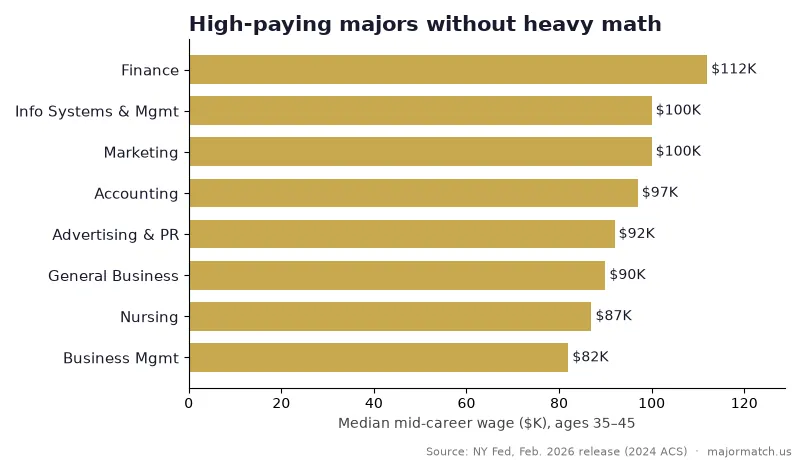
Quick answer: The highest-paying majors without heavy math are finance ($112,000 median mid-career pay), information systems and management ($100,000), marketing ($100,000), accounting ($97,000) and advertising and public relations ($92,000), per the New York Fed's 2026 outcomes-by-major data. Most ask for one applied or business calculus class and a statistics course, not the three-semester calculus sequence engineering requires. Nursing is the standout for job security: 2.1% unemployment and the lowest underemployment in the dataset.
There's a particular look a kid gets when a guidance counselor says "engineering pays the most." It's the look of someone remembering precalculus. If that's your house, this list is for you.
"Without heavy math" doesn't mean no math. It means no calculus sequence, no differential equations, no proofs. Most of these majors ask for one practical math course and a statistics class, the kind of math you use on a spreadsheet rather than a chalkboard. We ranked them by what graduates actually earn in their late 30s and early 40s, using the New York Fed's newest data. For a broader, all-around "I hate math" list, see our best majors if you hate math guide; this one is strictly about the top of the pay scale.
How did we rank majors by pay and math load?
Two steps. First, a math screen: a major qualified if it typically requires no more than one applied or business calculus course, plus statistics or college algebra. That rules out engineering, physics, math, economics (which usually needs calculus and econometrics) and computer science. This screen is our editorial judgment about how these degrees are usually built. Requirements vary by school, so read the catalog before you commit.
Second, we ranked qualifying majors by median mid-career wage (ages 35 to 45, full-time, bachelor's degree only) from the New York Fed's February 4, 2026 release, which uses 2024 American Community Survey data. Ties go to the higher early-career wage. The "Math you'll usually face" column describes typical requirements, not a guarantee.
What are the highest-paying majors without heavy math?
| Rank | Major | Mid-Career Median | Early-Career Median | Underemployment | Math you'll usually face |
|---|---|---|---|---|---|
| 1 | Finance | $112,000 | $70,000 | 27.8% | Business calculus (1), statistics |
| 2 | Information Systems & Management | $100,000 | $67,000 | 25.6% | Statistics, business math |
| 3 | Marketing | $100,000 | $60,000 | 49.3% | Business calculus or finite math, statistics |
| 4 | Accounting | $97,000 | $68,000 | 21.2% | Business calculus at many schools, statistics |
| 5 | Advertising & PR | $92,000 | $60,000 | 38.1% | One college math or statistics course |
| 6 | General Business | $90,000 | $60,000 | 50.4% | Business calculus or finite math, statistics |
| 7 | Nursing | $87,000 | $70,000 | 12.8% | Statistics, dosage calculations |
| 8 | Business Management | $82,000 | $56,000 | 52.6% | Business math, statistics |
| 9 | Medical Technicians | $80,000 | $62,000 | 47.0% | College algebra, statistics, intro chemistry |
| 10 | Commercial Art & Graphic Design | $80,000 | $50,000 | 37.1% | General-education math only |
Source: Federal Reserve Bank of New York, The Labor Market for Recent College Graduates, Outcomes by Major, released Feb. 4, 2026 (2024 ACS). Wages: full-time workers with a bachelor's degree only; early career = ages 22–27, mid-career = 35–45. Underemployment: recent grads 22–27. "Math you'll usually face" is MajorMatch's summary of typical U.S. requirements and varies by school.
Click any major in the table to open its free loan-vs-upside calculator, or compare debt and lifetime earnings with your own numbers in the degree loan vs. upside calculator. Then take the assessment to see which of these majors actually fit your teen.
What do these majors actually pay off in?
Short takes on each, with the detail that matters most for a family deciding.
1. Finance: $112,000 by mid-career
The highest-paying major on this list and one of the most reliable: 2.8% unemployment and only 27.8% underemployment. The math is real but practical: time value of money, spreadsheets, statistics. If your teen can balance a budget in Excel and likes the stakes, finance is the strongest pick here.
2. Information Systems & Management: $100,000
The "tech job without the computer science math" major. Graduates work as systems analysts, IT project managers and business analysts. It starts at $67,000, and its 25.6% underemployment rate is one of the best on the list.
3. Marketing: $100,000
Same mid-career pay as information systems, but a wider spread of outcomes. Nearly half of recent grads (49.3%) are underemployed. Analytics skills (Google Analytics, SQL basics, A/B testing) are what push marketing grads toward the top of that range.
4. Accounting: $97,000
The lowest underemployment of the business majors at 21.2%, and a clear license path (the CPA) that raises pay further. The math is mostly arithmetic and logic, done carefully and often. Detail-oriented kids who hate calculus tend to like it more than they expect.
5. Advertising & Public Relations: $92,000
The most creative major on this list, and one that only asks for one math or stats class. Starting pay of $60,000 matches marketing.
6. General Business: $90,000
Flexible and popular. Half of recent grads (50.4%) are underemployed, which is why we'd steer students toward a concentration (finance, accounting, supply chain) rather than a general degree.
7. Nursing: $87,000
The safest bet on the page. The 12.8% underemployment rate is the lowest of all 73 majors the New York Fed tracks, and 2.1% unemployment is near the bottom too. The math is statistics and dosage calculations, which matter enormously but aren't calculus. The hard part of nursing is the science courses and clinicals, not the math. See our nursing career paths guide.
8. Business Management: $82,000
A solid number with the highest underemployment on this list (52.6%). Management majors who intern in operations or sales do better than those who don't.
9. Medical Technicians: $80,000
This New York Fed category covers degrees like clinical lab science and radiologic technology. A $62,000 start is strong for a no-calculus major. Expect chemistry and anatomy, which are a different kind of hard.
10. Commercial Art & Graphic Design: $80,000
Almost no college math. Pay climbs with a portfolio and a move into art direction or UX design.
Which high-paying majors just missed the cut?
Two majors earn more than anything above but usually need more math than our screen allows. Construction services (which includes construction management) shows $120,000 at mid-career and only 17.9% underemployment, but many programs require an applied calculus course plus physics. Economics reaches $115,000, but most economics degrees require calculus and econometrics. If your teen can handle one tough math semester, both are worth a look, and construction management is one of the clearest paths on our return on investment ranking.
Which of these majors fits your teen?
Take the free adaptive assessment (about 15–25 minutes) to see your top 3 major matches, scored with our own proprietary scoring method. The full Pathfinder report is $29 if you want the deeper plan.
Take the Free Assessment →How much more do math-heavy majors pay?
A lot at the start, less later. In the same New York Fed dataset, computer engineering starts at $90,000 and mechanical engineering at $80,000, while the top of this list starts at $70,000. By mid-career, finance ($112,000) catches up with mechanical engineering ($120,000) more than most people expect. Our hardest majors ranking shows what that extra pay costs in study hours and dropout risk.
The honest summary: heavy math buys you a higher floor. Light-math majors can reach the same ceiling, but you have to build the ladder yourself with internships, certifications and, sometimes, a license like the CPA.
How do you pick between these majors?
Start with what your teen is willing to do on a random Tuesday afternoon. A future accountant enjoys getting a reconciliation exactly right. A future marketer enjoys watching a campaign work. A future nurse wants to be in the room when it matters. Those are different people.
Our free assessment measures those differences and matches your teen to 100 majors with our own proprietary scoring method. It takes about 15 to 25 minutes and shows the top 3 free. Then plug the leading major into the degree loan vs. upside calculator to see the debt side of the math.
Frequently asked questions
What's a good tech and business major if I hate math?
Information systems and management. It starts at a $67,000 median and reaches $100,000 by mid-career, with 25.6% underemployment, and usually requires statistics rather than calculus.
What high-paying majors need almost no college math?
Advertising and public relations ($92,000 median mid-career) and commercial art and graphic design ($80,000) typically require only one general-education math or statistics course.
What are the highest-paying university careers with little math?
Among no-calculus majors, finance ($112,000), information systems ($100,000), marketing ($100,000) and accounting ($97,000) lead in New York Fed mid-career pay. Nursing ($87,000) offers the most job security.
Which business major has the least math?
Marketing and management usually require one business math or finite math course plus statistics. Finance and accounting add more number work, but rarely more than one calculus course.
What is the highest-paying major that doesn't require calculus?
Among majors that typically need at most one business calculus course, finance pays the most: a $112,000 median at mid-career and $70,000 early-career, per the New York Fed's Feb. 2026 release.
Does nursing require a lot of math?
Nursing requires statistics and dosage calculations, not calculus. The challenge is anatomy, chemistry and clinical hours. It has the lowest underemployment rate (12.8%) of all 73 majors the New York Fed tracks.
Is accounting heavy on math?
Accounting uses a lot of arithmetic and logic but little advanced math. Many business schools require one business calculus course. Accounting grads have 21.2% underemployment and a $97,000 mid-career median.
What's the difference between this list and the 'hate math' list?
This list is strictly about pay: the top 10 majors by mid-career earnings that skip the calculus sequence. Our hate-math guide is a broader look at math-light majors and careers, including ones that pay less but fit well.
Can you get a tech job without heavy math?
Yes. Information systems and management grads start at a $67,000 median and reach $100,000 by mid-career, mostly in analyst and IT management roles, without the math load of computer science.