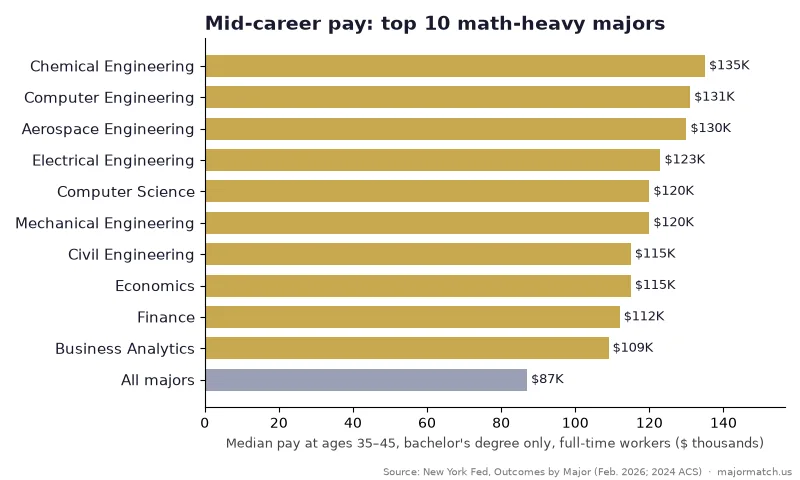
Quick answer: The best-paying majors for strong math students are chemical engineering ($85,000 early career, $135,000 mid-career), computer engineering ($90,000 to $131,000), aerospace engineering ($85,000 to $130,000), electrical engineering and computer science, per New York Fed data for bachelor's-only workers. Economics ($115,000 mid-career) and finance ($112,000) are the top picks for math students who like business. The fastest-growing math career is data scientist, projected to grow 35% from 2025 to 2035 (BLS). For comparison, the all-majors median is $58,000 early and $87,000 mid-career.
Every parent of a kid who breezes through algebra hears the same advice: "Just do engineering." Sometimes that's right. But being good at math is a starting point, not a major. A teen who loves proofs, a teen who loves taking engines apart and a teen who loves the stock market can all ace precalculus, and they'd be miserable in each other's majors.
So this guide does two things. First, it shows how the math-heavy majors actually pay, using the New York Fed's Outcomes by Major table (median pay for bachelor's-only workers, early career and mid-career, plus unemployment and underemployment for recent grads). Second, it sorts those majors by the kind of math work they lead to, so you can match the major to the kid, not just to the salary.
Everything below is real published data, linked at the source. Where the data can't answer a question, we say so.
What are the best majors if you're good at math?
Here's the short list, grouped by the kind of thinking each one rewards:
- Build physical things: Chemical Engineering, Aerospace Engineering, Electrical Engineering, Mechanical Engineering, Civil Engineering. Calculus and physics every semester, applied to real objects.
- Logic, code and data: Computer Science, Computer Engineering, Mathematics, Data Science, statistics. More abstract, more programming.
- Money, markets and risk: Economics, Finance, Actuarial Science, Business Analytics, Accounting. Math in service of business decisions.
- How the universe works: Physics. The most math-dense science, and one of the most grad-school-dependent.
Every one of these beats the all-majors median at mid-career. The gap between them is real, though, and so are the differences in how often graduates end up needing a graduate degree.
Which math-heavy majors pay the most?
The table below lists 15 math-heavy majors from the New York Fed's February 2026 release (2024 American Community Survey data). Pay figures are medians for full-time workers with a bachelor's degree only, so they aren't inflated by grad degrees. Unemployment and underemployment are for recent grads aged 22 to 27. Underemployment means working a job that typically doesn't require a degree.
| Major | Early career (22–27) | Mid-career (35–45) | Recent-grad unemployment | Recent-grad underemployment | Share with a grad degree |
|---|---|---|---|---|---|
| Chemical Engineering | $85,000 | $135,000 | 4.7% | 17.9% | 48% |
| Computer Engineering | $90,000 | $131,000 | 7.8% | 15.8% | 39% |
| Aerospace Engineering | $85,000 | $130,000 | 2.2% | 14.7% | 46% |
| Electrical Engineering | $82,000 | $123,000 | 3.2% | 21.1% | 48% |
| Computer Science | $87,000 | $120,000 | 7.0% | 19.1% | 33% |
| Mechanical Engineering | $80,000 | $120,000 | 4.4% | 20.1% | 39% |
| Civil Engineering | $75,000 | $115,000 | 2.3% | 15.6% | 37% |
| Economics | $72,000 | $115,000 | 3.5% | 33.1% | 42% |
| Finance | $70,000 | $112,000 | 2.8% | 27.8% | 31% |
| Business Analytics | $72,000 | $109,000 | 5.0% | 28.7% | 27% |
| Physics | $67,000 | $105,000 | 6.6% | 29.1% | 67% |
| Industrial Engineering | $83,000 | $100,000 | 4.2% | 31.7% | 41% |
| Mathematics | $70,000 | $100,000 | 5.8% | 26.2% | 51% |
| Information Systems & Management | $67,000 | $100,000 | 6.0% | 25.6% | 28% |
| Accounting | $68,000 | $97,000 | 2.6% | 21.2% | 34% |
| All majors | $58,000 | $87,000 | 4.2% | 39.4% | 39% |
Source: Federal Reserve Bank of New York, The Labor Market for Recent College Graduates, Outcomes by Major (released Feb. 4, 2026; 2024 ACS data). Sorted by mid-career median pay. Tap a major to open its free loan-vs-upside calculator.
Three things jump out. Engineering and computer science take the top seven mid-career spots. Economics and finance, the business-side math majors, land right behind engineering at $115,000 and $112,000. And pure mathematics, the major you'd guess would win for math kids, sits at $100,000 mid-career, tied with industrial engineering and information systems. Math majors do fine. They just don't top the chart on a bachelor's alone.
If cost is part of the decision, run your own numbers in the degree loan vs. upside calculator, then take the assessment to see which of these majors fit your teen.
Which math careers are growing fastest through 2035?
Majors are the path; careers are where the paychecks come from. These are the main math-heavy careers in the Bureau of Labor Statistics' Occupational Outlook Handbook, with May 2025 median pay and projected job growth from 2025 to 2035. The average for all occupations is 3% growth.
| Career | Median pay (May 2025) | Projected growth, 2025–35 | Typical entry education | Majors that feed it |
|---|---|---|---|---|
| Data scientists | $120,230 | 35% | Bachelor's | Data science, statistics, math, CS |
| Operations research analysts | $88,940 | 12% | Bachelor's | Math, industrial engineering, business analytics |
| Statisticians | $105,650 | 11% | Master's (some bachelor's roles) | Statistics, math |
| Software developers | $135,980 | 10% | Bachelor's | CS, computer engineering, math |
| Electrical engineers | $120,630 | 10% | Bachelor's | Electrical engineering |
| Actuaries | $130,000 | 9% | Bachelor's + certification exams | Actuarial science, math, statistics |
| Financial analysts | $103,570 | 7% | Bachelor's | Finance, economics, math |
| Mathematicians | $126,710 | 1% | Master's | Math (usually a PhD path) |
| High school teachers | $72,040 | 0% (about 63,500 openings a year) | Bachelor's + state license | Math or math education |
| All occupations | $50,980 | 3% | — | — |
Source: U.S. Bureau of Labor Statistics, Occupational Outlook Handbook (pages last modified Aug. 27, 2026). Each career name links to its BLS profile.
Data science is the standout: 35% projected growth and about 24,800 openings a year, according to BLS. Operations research and statistics are smaller fields but still growing about four times faster than the average job. Pure mathematician jobs are the opposite story: only about 2,200 of them in the whole country, with 1% projected growth, and most require a graduate degree. That's why most math majors end up working as analysts, actuaries, developers or teachers rather than under the title "mathematician."
Which of these majors fits your teen?
Take the free adaptive assessment (about 10–20 minutes) to see your top 3 major matches, scored with our own proprietary scoring method. The full Pathfinder report is $29 if you want the deeper plan.
Take the assessment →What is a good major for a student who is strong in math and science?
If your teen is strong in both math and science, engineering is usually the best-paying fit on a bachelor's degree alone. Chemical, computer, aerospace and electrical engineering all reach at least $123,000 at mid-career in the New York Fed data, and civil engineering has one of the lowest recent-grad unemployment rates on the list (2.3%).
The pure sciences pay off more slowly. Physics grads reach $105,000 at mid-career, but 67% of physics majors end up with a graduate degree, so plan on more school for many physics careers. BLS lists a doctoral degree as the typical entry point for physicists and astronomers. If your teen loves physics but wants a strong job at 22, engineering is the closest neighbor. Our guides to physics degree careers and chemical engineering careers go deeper.
Should you major in math itself if you're good at it?
It can be a great choice, with one honest caveat. Math majors start at $70,000 and reach $100,000 at mid-career, both well above the all-majors median. But 26% of recent math grads are underemployed, and 51% of math majors eventually earn a graduate degree, one of the highest shares in the table.
The math majors who do best tend to pair the degree with a direction early: actuarial exams, a statistics or computer science minor, or a teaching license. BLS notes that many employers expect actuarial candidates to have passed one or two certification exams before graduation, and that actuaries need programming skills too. If that sounds like your teen, read is actuarial science a good major and what you can do with a math degree.
Engineering, computer science or economics: which fits a math kid?
Here's a simple way to tell them apart. Ask your teen which of these problems sounds most fun:
- "How do we make this bridge, battery or rocket work?" That's engineering. The math is a tool for physical design, with lots of labs and team projects.
- "Why does this program break, and how do I make it faster?" That's computer science or computer engineering. Logic, structure and a lot of time writing code.
- "What's the risk here, and what's it worth?" That's economics, finance or actuarial science. Statistics and models applied to people and money.
- "Why is this true?" That's mathematics or physics. Proofs and theory, with the longest runway to a specialized career.
Pay differences between these groups matter less than fit. Economics reaches $115,000 at mid-career, the same as civil engineering's $115,000, with a very different day-to-day job. If you're comparing the two computing majors specifically, our computer science vs. software engineering guide breaks that down.
Which math-heavy majors hold up best with AI?
Nobody can promise which jobs AI will reshape, so treat any confident list with caution. What the official data does show: BLS expects data scientist jobs to grow 35% partly because companies are building AI into their work and will need data scientists to help put it to use. BLS also projects 10% growth for software developers, with AI listed among the reasons for demand.
There's a catch for families reading only the growth numbers. Right now, recent computer science grads have 7.0% unemployment and recent computer engineering grads 7.8%, compared with 4.2% for all recent grads (New York Fed). Strong long-term demand and a tough entry-level market can both be true. Majors that combine math with physical systems or regulated work, like civil engineering (2.3%) and accounting (2.6%), currently show much lower recent-grad unemployment. For the bigger picture, see our list of AI-proof college majors.
Is being good at high school math enough for a math-heavy major?
It's the right foundation, but college math feels different. High school math rewards speed and accuracy on familiar problem types. College math-heavy majors move on to courses like calculus, differential equations, and linear and abstract algebra (the typical math-major sequence, per BLS), and they ask students to work through unfamiliar problems for hours.
Good signs that a teen will thrive: they enjoy hard problems even when they get stuck, they take AP Calculus or AP Statistics and like it, and they're curious about why a method works. A teen who is good at math but dreads it may be happier in a major that uses some math without living in it, like accounting, business analytics or information systems. And if your teen is looking at the toughest options, our guide to hard majors that pay off shows which ones are worth the workload.
How should a math-strong teen choose a major?
Start with fit, then check the money. A practical order:
- Name the kind of math they enjoy using the four problem types above.
- Check the pay and the grad-school odds in the New York Fed table. A major where most people need a master's changes the cost math.
- Look at the careers, not just the major, using the BLS table and each major's guide.
- Test the fit with real coursework: a summer program, a community college class, or an online intro course in programming or statistics.
Our free assessment helps with step one. It scores your teen's strengths and interests with our proprietary scoring and returns their top 3 major matches, so you're not guessing between engineering and economics. Once you have a shortlist, run each major through the calculators to compare cost against long-run upside.
Frequently asked questions
What is the best major for someone who is good at math?
On pay alone, engineering leads: chemical engineering grads earn a median of $135,000 at mid-career, computer engineering $131,000 and aerospace engineering $130,000, per the New York Fed. The best major for a specific student depends on what kind of math they enjoy: physical design (engineering), logic and code (computer science, math), or money and risk (economics, finance, actuarial science).
Which math-heavy major has the lowest unemployment?
Among the 15 math-heavy majors in the New York Fed table, aerospace engineering (2.2%), civil engineering (2.3%), accounting (2.6%) and finance (2.8%) have the lowest unemployment for recent grads. The all-majors rate is 4.2%.
Do you need a master's degree for a math career?
Not for most of them. BLS lists a bachelor's degree as the typical entry level for data scientists, actuaries, operations research analysts, software developers, financial analysts and engineers. Mathematicians and most statisticians typically need a master's degree.
Is a math degree worth it?
Usually, yes. Math majors earn a median of $70,000 early in their careers and $100,000 at mid-career, above the all-majors medians of $58,000 and $87,000. The risk is drifting: 26% of recent math grads are underemployed, so pairing math with statistics, programming, actuarial exams or a teaching license helps.
What should I major in if I'm good at math but don't love coding?
Look at civil engineering, accounting, finance, economics or math education. All use real math, and in their day-to-day work programming is a supporting skill rather than the main job. Most analytical careers now involve some software, though; BLS notes that even actuaries need programming skills.
Sources
- Federal Reserve Bank of New York, The Labor Market for Recent College Graduates: Outcomes by Major (released Feb. 4, 2026; 2024 American Community Survey data)
- U.S. Bureau of Labor Statistics, Occupational Outlook Handbook: Data Scientists
- U.S. Bureau of Labor Statistics, Occupational Outlook Handbook: Actuaries
- U.S. Bureau of Labor Statistics, Occupational Outlook Handbook: Mathematicians and Statisticians
- U.S. Bureau of Labor Statistics, Occupational Outlook Handbook: Operations Research Analysts
- U.S. Bureau of Labor Statistics, Occupational Outlook Handbook: Software Developers, Quality Assurance Analysts, and Testers
- U.S. Bureau of Labor Statistics, Occupational Outlook Handbook: Electrical and Electronics Engineers
- U.S. Bureau of Labor Statistics, Occupational Outlook Handbook: Financial Analysts
- U.S. Bureau of Labor Statistics, Occupational Outlook Handbook: High School Teachers
- U.S. Bureau of Labor Statistics, Occupational Outlook Handbook: Physicists and Astronomers
- U.S. Census Bureau, American Community Survey (source data behind the New York Fed's by-major table)