Quick answer
Yes, for a student who loves math and can keep studying after college. Actuaries earned a median $130,000 in May 2025 (BLS), and 78% work in finance and insurance. The catch is the exams: BLS says reaching the first professional level can take up to 7 years. The good news is that the same skills lead straight into data science, statistics and finance if a student changes course.
Key takeaway: actuaries earned a $130,000 median in May 2025, but reaching the first professional level through exams can take up to 7 years.
Most teenagers have never met an actuary, which is part of why the career stays so well paid. Actuaries answer questions like how likely a 40-year-old driver is to crash this year, and what a company should charge so it can still pay every claim. It's math with real money and real people on the other end.
For parents, actuarial science has an unusual feature. Hiring depends less on which college a student attends and more on passing professional exams, and many students pass the first one or two before graduation. That makes the path clear, and demanding.
What Jobs Can You Get With an Actuarial Science Degree?
Pay is the national median from the Bureau of Labor Statistics (BLS), May 2025, unless we say otherwise.
1. Actuarial analyst (entry level)
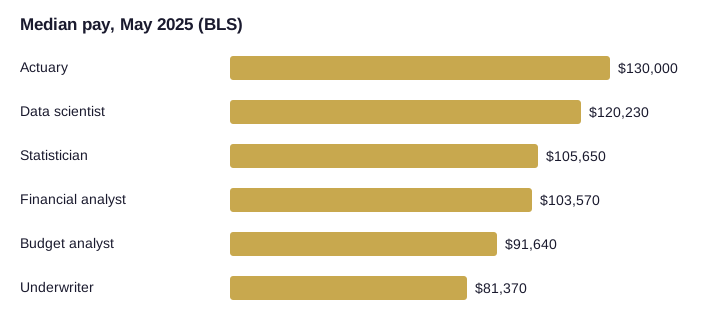
This is the starting job: pricing policies, building models and studying for exams on company time. BLS lists actuaries at a median of $130,000, with the top 10% above $215,100 and the bottom 10% below $78,570. Many employers raise pay as each exam is passed.
2. Health, life, or property and casualty actuary
Actuaries specialize. Health actuaries price insurance plans, life and pension actuaries work on long-term promises, and property and casualty actuaries cover cars, homes and businesses. The two exam bodies are the Society of Actuaries (life, health, retirement) and the Casualty Actuarial Society (property and casualty).
3. Consulting actuary
Consulting firms help employers run pension and benefit plans. More travel, more client work, often higher pay at senior levels.
4. Data scientist
The math overlaps heavily. BLS lists data scientists at a median of $120,230 with 35% projected growth, one of the fastest of any occupation.
5. Statistician
Statisticians earn a median $105,650, and BLS projects 11% growth. Some roles want a master's.
6. Underwriter
Underwriters decide whether to insure a person or business and on what terms. BLS lists insurance underwriters at a median of $81,370. Many actuarial students land here if exams stall.
7. Financial or budget analyst
Financial analysts (median $103,570) and budget analysts (median $91,640) use the same spreadsheets, models and judgment.
What Does an Actuarial Career Actually Look Like?
Trevor Stevens graduated from Drake University in Des Moines in May 2025 with a degree in actuarial science and moved to Denver for a full-time job as an actuarial senior analyst at The Cigna Group, where he had interned the summer before.
His story shows two things parents should know about this major. First, the job was lined up before graduation, which is typical for students who intern and start exams early. Second, his best mentors were other students. "Sitting down with upperclassmen and asking them about their internships or how they study for actuarial exams helped me to be successful when it was time for me to pursue those opportunities," he said of Gamma Iota Sigma, the insurance and actuarial student group. He also pointed out that Des Moines is full of insurance companies, so students can intern during the school year. Full profile: Drake News, “Class of 2025: Meet Trevor Stevens”.
How Much Do Actuarial Science Majors Make?
| Career | Median pay (May 2025) | Top 10% earn more than | Projected growth, 2025–35 | Typical entry education |
|---|---|---|---|---|
| Actuary | $130,000 | $215,100 | 9% | Bachelor's + exams |
| Data scientist | $120,230 | $199,130 | 35% | Bachelor's |
| Statistician | $105,650 | $174,050 | 11% | Master's (some bachelor's) |
| Financial analyst | $103,570 | — | — | Bachelor's |
| Budget analyst | $91,640 | — | — | Bachelor's |
| Insurance underwriter | $81,370 | — | — | Bachelor's |
Source: U.S. Bureau of Labor Statistics, Occupational Outlook Handbook (updated Aug. 27, 2026): May 2025 median pay and 2025–35 employment projections. Click any occupation for the BLS page. A dash means the figure is not shown in that BLS summary. Pay varies by state, employer and experience.
What Do Actuarial Science Majors Study?
Calculus through multivariable, linear algebra, probability, mathematical statistics, financial mathematics, economics, and a good dose of programming and spreadsheets. Strong programs line their courses up with the first exams, usually Probability and Financial Mathematics from the Society of Actuaries, and many offer credit for prerequisites through the SOA's Validation by Educational Experience system.
BLS notes that it can take up to 7 years after the first exams to reach associate status, and longer to reach fellowship. Employers often pay for study materials and give paid study hours. Ask any program you visit how many students pass an exam before graduating and where they intern. The Casualty Actuarial Society runs the property and casualty track.
Is Actuarial Science Worth It?
By the numbers, it's one of the strongest majors in our catalog. Our Actuarial Science Loan vs Upside calculator starts from Continuum wages of about $96,000 early in a career and $171,000 at mid-career. At its default $50,000 loan (6.5% for 10 years), total repayment is about $68,129, against an estimated lifetime earnings gain of about $3,523,325 over a high-school-only path, about 51.7 times the loan cost. That's an illustration you can adjust, not a promise.
The real risk is the exams, not the market. BLS counts about 31,200 actuaries and roughly 1,500 openings a year, so it's a small field. A student who discovers in junior year that they hate exam season can still pivot to data science, statistics, underwriting or finance without wasting much of the degree. That safety net is a big reason we rate the major well.
How Will AI Affect Actuarial Careers?
MajorMatch's AI task-exposure estimate for actuarial science is 51% (actuaries 52%, underwriters 54%, financial analysts 48%). Much of the coding and model-building is getting faster with AI tools. What stays human is judgment and accountability: a credentialed actuary still signs the opinions that regulators rely on. Compare majors in our AI-proof majors guide.
Is Actuarial Science the Right Major for Your Teen?
The students who thrive are disciplined about studying, enjoy probability more than proofs, and like the idea of a stable office career. If your teen loves math but wants more variety, our math degree guide and data science guide are worth a look.
Not sure? Take the assessment. It uses our own proprietary scoring method to compare your student's strengths and interests with all 100 majors, including actuarial science, and shows the top 3 free.
More Questions Parents Ask
Is actuarial science a hard major?
Yes, it's one of the more demanding math majors, with probability, statistics and financial math plus professional exams that many students start in college.
Is actuarial science a STEM major?
Yes. Actuarial science is a math-based field, and U.S. colleges generally treat it as STEM. Some schools house it in the business school.
What is the best major for an actuary?
Actuarial science is the most direct, but math, statistics and economics majors also become actuaries. Passing exams and landing internships matter more than the name on the degree.
Is actuarial science worth it?
For a student who will keep up with exams, usually yes: our calculator estimates about 51.7 times the cost of a $50,000 loan in lifetime upside. The skills also carry over to data science and finance.
Frequently Asked Questions
Is actuarial science a good major?
For students who enjoy math and can keep studying for professional exams, yes. Actuaries earned a median of $130,000 in May 2025, and the skills transfer to data science, statistics and finance.
How much do actuaries make?
BLS reports a median of $130,000 in May 2025. The top 10% earned more than $215,100.
How long does it take to become an actuary?
Students can pass early exams in college. BLS says reaching associate status can take up to 7 years, with fellowship taking longer.
Do you need an actuarial science degree to be an actuary?
No. Math, statistics and economics majors also become actuaries. What matters most is passing exams and getting internships.
What can you do with an actuarial science degree besides actuary?
Data scientist, statistician, underwriter, financial analyst, budget analyst and risk analyst are common alternatives.