Quick answer
Food science majors mostly work for food manufacturers, developing new products, testing quality and keeping food safe. BLS lists food scientists at a median of $88,720 (May 2025), and food manufacturing is the largest employer of agricultural and food scientists. It's a small, friendly field where nearly every grocery-store product needs someone like your kid.
Key takeaway: food scientists earned an $88,720 median in May 2025, and food manufacturing is the largest employer of agricultural and food scientists.
Most high school students have never heard of food science as a major. That's a shame, because it may be the most practical science degree nobody talks about. It's chemistry, microbiology and engineering pointed at something everyone eats three times a day.
Kids who like baking experiments, read nutrition labels for fun or wonder why one granola bar stays chewy and another goes stale usually love it. The jobs are real and steady, and because the field is small, a student who takes the internships seriously tends to stand out fast.
What Jobs Can You Get With a Food Science Degree?
Pay is the national median from the Bureau of Labor Statistics (BLS), May 2025, unless we say otherwise.
1. Product developer (R&D food scientist)
You invent and reformulate products: less sugar, more protein, a new flavor, a cheaper ingredient that tastes the same. BLS lists food scientists and technologists at a median of $88,720, and agricultural and food scientists in research and development earn a median $93,950.
2. Quality assurance or quality control specialist
Every production line needs people who test samples, track down the cause when something is off and keep records that satisfy auditors. It is the most common first job in the field and a fast way to learn how a plant really runs.
3. Food safety specialist
Food safety people design the plans that keep pathogens out of products and lead the response when a recall hits. Microbiology classes pay off here.
4. Food science technician
Technicians run the lab tests and pilot batches. BLS median: $52,130. It needs less schooling, and many bachelor's grads take it as a starting point.
5. Sensory scientist
Sensory scientists run taste panels and turn "I like it" into data. If a company changes a recipe, they find out whether customers will notice.
6. Flavor chemist or ingredient specialist
Flavor and ingredient companies hire food scientists to build flavors and help customers use their ingredients. Some roles lean toward sales and travel.
7. Regulatory or labeling specialist
Someone has to make sure every claim on a package, from "good source of fiber" to the allergen list, follows federal rules. Detail-minded students do well here.
8. Microbiologist or graduate researcher
With a master's or Ph.D., food scientists lead research at companies, universities and government labs. BLS lists microbiologists at a median of $87,990.
What Does a Food Science Career Actually Look Like?
Monica Stampfli is a Purdue food science graduate whose job is, in her words, making snacks better. Purdue's College of Agriculture profiled her in April 2026. She played a lot of sports in high school, and that's where the interest in nutrition started. After an internship at Perfect Snacks, her first job was product development manager at YouBar in Los Angeles. "It was a great first job because it was a small company, so I got to do a lot of different things," she said. Today she's a senior research and development scientist at Simple Mills, the gluten-free brand.
Her days move between lab formulas, consumer research and plant trials. Her rule is simple: "No matter how clean or healthy a product is, if it doesn't taste good, no one will keep buying it." And the part she's proudest of: "seeing someone in a grocery store picking up a product that I have had a hand in developing and putting it in their cart." Full profile: Purdue Agriculture, “Innovating the snack aisle”.
How Much Do Food Science Majors Make?
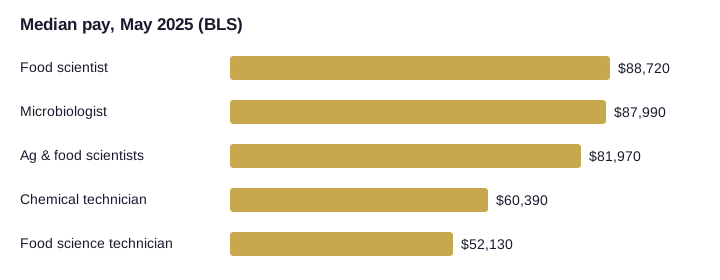
| Career | Median pay (May 2025) | Top 10% earn more than | Projected growth, 2025–35 | Typical entry education |
|---|---|---|---|---|
| Food scientist and technologist | $88,720 | — | 6% | Bachelor's |
| Microbiologist | $87,990 | — | — | Bachelor's |
| Agricultural and food scientists (all) | $81,970 | $142,300 | 6% | Bachelor's |
| Chemical technician | $60,390 | — | — | Associate's |
| Food science technician | $52,130 | $78,820 | 5% | Associate's |
Source: U.S. Bureau of Labor Statistics, Occupational Outlook Handbook (updated Aug. 27, 2026): May 2025 median pay and 2025–35 employment projections. Click any occupation for the BLS page. A dash means the figure is not shown in that BLS summary. Pay varies by state, employer and experience.
What Do Food Science Majors Study?
Expect general and organic chemistry, biology and microbiology in the first two years, then food chemistry, food microbiology, food processing and engineering, sensory evaluation, nutrition and food law. Most programs end with a product development project where students build a new food from scratch.
When comparing schools, look for programs approved by the Institute of Food Technologists (IFT), a pilot plant students can actually use, and strong ties to food companies for internships. Many of the biggest programs sit inside land-grant universities' agriculture colleges, which often have lower in-state tuition than parents expect.
Is Food Science a Good Major?
Our Food Science Loan vs Upside calculator starts from Continuum wages of about $69,000 early in a career and $116,000 at mid-career. At its default $50,000 loan (6.5% for 10 years), total repayment is about $68,129, against an estimated lifetime earnings gain of about $1,440,270 over a high-school-only path, about 21.1 times the loan cost. That's an illustration, and you can change every input.
The honest limits: the field is small. BLS projects about 2,700 openings a year across all agricultural and food scientists, and many jobs sit near food plants, which aren't always in big cities. On the other side, the national median for all workers is $50,980, and food doesn't go out of style in a recession.
How Will AI Affect Food Science Careers?
MajorMatch's AI task-exposure estimate for food science is 42%, which is moderate. AI tools can speed up literature reviews, formulation suggestions and report writing. They can't taste a sample, run a pilot batch or walk a plant floor during an audit. Compare majors in our AI-proof majors guide.
Is Food Science the Right Major for Your Teen?
It suits the student who likes chemistry but wants to hold the result in their hands. If your teen likes the science but not the food, our biology degree guide covers a wider set of paths.
Not sure? Take the assessment. It uses our own proprietary scoring method to compare your student's strengths and interests with all 100 majors, including food science, and shows the top 3 free.
More Questions Parents Ask
Is food science a STEM major?
Yes. Food science is built on chemistry, microbiology and engineering, and U.S. colleges generally classify it as a STEM field.
Is food science a hard major?
It's a real science major, with organic chemistry and microbiology, but it is usually considered less brutal than pre-med or engineering. Hands-on lab and pilot-plant work keeps many students engaged.
Is food science a good pre-med major?
It can be, because it covers chemistry and biology and stands out on applications. Your student should check that the plan includes every medical school prerequisite, such as physics and biochemistry.
What is the salary for a food science degree?
BLS lists food scientists and technologists at a median of $88,720 (May 2025). Food science technicians, a common entry role, earn a median of $52,130.
Frequently Asked Questions
What jobs can you get with a food science degree?
Product developer, quality assurance specialist, food safety specialist, food science technician, sensory scientist, flavor or ingredient specialist, regulatory and labeling specialist, and, with graduate school, research scientist.
How much do food scientists make?
BLS lists food scientists and technologists at a median of $88,720 in May 2025. Agricultural and food scientists overall earned a median of $81,970, with the top 10% above $142,300.
Is food science a good major?
For students who like chemistry and biology, yes. It is a small field with steady demand, and food manufacturing is the largest employer.
Is food science the same as nutrition?
No. Nutrition focuses on how food affects the body and often leads to dietitian work. Food science focuses on making, preserving and testing food.
Is food science hard?
It is a science major with chemistry, microbiology and some engineering, so expect real lab work and math.