Quick answer: Statistics is a strong major if your teen enjoys math, data and coding. Its core careers pay roughly 1.5 to 2.5 times the median for all workers ($50,980 in May 2025), and every one of them is projected by the Bureau of Labor Statistics to grow faster than average. Plan on either a master's degree or a direct analyst role: statisticians typically need a master's, while data scientists, actuaries and operations research analysts typically start with a bachelor's.
"Is statistics a good major?" usually comes up when a student is good at math but doesn't want to spend four years on proofs, or when a family hears that "data" jobs pay well and wants to know which degree actually gets you there.
Statistics is the major built for that. It's the study of collecting data, measuring uncertainty and drawing conclusions you can defend, and it shows up in nearly every industry: drug trials, insurance pricing, sports analytics, elections, product testing and public health.
This guide uses the Bureau of Labor Statistics' Occupational Outlook Handbook (May 2025 pay, 2025–35 projections), the New York Fed's outcomes by major, and the federal DHS STEM list. Sources are linked throughout and listed at the end.
Is statistics a good major?
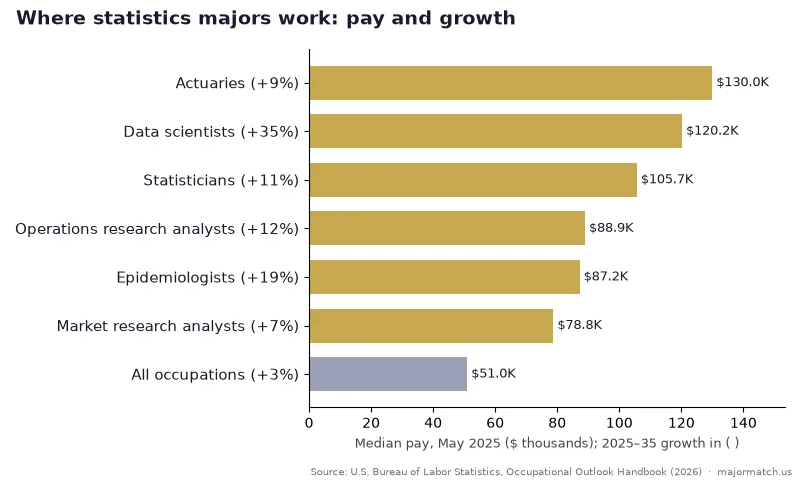
Yes, for the right student. The careers statistics leads to are well paid and growing. All six careers in the table below have median pay above $50,980, the median for all U.S. workers, and all are projected to grow at least twice as fast as the 3% average from 2025 to 2035. Data scientists lead at 35%.
It's also a flexible degree. The Bureau of Labor Statistics lists statistics as a common degree field for data scientists and actuaries, and as a useful path into market research. A statistics major can still move into finance, tech, healthcare, government or graduate school later.
The honest downside: the title "statistician" usually requires a master's degree, and the major demands real comfort with calculus, probability and programming. Students who want math with a clear purpose tend to love it. Students who only tolerate math usually don't.
What jobs can you get with a statistics degree?
These are the main careers statistics majors move into, with figures from the Bureau of Labor Statistics. Each career name links to its official profile.
| Career | Median pay (May 2025) | Projected growth, 2025–35 | Openings per year | Typical entry education |
|---|---|---|---|---|
| Data scientists | $120,230 | 35% | 24,800 | Bachelor's |
| Actuaries | $130,000 | 9% | 1,500 | Bachelor's + certification exams |
| Statisticians | $105,650 | 11% | 2,000* | Master's (some entry-level bachelor's jobs) |
| Operations research analysts | $88,940 | 12% | 7,500 | Bachelor's |
| Epidemiologists | $87,220 | 19% | 800 | Master's |
| Market research analysts | $78,760 | 7% | 82,000 | Bachelor's |
| All occupations | $50,980 | 3% | — | — |
*BLS projects about 2,000 openings a year for mathematicians and statisticians combined; statisticians hold about 31,300 of the 33,500 jobs. Source: U.S. Bureau of Labor Statistics, Occupational Outlook Handbook (May 2025 wages, 2025–35 projections).
- Data scientist: builds models that predict or classify things, often with machine learning. The fastest-growing option, with about 24,800 openings a year.
- Actuary: prices risk for insurers and pension plans. Highest median pay in the group, but it requires passing a series of professional exams. See is actuarial science a good major.
- Statistician or biostatistician: designs studies and surveys and analyzes the results. Biostatisticians work in drug companies, public health agencies and hospitals.
- Operations research analyst: uses models to help organizations schedule, route and price things better.
- Market research analyst: studies customers and sales data. The largest field here, with about 82,000 openings a year.
- Epidemiologist: tracks the causes and spread of disease. BLS says epidemiologists typically need a master's degree, often in public health, and those programs include math and statistics coursework. See what you can do with a public health degree.
How much do statistics majors make?
In the careers above, median pay runs from $78,760 (market research analysts) to $130,000 (actuaries), according to BLS May 2025 data. Statisticians earn a median of $105,650. The lowest-paid 10% earn less than $64,000 and the top 10% more than $174,050.
Where a statistician works matters. Median pay is $132,620 in the federal government and $130,590 in scientific research and development, compared with $82,480 in education and $79,000 in state and local government.
For pay by major (not by job), the New York Fed doesn't publish statistics separately. Its closest category, mathematics, shows median pay of $70,000 for ages 22 to 27 and $100,000 for ages 35 to 45, compared with $58,000 and $87,000 for all majors. Treat that as a rough guide, not a statistics-specific number. You can run the math-major numbers yourself in our mathematics loan vs. upside calculator.
Do you need a master's degree in statistics?
For the job title "statistician," usually yes. BLS says statisticians typically need a master's degree, though some entry-level positions accept a bachelor's. Federal government jobs can be open with a bachelor's degree or significant math coursework.
For most other statistics careers, no. Data scientists, actuaries, operations research analysts and market research analysts typically enter with a bachelor's degree. Actuaries need exams instead, and BLS notes that many employers expect candidates to pass one or two before graduation.
That's why grad school is common in this field: 51% of math majors (the closest category in the New York Fed data) hold a graduate degree, compared with 39% of all majors. If you're weighing that extra cost, see our master's degree ROI by field.
Is statistics the right fit for your teen?
Take the free adaptive assessment (about 10 to 20 minutes) to see your top 3 major matches, scored with our own proprietary scoring method. The full Pathfinder report is $29 if you want the deeper plan.
Take the assessment →Statistics vs. math major: which is better?
Pick statistics if your teen likes working with real data and wants a direct path to analyst jobs. Pick math if they enjoy theory and proofs, or want to keep doors open to teaching, cryptography or a Ph.D.
The two overlap heavily in the first two years (calculus, linear algebra, probability), so switching between them early is usually manageable. BLS growth favors the applied side: statisticians are projected to grow 11% from 2025 to 2035, while mathematician jobs are expected to grow just 1%. For the math route, see what you can do with a math degree.
Statistics vs. data science major
Statistics goes deeper on probability, inference and experimental design. Data science adds more programming, databases and machine learning. Both lead to data scientist jobs, and BLS lists statistics as a common degree field for them.
A practical rule: a statistics major with solid coding classes (Python or R, plus databases) competes well for data science roles, and it's the stronger base for biostatistics and grad school. For the data science side, see is a data science major worth it and computer science vs. data science.
Is statistics a hard major?
It's demanding, but in a specific way. Expect calculus, linear algebra, probability theory, mathematical statistics and programming. BLS lists math, analytical and logical-thinking skills as important for statisticians, along with the ability to explain results to people who aren't technical.
The students who struggle are usually the ones who dislike abstract math or coding, not the ones who find it hard at first. If AP Statistics or AP Calculus felt satisfying, that's a good sign. If your teen is strong in math but undecided, our list of majors for students who are good at math compares statistics with its neighbors.
Is statistics a STEM major?
Yes. Statistics (CIP 27.0501), mathematical statistics and probability (27.0502), mathematics and statistics (27.0503), biostatistics (26.1102) and business statistics (52.1302) are all on the federal DHS STEM Designated Degree Program List. See what majors are considered STEM for how the list works.
Who should major in statistics?
A few signs it fits:
- They like math most when it answers a real question, like who will win, whether a drug works, or what customers will buy.
- They're comfortable learning to code, or already enjoy it.
- They'd rather explain what the numbers mean than just calculate them. BLS lists communication skills as important for statisticians.
- They're open to grad school, or to an analyst role that leads somewhere bigger.
If that sounds like your teen, statistics deserves a spot on the list. If you're not sure, take the assessment. It looks at your teen's interests and strengths with our proprietary scoring and returns their top 3 major matches, so you can see whether statistics, math, data science or something else fits best.
Frequently asked questions
What are the best jobs for statistics majors?
The main ones are data scientist ($120,230 median pay, 35% projected growth from 2025 to 2035), actuary ($130,000, 9%), statistician ($105,650, 11%), operations research analyst ($88,940, 12%), epidemiologist ($87,220, 19%) and market research analyst ($78,760, 7%), according to the Bureau of Labor Statistics.
Is statistics a good major in 2026?
Yes, for students who like math and data. Every core statistics career is projected to grow at least twice as fast as the 3% average for all jobs from 2025 to 2035, led by data scientists at 35%, according to BLS.
How much do statistics majors make?
It depends on the job. BLS May 2025 median pay ranges from $78,760 for market research analysts to $130,000 for actuaries. Statisticians earn a median of $105,650, and $132,620 in the federal government.
Can you get a job with a bachelor's in statistics?
Yes. Data scientists, actuaries, operations research analysts and market research analysts typically enter with a bachelor's degree. The job title statistician usually expects a master's, although BLS says some entry-level positions accept a bachelor's.
Is statistics a STEM major?
Yes. Statistics (CIP 27.0501), mathematical statistics, biostatistics and business statistics are on the federal DHS STEM Designated Degree Program List.
Should I major in statistics or data science?
Choose statistics for deeper training in probability, inference and study design, which is a strong base for biostatistics and grad school. Choose data science for more programming and machine learning. Both lead to data scientist jobs.
Sources
- U.S. Bureau of Labor Statistics, Occupational Outlook Handbook: Mathematicians and Statisticians (May 2025 pay; 2025–35 projections)
- U.S. Bureau of Labor Statistics, Occupational Outlook Handbook: Data Scientists
- U.S. Bureau of Labor Statistics, Occupational Outlook Handbook: Actuaries
- U.S. Bureau of Labor Statistics, Occupational Outlook Handbook: Operations Research Analysts
- U.S. Bureau of Labor Statistics, Occupational Outlook Handbook: Market Research Analysts
- U.S. Bureau of Labor Statistics, Occupational Outlook Handbook: Epidemiologists
- Federal Reserve Bank of New York, The Labor Market for Recent College Graduates: Outcomes by Major (released Feb. 4, 2026; 2024 American Community Survey data)
- U.S. Department of Homeland Security, DHS STEM Designated Degree Program List (last updated July 22, 2024)