Quick answer
For a student set on flying for an airline, an aviation degree is often worth it. Airline pilots earned a median $232,140 in May 2025 (BLS), and an approved four-year aviation degree can cut the hours needed for an airline certificate from 1,500 to 1,000. The catch is the stretch between graduation and that first airline job, usually spent instructing for far less.
Key takeaway: airline pilots earned a $232,140 median in May 2025, and an FAA-approved aviation bachelor's can cut the airline-certificate requirement from 1,500 to 1,000 flight hours.
Ask a room of high school seniors who wants to be a pilot and a few hands shoot up. They've been on flight simulators since middle school. They know the tail numbers. What they usually don't know is how the path really works, and neither do most parents writing the tuition checks.
Here's the short version. A degree alone doesn't make anyone a pilot. Flight certificates and hours do. What a good aviation program does is bundle the training, shorten the hour requirement and plug students into airline pipelines. Whether that's worth the cost depends on which job your kid actually wants, so we cover pilots and the rest of aviation below.
What Jobs Can You Get With an Aviation Degree?
Pay below is the national median from the Bureau of Labor Statistics (BLS), May 2025, unless we say otherwise.
1. Airline pilot
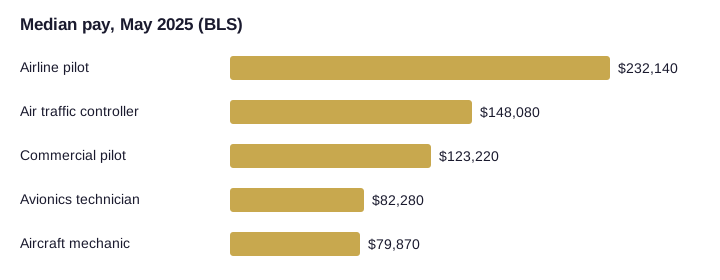
The big one. BLS reports a median of $232,140 for airline pilots, copilots and flight engineers, with the top 10% above $463,830. Pilots start as first officers and get raises with seniority. BLS says airline pilots fly about 75 hours a month and spend another 150 on planning and other duties. Federal law makes them retire at 65.
2. Certified flight instructor (CFI)
This is the job most new pilots hold first, and it's how they build hours toward an airline certificate. Many aviation students instruct at their own university's flight school after graduation. Pay is modest. The point is the logbook.
3. Commercial or charter pilot
Charter, cargo, air ambulance, crop dusting, corporate flying. BLS lists commercial pilots at a median of $123,220, with the top 10% above $266,620. Plenty of people stay here for good because they like the variety or being home more nights.
4. Air traffic controller
Controllers keep aircraft safely apart, mostly for the Federal Aviation Administration. BLS median: $148,080. Growth is slow (2% through 2035), but about 2,100 openings come up every year as controllers leave, and the FAA requires them to retire at 56. Some colleges run FAA-approved Air Traffic Collegiate Training Initiative programs.
5. Aircraft or avionics technician
Mechanics keep the fleet flying. BLS lists aircraft mechanics at $79,870 and avionics technicians at $82,280. Most train through FAA-approved maintenance programs that take far less than four years.
6. Aviation management and operations
Airline operations, dispatch, airport management, safety and scheduling. Aviation management majors land here, and so do pilots who want a ground job later. Dispatchers are the people who decide, at 3 a.m., whether a flight goes.
What Does the Path to the Cockpit Actually Look Like?
Grace Stachowiak graduated from Western Michigan University in April 2025 with two degrees, aviation flight science and aviation management and operations. Through Delta's Propel pilot career program she had a guaranteed route to the airline before she walked at commencement. "I'm 22, and I have a guaranteed job for the rest of my life already if I want it," she told the university.
Notice what came next, though. She stayed at Western as a certified flight instructor to finish the flight hours she needed, before moving on to the airline side. That's the normal sequence even for students who do everything right. (Western Michigan University News, April 2025)
Not everyone heads for an airline. Emily Hartshorn started at the University of Nebraska at Kearney planning to study business. She didn't know UNK had an aviation program until she got to know the aviation students who studied at the campus Starbucks where she worked. She switched majors. A 2022 summer internship with Silverhawk Aviation, a Lincoln-based charter company, turned into a full-time job flying Cessna Citation business jets right after she graduated that December. She also teaches flying on the side. "There are so many opportunities in aviation and so many different avenues you can go down," she said. "There's adventure, the pay is pretty good, and the network of people is amazing." (UNK News, October 2025)
How Much Do Aviation Majors Make?
| Career | Median pay (May 2025) | Top 10% earn more than | Projected growth, 2025–35 | Typical entry path |
|---|---|---|---|---|
| Airline pilot, copilot, flight engineer | $232,140 | $463,830 | 8% | Bachelor's + commercial or military flying |
| Air traffic controller | $148,080 | $215,610 | 2% | Associate's or bachelor's (AT-CTI), or experience |
| Commercial pilot | $123,220 | $266,620 | 5% | Flight training; degree often preferred |
| Avionics technician | $82,280 | $113,680 | 9% | FAA-approved program or on-the-job |
| Aircraft mechanic | $79,870 | $128,890 | 5% | FAA-approved maintenance program |
Source: U.S. Bureau of Labor Statistics, Occupational Outlook Handbook (updated Aug. 27, 2026): May 2025 median pay and 2025–35 employment projections. Click any occupation for the BLS page. A dash means the figure is not shown in that BLS summary. Pay varies by state, employer and experience.
What Do Aviation Majors Study?
Flight-track students (often called professional pilot or flight science) split their time between the classroom and the airport: aerodynamics, weather, navigation, aviation law and human factors, plus flight lessons from private pilot through instrument, commercial and multi-engine ratings. Management-track students take airline economics, airport operations and safety systems instead of most of the flying.
The detail parents should know is federal. An airline transport pilot certificate normally requires 1,500 flight hours. Under FAA rule 14 CFR 61.160, graduates of an approved bachelor's program with an aviation major can qualify for a restricted certificate at 1,000 hours. Those 500 hours can be a year or more of instructing. Ask any program you visit whether it holds that FAA authorization, and ask what flight training costs on top of tuition, because it's usually billed separately.
Is an Aviation Degree Worth It?
Our Aviation Loan vs Upside calculator starts from Continuum wages of about $76,000 early in a career and $137,000 at mid-career. At its default $50,000 loan (6.5% for 10 years), total repayment is about $68,129, against an estimated lifetime earnings gain of about $2,210,800 over a high-school-only path, about 32.5 times the loan cost. It's an illustration, not a quote. For flight students, raise the loan amount to match the real flight-training bill and watch what changes.
Three honest caveats. First, BLS says airline pilots typically need a bachelor's degree in any field, so a student could major in something else and train on the side; the aviation degree mostly buys the hour reduction and the airline connections. Second, a failed FAA medical exam can end a flying career before it starts, so get the medical certificate early. Third, pilot hiring has moved in waves for decades. A management track gives a student something to stand on if a hiring slowdown hits the year they're ready.
How Will AI Affect Aviation Careers?
Aviation is one of the least AI-exposed majors in our catalog. MajorMatch's task-exposure estimate for the major is 17%: commercial pilots score 23%, avionics technicians 19% and aircraft mechanics 10%. Cockpits have been automating for decades, and federal rules still put trained humans in the seats and in the hangar. The likelier change is in the paperwork around flying: scheduling, dispatch planning and maintenance records. Compare majors in our AI-proof majors guide.
Is Aviation the Right Major for Your Teen?
The kids who thrive can study for a written exam on Tuesday and fly a checkride on Thursday without falling apart. Calm under pressure, comfortable with rules, fine being away from home. If your teen loves aircraft but not the lifestyle, maintenance and air traffic control pay well with less schooling. Our trade school vs college guide covers that tradeoff.
Still unsure? Take the assessment. It uses our own proprietary scoring method to compare your student's strengths and interests with all 100 majors, including aviation, and shows the top 3 free.
More Questions Parents Ask
Is aviation management a good degree for pilots?
Yes, for a pilot who wants a backup plan, because airlines usually ask for a bachelor's degree in any field and management courses lead to ground jobs. To get the 1,000-hour benefit, the program must be FAA-authorized under 14 CFR 61.160.
How much does an aviation degree pay?
It depends on the job: BLS reports May 2025 medians of $232,140 for airline pilots, $148,080 for air traffic controllers and $79,870 for aircraft mechanics.
Is aviation a hard major?
The classes are manageable, but the pace of flight training, FAA written exams and checkrides, and an FAA medical certificate make it demanding. Weather and scheduling can also push training back.
Can you major in aviation?
Yes. Many universities offer professional pilot (flight science), aviation management, air traffic and maintenance majors, and some community colleges offer two-year versions.
Frequently Asked Questions
Is an aviation degree worth it?
For students headed to the airlines it often is, mainly because an approved bachelor's program can lower the airline certificate requirement from 1,500 to 1,000 flight hours and many programs have airline hiring pipelines. The cost of flight training is the main thing to check.
Do you need a degree to be an airline pilot?
BLS says airline pilots typically need a bachelor's degree, in any field, plus commercial or military flying experience and FAA certificates. Commercial pilots typically need flight training, and some employers prefer a degree.
How much do airline pilots make?
The BLS median for airline pilots, copilots and flight engineers was $232,140 in May 2025. New first officers earn less, and pay rises with seniority.
What can you do with an aviation degree besides fly?
Air traffic control, aircraft maintenance and avionics, airline operations and dispatch, airport management and aviation safety are common paths.
How long does it take to become an airline pilot?
Usually four years of school and training, plus a year or more of instructing or charter flying to reach the 1,000 to 1,500 hours an airline certificate requires.