Quick answer: The most AI-resilient business majors are accounting (2.6% recent-grad unemployment, 115,300 accountant openings a year), finance (2.8% unemployment, $112,000 mid-career pay) and supply chain (logisticians +17.6% growth to 2035). Economics pays well ($115,000 mid-career) but has 33.1% underemployment. Marketing, general business and business management have the highest underemployment: 49.3%, 50.4% and 52.6%.
Picture two people with the same business degree. One reviews loan applications against a checklist and flags the ones that don't fit. The other runs the team that decides what the checklist should say, and answers to the bank's regulators when it's wrong. Both jobs live in spreadsheets. Only one of them is projected to grow.
That split runs through the whole business family, and it explains most of the AI question for business majors. We used BLS projections to 2035, New York Fed outcomes by major, and Microsoft Research's AI applicability scores, built from 200,000 real Copilot conversations. We also used published usage data from Anthropic and Google. They point in the same direction.
This page covers business majors only. For the full ranking across all fields, see our list of AI-proof college majors. For computer science, IT and data science, see Is Computer Science Still Worth It With AI?
Which business majors are most AI-proof?
Here is our ranking, from most to least resilient. It weighs early-career outcomes, the projected demand for the jobs each major feeds, and how much of that work AI already handles.
- Supply chain management. Logisticians are projected to grow 17.6% with an AI score of 0.16, lower than most business jobs in the tables below. The work runs on trucks, ports, suppliers and shortages in the real world.
- Accounting. It has the lowest recent-grad unemployment in the group (2.6%), and accountants have about 115,300 openings a year. The CPA license adds a legal sign-off that software can't hold.
- Finance. It has 2.8% unemployment and $112,000 mid-career pay. Financial managers are projected to grow 9.7%, but parts of the analyst and advisor work are highly exposed.
- Healthcare administration. Medical and health services managers are projected to grow 24.2%, the fastest of any management job in the BLS projections. See healthcare administration careers.
- Business analytics. The jobs are growing fast, but they're among the most AI-exposed. It pays off for students who pair analytics with a field they know well.
- Economics. It has the highest mid-career pay here ($115,000), but one in three recent grads is underemployed.
- Marketing. Marketing managers do well. The entry-level content and research work is some of the most AI-applicable in business.
- General business and business management. These have the highest underemployment of any business major, at 50.4% and 52.6%.
Business, but which kind? Find out which fits your teen.
Take the free adaptive assessment (about 10 to 20 minutes) to see your top 3 major matches, scored with our own proprietary scoring method. The full Pathfinder report is $29 if you want the deeper plan.
Take the assessment →How do business majors compare on jobs and pay right now?
Before you look at AI, look at where graduates of each business major land today. This is New York Fed data for workers aged 22 to 27, with mid-career pay at 35 to 45:
| Business major | Recent-grad unemployment | Recent-grad underemployment | Early-career pay (22–27) | Mid-career pay (35–45) | Calculator |
|---|---|---|---|---|---|
| Accounting | 2.6% | 21.2% | $68,000 | $97,000 | Run the numbers |
| Finance | 2.8% | 27.8% | $70,000 | $112,000 | Run the numbers |
| Economics | 3.5% | 33.1% | $72,000 | $115,000 | Run the numbers |
| Business Analytics | 5.0% | 28.7% | $72,000 | $109,000 | Run the numbers |
| Information Systems & Management | 6.0% | 25.6% | $67,000 | $100,000 | Run the numbers |
| Marketing | 4.4% | 49.3% | $60,000 | $100,000 | Run the numbers |
| General Business | 4.3% | 50.4% | $60,000 | $90,000 | Run the numbers |
| Business Management | 3.8% | 52.6% | $56,000 | $82,000 | Run the numbers |
| All majors | 4.2% | 39.4% | $58,000 | $87,000 | — |
The spread is wide for majors that all sit in the same college. Accounting grads have the lowest unemployment of the group. Finance and economics grads earn the most by mid-career. But about half of general business, business management and marketing grads work in jobs that don't need a degree. AI is adding pressure to a gap that already existed.
Which business jobs is AI already changing?
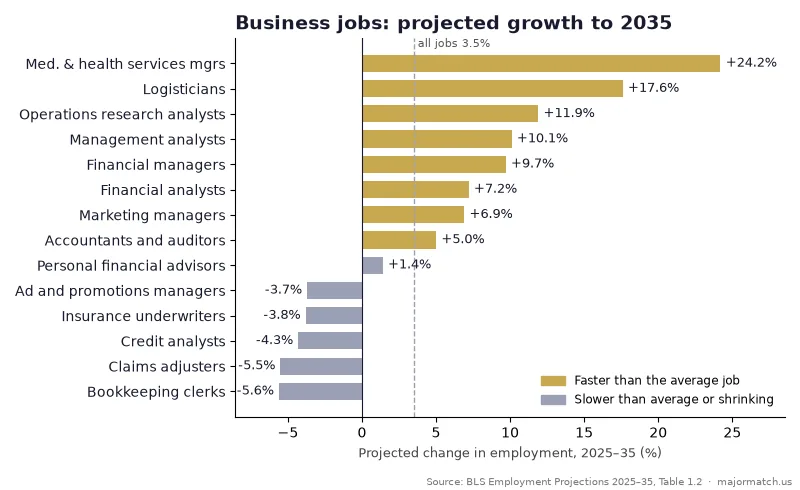
These are the business jobs the BLS projects to grow through 2035. Microsoft's AI score shows how much each job's work overlaps with what people already use Copilot for:
| Job | Usual business major | AI applicability score (Microsoft) | Projected growth, 2025–35 | Openings per year | Median pay (2025) |
|---|---|---|---|---|---|
| Medical and health services managers | Healthcare admin, business | 0.16 (43% score higher) | +24.2% | 62,300 | $123,860 |
| Logisticians | Supply chain | 0.16 (44% score higher) | +17.6% | 26,600 | $82,320 |
| Operations research analysts | Business analytics, math | 0.31 (11% score higher) | +11.9% | 7,500 | $88,940 |
| Management analysts | Business, economics | 0.35 (3% score higher) | +10.1% | 94,100 | $101,860 |
| Financial managers | Finance, accounting | 0.15 (48% score higher) | +9.7% | 65,600 | $166,570 |
| Financial and investment analysts | Finance, economics | 0.28 (15% score higher) | +7.2% | 24,700 | $102,740 |
| Marketing managers | Marketing | 0.19 (34% score higher) | +6.9% | 34,000 | $166,790 |
| Accountants and auditors | Accounting | 0.19 (32% score higher) | +5.0% | 115,300 | $83,680 |
| Human resources managers | HR, management | 0.14 (53% score higher) | +5.5% | 16,800 | $149,280 |
And these are the business jobs projected to grow slowly or shrink:
| Job | Usual business major | AI applicability score (Microsoft) | Projected growth, 2025–35 | Openings per year | Median pay (2025) |
|---|---|---|---|---|---|
| Personal financial advisors | Finance | 0.36 (2% score higher) | +1.4% | 17,100 | $105,070 |
| Public relations specialists | PR, marketing, communications | 0.37 (2% score higher) | +1.8% | 23,000 | $74,750 |
| Advertising and promotions managers | Marketing | 0.19 (34% score higher) | −3.7% | 2,300 | $133,660 |
| Insurance underwriters | Finance, risk | 0.16 (44% score higher) | −3.8% | 6,800 | $81,370 |
| Credit analysts | Finance | 0.16 (44% score higher) | −4.3% | 3,100 | $83,510 |
| Claims adjusters, examiners and investigators | Business, finance | 0.21 (29% score higher) | −5.5% | 20,900 | $78,000 |
| Bookkeeping, accounting and auditing clerks | Often no degree; accounting dropouts | 0.24 (22% score higher) | −5.6% | 144,100 | $50,670 |
Notice what the AI score does and doesn't predict. Management analysts are among the most AI-applicable jobs anywhere: only 3% of the 785 scored jobs rank higher. Yet the BLS projects them to grow 10.1%. Credit analysts and insurance underwriters score lower on AI and are projected to shrink. BLS projections reflect many forces besides generative AI, including older automation software. Still, the split holds. Growing jobs are the ones where a person makes the call and answers for it. Shrinking jobs are the ones where a person applies rules to a file.
AI companies' own data points the same way. Anthropic's March 2026 Economic Index report found two business workflows more than doubled in its API data in three months: sales and outreach automation, and automated trading and market operations. Google's ATLAS study found human resources specialists among the 3% of occupations where AI was used for more than three-quarters of tasks.
Is accounting AI-proof?
The bookkeeping part isn't. The accountant part mostly is, for now. In the OpenAI and Penn GPTs are GPTs paper, GPT-4's own ratings marked 100% of accountant and auditor tasks as exposed under the broadest measure, which counts software built on top of a language model. Bookkeeping, accounting and auditing clerks are projected to shrink 5.6%, even though they still have about 144,100 openings a year from turnover.
Accountants and auditors are a different story. They are projected to grow 5.0%, and their Microsoft score (0.19) sits in the middle of the business jobs above. Look at the tasks in their O*NET profile: "Report to management about asset utilization and audit results, and recommend changes." "Collect and analyze data to detect deficient controls, duplicated effort, extravagance, fraud, or non-compliance." Finding fraud and signing an audit opinion are judgment calls that carry legal liability.
Our advice: choose accounting if your teen plans to go for the CPA or the audit and advisory track. A student who wants the major for bookkeeping-style work is aiming at the part that is shrinking. Compare it with finance vs. accounting or accounting vs. business management.
Is finance a good major with AI?
Yes, but finance majors should pick their lane with care. Financial managers, the people who run treasury, budgeting and risk, are projected to grow 9.7% with a median of $166,570 and an AI score (0.15) lower than about half of all jobs. Financial and investment analysts grow 7.2% but score 0.28, more exposed than 85% of jobs. Anthropic names financial analysts among the most exposed occupations in its observed-exposure data.
Two finance jobs to look at hard: personal financial advisors (+1.4% growth, among the 2% most AI-applicable jobs) and credit analysts (−4.3%). If your teen likes finance, the safer path runs toward managing money and risk inside a company, not producing reports about it. Finance vs. economics and finance vs. business analytics show the trade-offs side by side.
Will AI replace marketing majors?
It will replace some of what junior marketers do. Market research analysts and marketing specialists score 0.35; only 3% of jobs score higher. Public relations specialists score 0.37 and grow just 1.8%. Pew found the most common work uses of chatbots are research (57%), editing (52%) and drafting (47%). That is the daily work of an entry-level marketing job.
Marketing managers are projected to grow 6.9%, with a median of $166,790. The gap between the two jobs is the problem. Marketing grads already have 49.3% underemployment, and AI makes the first rung harder to reach. Marketing still works for a student who builds proof early, like campaigns run, budgets managed and results measured. See marketing vs. business management and marketing vs. communications.
Is economics an AI-proof degree?
Economics is a strong degree with an odd AI profile. The job titled "economist" scores 0.33 on Microsoft's scale, more AI-applicable than 94% of jobs. It's also tiny: about 1,100 openings a year, and it usually needs a master's.
But most econ majors don't become economists. They go into finance, consulting, policy and management. That is why the major's outcomes look good: 3.5% recent-grad unemployment and $115,000 mid-career pay, higher than any other business major in the table. The 33.1% underemployment rate is the warning sign. Econ pays off for students who add a quantitative or professional skill to it. Compare economics vs. business management.
What about business analytics and information systems?
These majors sit right at the AI frontier. Data scientists are among the 2% most AI-applicable jobs, yet the BLS projects them to grow 34.6%, one of the fastest rates of any occupation. Operations research analysts grow 11.9%. Business analytics grads have 5.0% unemployment and $109,000 mid-career pay. Information systems grads have 6.0% and $100,000.
The lesson from these numbers: being AI-exposed doesn't mean being in decline when demand for the work is rising faster than AI can absorb it. For the tech side of this question, read Is Computer Science Still Worth It With AI?
How can a business student make the degree harder to replace?
- Aim for the licensed or accountable version of the job. CPA, CFA, or a role that signs off rather than prepares.
- Attach business to a physical or regulated field. Healthcare, construction, energy, logistics. These are where the growing manager jobs are.
- Get an internship before senior year. Stanford's research found AI's early job effects show up as less hiring of 22- to 25-year-olds. An internship that turns into an offer skips that step.
- Learn to use the tools well. Anthropic found that people who had used Claude for six months or more were about 10% more successful in their conversations than newer users. Its authors suggest that may reflect learning by doing.
OpenAI's GDPval test is useful here. It covers 44 occupations, including accountants and auditors, financial managers, financial analysts and project management specialists. The best model's work was rated as good as or better than an expert's in just under half of the tasks. OpenAI notes that the test is one-shot and leaves out the back-and-forth of real work. AI can now produce a first draft of business work. Graduates who can judge, fix and stand behind that draft will be in demand.
Three free tools help you check a path before you commit to it. The Major Earnings Continuum maps 100 majors to their careers and mid-career pay. The Major Payoff Report 2026 ranks 100 majors by payoff. The degree loan vs. upside calculator compares what a degree costs against what it tends to pay back.
Frequently asked questions
What business degrees will not be made redundant by AI?
The business degrees that lead to decision-making and licensed roles hold up best: accounting (aimed at the CPA), finance (aimed at financial management), supply chain management and healthcare administration. BLS projects financial managers to grow 9.7%, logisticians +17.6% and medical and health services managers +24.2% from 2025 to 2035.
Which business major is safest from AI?
Supply chain management and accounting. Logisticians score 0.16 on Microsoft's AI applicability scale and are projected to grow 17.6%. Accounting grads have 2.6% recent-grad unemployment, the lowest of the business majors in New York Fed data.
Is accounting going to be replaced by AI?
Bookkeeping work is shrinking. Bookkeeping, accounting and auditing clerks are projected to decline 5.6% by 2035. Accountants and auditors are projected to grow 5.0%, with about 115,300 openings a year, because audit opinions, fraud detection and tax judgments require a licensed, accountable person.
Is finance a good major with AI?
Yes. Finance grads have 2.8% recent-grad unemployment and $112,000 median mid-career pay (New York Fed). The safer finance jobs are in managing money and risk: financial managers grow 9.7%. Personal financial advisors (+1.4%) and credit analysts (−4.3%) look weaker.
Is economics an AI-proof degree?
Partly. The economist job itself is highly AI-applicable (score 0.33) and small. But economics majors mostly work in finance, consulting and management, and they earn $115,000 at mid-career with 3.5% recent-grad unemployment. The risk is the 33.1% underemployment rate.
Will AI replace marketing jobs?
AI is taking over much of the entry-level writing and research in marketing. Market research analysts and PR specialists are among the 3% most AI-applicable jobs. Marketing managers are still projected to grow 6.9%. The challenge is getting the first job: marketing grads have 49.3% underemployment.
Is a business degree still worth it?
It depends on the type of business degree. Accounting, finance and economics grads have unemployment well below the all-majors average. General business and business management grads have about 50% underemployment. Our business degree guide covers costs and payoff, and the MajorMatch assessment shows which business major, if any, fits your teen.
Sources
Every figure on this page comes from the documents below. MajorMatch joined the Microsoft Research occupation scores to the BLS 2025–35 projections table by SOC code; that join is our own analysis.
- U.S. Bureau of Labor Statistics, Employment Projections 2025–35, Table 1.2: Occupational projections and worker characteristics
- Federal Reserve Bank of New York, The Labor Market for Recent College Graduates, Outcomes by Major (February 2026 release)
- Tomlinson, Jaffe, Wang, Counts and Suri (Microsoft Research), “Working with AI: Measuring the Applicability of Generative AI to Occupations,” arXiv 2507.07935 (2025)
- Microsoft Research, working-with-ai data repository (AI applicability scores for 785 occupations)
- O*NET OnLine, Accountants and Auditors (13-2011.00) task list; O*NET 30.0 database
- Eloundou, Manning, Mishkin and Rock (OpenAI / University of Pennsylvania), “GPTs are GPTs,” arXiv 2303.10130 (2023)
- OpenAI, “Measuring the performance of our models on real-world tasks” (GDPval, September 25, 2025)
- Massenkoff and McCrory (Anthropic), “Labor market impacts of AI: A new measure and early evidence” (March 5, 2026)
- Anthropic, “Anthropic Economic Index report: Learning curves” (March 24, 2026)
- Iscenko, Strand et al. (Google and Google DeepMind), “Google’s AI & Economy ATLAS v1.0” (July 23, 2026)
- Brynjolfsson, Chandar and Chen, “Canaries in the Coal Mine?” Stanford Digital Economy Lab (revised August 12, 2026)
- Pew Research Center, “U.S. Workers Are More Worried Than Hopeful About Future AI Use in the Workplace” (February 25, 2025)