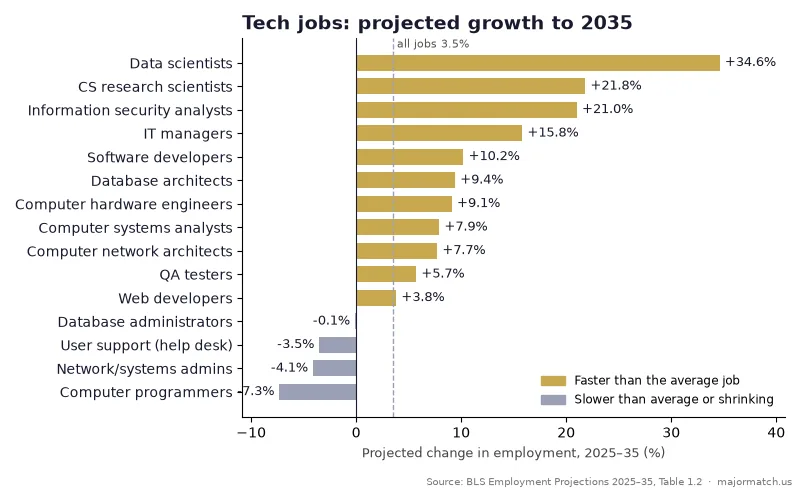
Quick answer: Yes, with a plan. CS grads earn $120,000 at mid-career and have 19.1% underemployment (New York Fed). But their 7.0% recent-grad unemployment ranks 4th-highest of 73 majors. The tech jobs projected to grow fastest to 2035 are data scientists (+34.6%), CS research scientists (+21.8%), information security analysts (+21.0%) and IT managers (+15.8%). Programmers (−7.3%), help desk (−3.5%) and network admins (−4.1%) are projected to shrink.
In the AI usage data, tech is in a different spot from every other field. When Anthropic measured which jobs Claude actually performs at work, computer programmers came out on top, with 75% of their tasks covered. Coding is still the most common use of Claude: Computer and Mathematical tasks make up 35% of Claude.ai conversations. Microsoft Research's study of 200,000 Copilot conversations also put computer and math jobs among the most AI-applicable.
At the same time, the Bureau of Labor Statistics projects software developer jobs to grow 10.2% from 2025 to 2035, about three times the average. The World Economic Forum lists software developers among the five jobs with the largest expected global growth by 2030.
Both facts are true. Which one matters for your teen depends on which tech major they pick and which job they aim for. This page compares the tech majors using New York Fed outcomes, BLS projections and the AI usage data. For every major ranked on AI risk, see our AI-proof college majors list.
Is computer science still worth it?
For most students who would have picked it anyway, yes. Here is what the numbers show:
- Pay is still near the top. CS grads earn a median $87,000 early in their careers and $120,000 at mid-career. The all-majors medians are $58,000 and $87,000.
- Once in, the job uses the degree. CS underemployment is 19.1%, against 39.4% for all majors. Computer engineering's 15.8% is the 4th-lowest of 73 majors.
- Getting in is the hard part. Computer engineering has the 2nd-highest recent-grad unemployment of 73 majors (7.8%), and CS is 4th (7.0%).
So the risk isn't that CS stops paying. The risk is that the first rung of the ladder gets narrower, and students who arrive with only coursework get stuck below it.
What is happening to computer science graduates right now?
Here are the computing and quantitative majors side by side, from New York Fed data:
| Major | Recent-grad unemployment | Rank of 73 (1 = highest) | Recent-grad underemployment | Early-career pay | Mid-career pay | Calculator |
|---|---|---|---|---|---|---|
| Computer Science | 7.0% | 4 | 19.1% | $87,000 | $120,000 | Run the numbers |
| Computer Engineering | 7.8% | 2 | 15.8% | $90,000 | $131,000 | Run the numbers |
| Electrical Engineering | 3.2% | 48 | 21.1% | $82,000 | $123,000 | Run the numbers |
| Information Systems & Management | 6.0% | 14 | 25.6% | $67,000 | $100,000 | Run the numbers |
| Mathematics | 5.8% | 15 | 26.2% | $70,000 | $100,000 | Run the numbers |
| Business Analytics | 5.0% | 21 | 28.7% | $72,000 | $109,000 | Run the numbers |
| All majors | 4.2% | — | 39.4% | $58,000 | $87,000 | — |
Some of the entry-level squeeze comes from the tech hiring cycle, and some looks like AI. The best evidence on the AI part comes from Stanford's Digital Economy Lab. Brynjolfsson, Chandar and Chen (revised August 2026) used ADP payroll records and found that employment of 22- to 25-year-olds in AI-exposed jobs is now 19% below where it would be had it kept pace with less-exposed peers. Experienced workers show no gap. The effect works mainly through less hiring. The authors add that it persists even when tech firms and computer jobs are excluded, and they describe these as early, descriptive signals rather than proof of cause.
For context, the New York Fed reports that all recent college grads had about 5.6% unemployment in the second quarter of 2026. Their underemployment rate edged up to 42%.
Which tech jobs is AI shrinking, and which are growing?
Tech isn't one job. These are BLS projections for 15 computing occupations, with Microsoft's AI applicability score for each:
| Job | AI applicability score (Microsoft) | Projected growth, 2025–35 | Openings per year | Median pay (2025) |
|---|---|---|---|---|
| Data scientists | 0.36 (2% score higher) | +34.6% | 24,800 | $120,230 |
| Computer and information research scientists | 0.17 (41% score higher) | +21.8% | 2,900 | $140,300 |
| Information security analysts | 0.22 (26% score higher) | +21.0% | 14,100 | $129,180 |
| Computer and information systems managers | 0.15 (47% score higher) | +15.8% | 53,500 | $175,140 |
| Software developers | 0.28 (15% score higher) | +10.2% | 95,300 | $135,980 |
| Database architects | 0.31 (10% score higher) | +9.4% | 3,900 | $139,500 |
| Computer hardware engineers | 0.31 (9% score higher) | +9.1% | 4,100 | $161,740 |
| Computer systems analysts | 0.31 (10% score higher) | +7.9% | 32,900 | $105,850 |
| Computer network architects | 0.25 (19% score higher) | +7.7% | 9,600 | $134,050 |
| Software QA analysts and testers | 0.33 (7% score higher) | +5.7% | 10,700 | $104,300 |
| Web developers | 0.35 (3% score higher) | +3.8% | 5,300 | $92,650 |
| Database administrators | 0.30 (12% score higher) | −0.1% | 3,300 | $104,620 |
| Computer user support specialists | 0.33 (5% score higher) | −3.5% | 39,700 | $61,860 |
| Network and computer systems administrators | 0.25 (19% score higher) | −4.1% | 13,400 | $99,130 |
| Computer programmers | 0.31 (10% score higher) | −7.3% | 4,400 | $100,390 |
Here's the pattern. Every job in this table is more AI-applicable than the median job. That alone doesn't predict decline. The jobs that are growing combine technical skill with responsibility for something bigger than the code: security, data that drives decisions, systems design, research, or a team. The jobs that are shrinking are the ones where the core task is writing or maintaining code to spec, or answering routine support tickets.
Is tech the right fit, or just the popular choice?
Take the free adaptive assessment (about 10 to 20 minutes) to see your top 3 major matches, scored with our own proprietary scoring method. The full Pathfinder report is $29 if you want the deeper plan.
Take the assessment →Why are programmer jobs shrinking while software developer jobs grow?
Compare the top tasks in each job's O*NET profile. For computer programmers:
- "Write, analyze, review, and rewrite programs, using workflow chart and diagram..."
- "Correct errors by making appropriate changes and rechecking the program..."
And for software developers:
- "Analyze user needs and software requirements to determine feasibility of design within time and cost constraints."
- "Confer with systems analysts, engineers, programmers and others to design systems..."
The programmer's tasks are the ones AI tools do now. The developer's tasks start with deciding what should be built, for whom and at what cost. Anthropic reports that coding work is moving from chat into automated API workflows such as Claude Code. Its authors say that shift "may signal more imminent transformation of work" for the jobs involved. That fits the BLS projections: programmers are projected to shrink 7.3% while developers grow 10.2%, with 95,300 openings a year.
OpenAI's GDPval benchmark tested AI on real tasks from 44 occupations, software developers among them. The best model's work was rated as good as or better than an expert's in just under half of the tasks. OpenAI notes that the test is one-shot. It leaves out the context-gathering and revision that real projects need, which is the part of the job where a developer adds the most.
Can you still get a job with an IT degree, or will AI make it harder?
This is one of the most common AI questions we see in search data, and the answer depends on which IT job. The traditional entry route through the help desk is shrinking. Computer user support specialists are projected to decline 3.5%, and their work is among the 5% most AI-applicable. Network and computer systems administrators are projected to shrink 4.1%.
But the IT jobs one or two steps up are growing. Information security analysts grow 21.0%, computer network architects +7.7%, and computer and information systems managers +15.8%, with a median of $175,140. IT managers also score lower on AI (0.15) than about half of all jobs. Their O*NET tasks are about people and priorities: "Direct daily operations of department," "Recruit, hire, train and supervise staff."
An IT degree still works if it points toward security, cloud and network design, or management, not toward support tickets alone. See IT degree careers, and compare cybersecurity vs. IT or IT vs. information systems. The IT degree calculator shows cost against expected pay.
Is cybersecurity AI-proof?
It's one of the safer bets in tech. Information security analysts score 0.22 on Microsoft's AI scale. That is lower than most computing jobs, though still above the median job. Their projected growth of 21.0% ranks 12th of all 784 occupations in the BLS table. The work in their O*NET profile includes "Perform risk assessments and execute tests of data processing system" and "Review violations of computer security procedures and discuss procedures with violators." That means investigating incidents and holding people to rules, and someone has to answer for the result.
The WEF ranks networks and cybersecurity among the fastest-rising skills employers expect to need by 2030. Read Is a Cybersecurity Degree Worth It?, compare CS vs. cybersecurity, or run the cybersecurity calculator.
Is data science still worth it?
Data science is the clearest case of a job that is both highly exposed and booming. Data scientists are among the 2% most AI-applicable jobs, and the BLS projects them to grow 34.6%, the 3rd-fastest of 784 occupations. Statisticians grow 11.0%. AI makes each analyst more productive, and companies are finding more questions they want answered with data.
The catch is that the entry work, cleaning data and writing standard queries and charts, is what AI does best. Students do better with depth in statistics and a field to apply it to, such as health, finance or operations. See Is a Data Science Major Worth It?, CS vs. data science and the data science calculator.
Should you major in artificial intelligence?
Some colleges now offer an AI major or concentration. The occupation closest to it, computer and information research scientists, is projected to grow 21.8%, with a median of $140,300. But it's small, about 2,900 openings a year, and the BLS lists a master's degree as the typical entry. The WEF names AI and machine learning specialists among the fastest-growing jobs in percentage terms.
Our view: a CS or math degree with machine learning electives keeps more doors open than a narrowly named AI degree. It covers the same core plus the systems and theory that employers hire for, and the name still means something if the field changes again in five years.
CS vs. computer engineering vs. information systems: which holds up best?
- Computer engineering has the highest pay here ($131,000 mid-career) and the lowest underemployment (15.8%). Hardware is harder for AI to replace. Computer hardware engineers grow 9.1%, and electrical engineers score just 0.11 on AI. Compare CS vs. computer engineering and EE vs. computer engineering.
- Computer science has the most job openings and the broadest options. It is also the most exposed to AI coding tools at entry level.
- Information systems has lower pay ($100,000) but less entry-level unemployment (6.0%). It sits in the business school and leads toward IT management and systems analysis. Compare CS vs. information systems. For the business side, see which business majors are AI-proof.
See also computer science vs. software engineering.
What should a CS student do differently now?
- Get real experience before graduation. AI's early job effects show up as fewer entry-level hires. An internship, co-op or shipped project that someone uses is the most direct way around that.
- Take the courses AI can't shortcut. Systems, security, networks, hardware, and statistics. These map to the growing jobs in the table above.
- Pair computing with a field. Health, finance, energy, manufacturing. The growing tech jobs are about solving problems for someone.
- Use AI tools seriously, and check their work. Anthropic found that people who had used Claude for six months or more had about a 10% higher success rate than newer users. A graduate who can direct these tools and catch their mistakes is worth more than one who competes with them.
Not sure your teen is a CS person at all? Our guide to jobs AI can’t replace covers the careers furthest from AI, and many of them are technical.
Three free tools help you check a path before you commit to it. The Major Earnings Continuum maps 100 majors to their careers and mid-career pay. The Major Payoff Report 2026 ranks 100 majors by payoff. The degree loan vs. upside calculator compares what a degree costs against what it tends to pay back.
Frequently asked questions
Is computer science still worth it with AI?
Yes, for most students who are a good fit. CS grads earn $120,000 at mid-career, and the BLS projects software developers to grow 10.2% by 2035, with about 95,300 openings a year. The challenge is the first job: CS recent-grad unemployment is 7.0%, the 4th-highest of 73 majors in New York Fed data.
Will AI replace software engineers?
AI is taking over much of the pure coding. Computer programmers are projected to shrink 7.3%, and Anthropic found programmers have the highest observed AI exposure, with 75% task coverage. Software developers, who decide what to build and design systems, are projected to grow 10.2%.
Can I still get a job with a bachelor's in information technology?
Yes, but aim above the help desk. Computer user support jobs are projected to shrink 3.5%. Information security analysts (+21.0%), network architects (+7.7%) and IT managers (+15.8%) are growing.
Is cybersecurity AI-proof?
No field is fully AI-proof. Cybersecurity is one of the most resilient in tech: information security analysts score 0.22 on Microsoft's AI applicability scale, lower than most computing jobs, and are projected to grow 21.0% from 2025 to 2035.
Is data science still a good major?
Data scientists are among the 2% most AI-applicable jobs, yet the BLS projects them to grow 34.6%, the 3rd-fastest of 784 occupations, with a median of $120,230. It works best with strong statistics and a field to apply it to.
What is the most future-proof tech degree?
Based on this data, computer engineering and cybersecurity-focused degrees. Computer engineering grads have 15.8% underemployment, the 4th-lowest of 73 majors, and hardware is harder for AI to replace. Information security is among the fastest-growing jobs.
How do I know if my teen should major in CS?
Look at aptitude, not just the job market. CS rewards persistence with abstract problems. The MajorMatch assessment takes 10 to 20 minutes and uses our proprietary scoring to show your teen's top 3 major matches for free.
Sources
Every figure on this page comes from the documents below. MajorMatch joined the Microsoft Research occupation scores to the BLS 2025–35 projections table by SOC code; that join is our own analysis.
- U.S. Bureau of Labor Statistics, Employment Projections 2025–35, Table 1.2: Occupational projections and worker characteristics
- Federal Reserve Bank of New York, The Labor Market for Recent College Graduates (2026:Q2 highlights; Outcomes by Major, February 2026 release)
- Tomlinson, Jaffe, Wang, Counts and Suri (Microsoft Research), “Working with AI: Measuring the Applicability of Generative AI to Occupations,” arXiv 2507.07935 (2025)
- Microsoft Research, working-with-ai data repository (AI applicability scores for 785 occupations)
- O*NET OnLine, Computer Programmers (15-1251.00) task list; O*NET 30.0 database
- O*NET OnLine, Software Developers (15-1252.00) task list
- O*NET OnLine, Information Security Analysts (15-1212.00) task list
- O*NET OnLine, Computer and Information Systems Managers (11-3021.00) task list
- Massenkoff and McCrory (Anthropic), “Labor market impacts of AI: A new measure and early evidence” (March 5, 2026)
- Anthropic, “Anthropic Economic Index report: Learning curves” (March 24, 2026)
- OpenAI, “Measuring the performance of our models on real-world tasks” (GDPval, September 25, 2025)
- Brynjolfsson, Chandar and Chen, “Canaries in the Coal Mine? Six Facts about the Recent Employment Effects of Artificial Intelligence,” Stanford Digital Economy Lab (revised August 12, 2026)
- World Economic Forum, Future of Jobs Report 2025 (press release, January 8, 2025)