Quick answer: For bachelor's-only pay, physics ($105,000 mid-career) and mathematics or biochemistry ($100,000) lead the science majors in the New York Fed data. Biology starts lower ($45,000 early career) because more than 60% of biology graduates later earn a graduate degree. Occupational medians from the Bureau of Labor Statistics are useful for specific jobs, but they are not the same thing as starting pay for a major.
When families search for science majors that make money, two very different numbers get mixed together. One is what people in a job earn — physicists, data scientists, chemists — which the Bureau of Labor Statistics publishes as a median for everyone in that occupation, at every experience level. The other is what graduates from a specific undergraduate major earn, early and at mid-career, with only a bachelor's degree.
Those are not interchangeable. The Occupational Outlook Handbook lists a May 2025 median of $172,250 for physicists, and it also says the typical entry education is a doctoral or professional degree. A high-school senior choosing a physics major should know that number, and should also know what physics majors earn if they stop at a bachelor's.
This guide keeps the two views apart. First, a ranking of science majors using the New York Fed labor-market outcomes (2024 figures, released February 4, 2026): median wages for full-time workers with a bachelor's degree only, early career (ages 22–27) and mid-career (ages 35–45). Then, a table of science occupations with May 2025 pay, 2025–35 outlook, and the education those jobs usually need. Engineering and computer science already have their own guides on this site; they appear only as context, so this page can focus on natural, physical, life, and quantitative sciences.
Which science majors pay the most after a bachelor's degree?
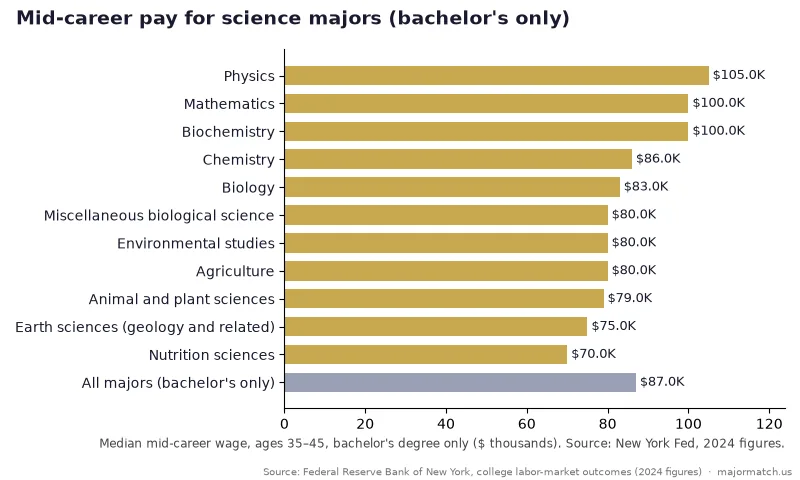
If you rank science majors by mid-career pay for people who did not add a graduate degree, the New York Fed data lines up like this:
| Major | Early-career median (ages 22–27) | Mid-career median (ages 35–45) | Unemployment | Underemployment | Share with a graduate degree |
|---|---|---|---|---|---|
| Physics | $67,000 | $105,000 | 6.6% | 29.1% | 67.3% |
| Mathematics | $70,000 | $100,000 | 5.8% | 26.2% | 51.3% |
| Biochemistry | $52,000 | $100,000 | 2.7% | 42.0% | 71.9% |
| Chemistry | $50,000 | $86,000 | 4.3% | 42.8% | 67.5% |
| Biology | $45,000 | $83,000 | 4.3% | 51.1% | 64.0% |
| Miscellaneous biological science | $46,000 | $80,000 | 4.4% | 46.9% | 59.5% |
| Environmental studies | $50,000 | $80,000 | 6.3% | 50.5% | 31.9% |
| Agriculture | $56,000 | $80,000 | 1.4% | 57.1% | 22.5% |
| Animal and plant sciences | $46,600 | $79,000 | 2.5% | 53.5% | 36.6% |
| Earth sciences (geology and related) | $50,000 | $75,000 | 3.8% | 31.4% | 45.6% |
| Nutrition sciences | $50,000 | $70,000 | 4.5% | 48.3% | 50.6% |
| All majors | $58,000 | $87,000 | 4.2% | 39.4% | 39.3% |
A few patterns jump out. Physics and mathematics pay well early and keep paying well. Biochemistry starts closer to chemistry or biology, then climbs to a $100,000 mid-career median — the same mid-career figure as mathematics. Biology's early-career median of $45,000 is below the $58,000 figure for all majors, and 51.1% of recent biology graduates are underemployed, meaning they work in a job that typically does not require a degree. That is not a reason to avoid biology. It is a reason to treat medical school, research, or another planned next step as part of the decision, not a surprise in year four.
Environmental studies and agriculture cluster around an $80,000 mid-career median. Earth sciences (the Fed's geology-and-related grouping) comes in at $75,000 mid-career, with lower underemployment than biology. Nutrition sciences is the lowest mid-career figure in this set, at $70,000.
Unemployment among recent graduates is not dramatic in these fields — most sit near the 4.2% rate for all majors — but environmental studies (6.3%) and physics (6.6%) run higher. Underemployment is the sharper split: physics (29.1%) and mathematics (26.2%) look more like career-ready bachelor's majors; biology, environmental studies, agriculture, and animal and plant sciences are all above 50%.
These wages are for bachelor's-only workers and exclude people currently in school. They also do not tell you what a particular campus, internship, or city will pay. Use them as a comparison, then price the actual path with the Lifetime Upside Calculator and browse mid-career pay visually on the Major Earnings Continuum.
Which science jobs pay the most — and what education do they need?
Occupational medians answer a different question: what do people in this job earn, and what education do employers usually want? Figures below are May 2025 medians from the Occupational Outlook Handbook, with projected growth for 2025–35 (the outlook for all occupations is 3%).
| Occupation | Median pay (May 2025) | Projected growth, 2025–35 | Typical entry education | Common undergraduate majors |
|---|---|---|---|---|
| Physicists | $172,250 | 7% | Doctoral or professional degree | Physics, astronomy |
| Actuaries | $130,000 | 9% | Bachelor's degree | Actuarial science, mathematics, statistics |
| Biochemists and biophysicists | $127,410 | 12% | Doctoral or professional degree | Biochemistry, chemistry, biology |
| Mathematicians | $126,710 | 1% | Master's degree | Mathematics, statistics |
| Data scientists | $120,230 | 35% | Bachelor's degree | Data science, statistics, mathematics, computer science |
| Materials scientists | $117,790 | 8% | Bachelor's degree | Chemistry, materials science, physics |
| Statisticians | $105,650 | 11% | Master's degree (some bachelor's entry jobs) | Statistics, mathematics |
| Medical scientists | $103,410 | 13% | Doctoral or professional degree | Biology, biochemistry, chemistry |
| Geoscientists | $101,920 | 5% | Bachelor's degree | Earth sciences, geology, environmental science |
| Atmospheric and space scientists | $99,070 | 3% | Bachelor's degree | Atmospheric science, physics, earth sciences |
| Hydrologists | $96,600 | 2% | Bachelor's degree | Earth sciences, environmental science, chemistry |
| Chemists | $91,240 | 6% | Bachelor's degree | Chemistry, biochemistry |
| Food scientists and technologists | $88,720 | 6% | Bachelor's degree | Food science, chemistry, agriculture |
| Microbiologists | $87,990 | 6% | Bachelor's degree | Microbiology, biology, biochemistry |
| Epidemiologists | $87,220 | 19% | Master's degree | Biology, public health, statistics |
| Environmental scientists and specialists | $82,220 | 6% | Bachelor's degree | Environmental science, biology, chemistry, earth sciences |
| Zoologists and wildlife biologists | $76,780 | 4% | Bachelor's degree | Biology, zoology, environmental science |
| Forensic science technicians | $72,060 | 13% | Bachelor's degree | Forensic science, chemistry, biology |
| All occupations | $50,980 | 3% | — | — |
The highest occupational numbers are easy to misread. Physicists and biochemists sit at the top because the jobs themselves usually require a doctorate, not because every physics or biochemistry major earns that amount after four years. Medical scientists ($103,410, 13% projected growth) also typically need a Ph.D. or a medical degree. Epidemiologists ($87,220, 19% growth) typically need a master's.
The bachelor's-accessible jobs that still pay well are the ones to look at if graduate school is not the plan: actuaries at $130,000 (9% growth), data scientists at $120,230 (35% growth), materials scientists at $117,790, geoscientists at $101,920, atmospheric and space scientists at $99,070, chemists at $91,240, food scientists at $88,720, and microbiologists at $87,990. Statisticians pay well ($105,650) but typically enter with a master's; the Handbook notes that some entry jobs are open to bachelor's graduates.
Forensic science technicians ($72,060) and zoologists and wildlife biologists ($76,780) are real science careers with modest medians and, in forensics, faster-than-average growth (13%). They can be excellent fits. They are not the answer to "which science majors make the most money."
Do you need graduate school to make a science major pay off?
Often, yes — and the Fed data shows you where. Among working-age adults with at least a bachelor's in biochemistry, 71.9% later earn a graduate degree. Chemistry is 67.5%, physics 67.3%, and biology 64.0%. The figure for all majors is 39.3%. Environmental studies (31.9%) and agriculture (22.5%) are less graduate-dependent, which is one reason their bachelor's-only mid-career wages are still competitive with biology's.
Graduate school is not automatically a bad investment in these fields. It is how many biologists become medical scientists, physicians, or pharmacist-adjacent professionals, and how many chemists move into research or specialized industry roles. It is a bad surprise when a family budgets for four years and then learns the target job is a six- or eight-year path.
A practical test: if the career your teen names appears in the occupation table with "doctoral" or "master's" as typical entry education, write down the extra years and cost now. If the career is actuarial work, data science, chemistry in industry, geoscience, food science, or environmental science, a bachelor's can be the terminal degree. Confirm the licensing or exam path (actuarial exams, a geologist's state license in many states) before you treat the major as a complete plan.
Related walks for specific majors: Is a Biology Degree Worth It?, Is a Data Science Major Worth It?, Is Actuarial Science a Good Major?, Is Statistics a Good Major?, What Can You Do With a Chemistry Degree?, What Can You Do With a Physics Degree?, and Environmental Science Major Careers.
How is this different from 'highest-paying majors' or STEM overall?
The highest-paying college majors overall are still dominated by engineering, computer science, and some business and health fields. The New York Fed mid-career median for chemical engineering is $135,000, and for computer science it is $120,000, with early-career medians of $85,000 and $87,000. Those are not hidden here to sandbag science. They are covered in The Highest-Paying College Majors in 2026, Best Engineering Majors, Ranked by Pay and Jobs, and our computer science pages, and they would bury the science-only comparison if we mixed them in.
Computer science is a science in many college catalogs. If that is the question you arrived with, use those pages. This post is for families comparing biology, chemistry, physics, biochemistry, environmental science, earth sciences, mathematics, statistics, data science, and related life and physical sciences — the group behind searches like "science majors that make money."
For what officially counts as STEM, including edge cases such as psychology, nursing, and economics, see What Majors Are Considered STEM?. For a broader starting-salary view across many fields, see the College Major Salary Guide. Those pages stay as they are; this one exists so the science-only question has a direct answer.
How should a student choose among high-paying science majors?
Pay is a filter, not the decision. A physics major who dislikes long problem sets will not collect that mid-career median, and a biology major who is aiming at medical school is playing a different game than a biology major who wants to stop at a bachelor's.
A simple way to use this page:
- If quantitative work is a strength, start with physics, mathematics, statistics, data science, or actuarial science, and check early-career pay plus exam or portfolio requirements.
- If lab science is the draw, compare chemistry and biochemistry (stronger bachelor's and mid-career pay) with biology (plan the graduate or professional step explicitly).
- If fieldwork or the environment is the draw, look at geoscience, environmental science, hydrology, and atmospheric science, and weigh the bachelor's-accessible job list above.
- If health or food systems are the draw, separate the bachelor's jobs (food science, microbiology, clinical or technician roles) from the doctoral ones (medical scientist, many research biologist titles).
Then run the shortlist through real fit, not just a salary table. The free MajorMatch assessment takes about 10–20 minutes and scores ability, Holland interests, and persistence against 100 majors. The Major Earnings Continuum is a free map of majors to mid-career pay, and the loan-versus-upside calculator will show whether the extra cost of a given campus or a later graduate degree still pencils out.
Not sure which science major actually fits?
Take the free adaptive assessment (about 10 to 20 minutes) to see your top 3 major matches, scored with our own proprietary scoring method. The full Pathfinder report is $29 if you want the deeper plan.
Take the assessment →Frequently asked questions
What are the highest-paying science majors?
In the New York Fed's bachelor's-only data, physics leads this set at a $105,000 mid-career median, followed by mathematics and biochemistry at $100,000. Chemistry ($86,000) and biology ($83,000) follow. Occupational medians for physicists and biochemists are higher because those jobs typically need a doctorate.
What science majors make the most money without graduate school?
Physics and mathematics have the strongest bachelor's-only mid-career pay in the Fed data. On the job side, actuarial work ($130,000), data science ($120,230), materials science ($117,790), geoscience ($101,920), and chemistry ($91,240) are bachelor's-accessible occupations in the May 2025 BLS figures.
Is biology a bad major for pay?
Not if the plan includes a graduate or professional degree — 64% of biology graduates later earn one, and many move into medicine or research. With a bachelor's only, biology's early-career median is $45,000 and underemployment is 51.1%, so the bachelor's-only path needs a specific job target.
Does computer science count as a science major?
Often yes in college catalogs, and it pays more than most of the majors on this page (New York Fed: $87,000 early career, $120,000 mid-career). It is covered in our computer science guides so this page can compare natural, physical, life, and quantitative sciences fairly.
Where do these salary numbers come from?
Major-level wages are from the Federal Reserve Bank of New York's college labor-market outcomes (2024 figures, released February 4, 2026), for full-time workers with a bachelor's degree only. Occupational pay and outlook are from the U.S. Bureau of Labor Statistics Occupational Outlook Handbook and Employment Projections (May 2025 pay, 2025–35 outlook).
How do I tell if a high-paying science major actually fits my teen?
Use pay to narrow the list, then check aptitude and interest. A ~10–20 minute adaptive assessment will return a free top 3 major matches. Pair that with the Major Earnings Continuum and the loan-versus-upside calculator before you treat any median as a promise.
Sources
- Federal Reserve Bank of New York, The Labor Market for Recent College Graduates — Outcomes by Major (2024 figures, released February 4, 2026)
- U.S. Bureau of Labor Statistics, Employment Projections, occupational projections and characteristics (2025–35), May 2025 wages
- BLS Occupational Outlook Handbook: Physicists and Astronomers
- BLS Occupational Outlook Handbook: Data Scientists
- BLS Occupational Outlook Handbook: Actuaries
- BLS Occupational Outlook Handbook: Biochemists and Biophysicists
- BLS Occupational Outlook Handbook: Chemists and Materials Scientists
- BLS Occupational Outlook Handbook: Mathematicians and Statisticians
- BLS Occupational Outlook Handbook: Geoscientists
- BLS Occupational Outlook Handbook: Medical Scientists
- BLS Occupational Outlook Handbook: Environmental Scientists and Specialists
- BLS Occupational Outlook Handbook: Microbiologists
- BLS Occupational Outlook Handbook: Agricultural and Food Scientists
- BLS Occupational Outlook Handbook: Epidemiologists
- BLS Occupational Outlook Handbook: Forensic Science Technicians