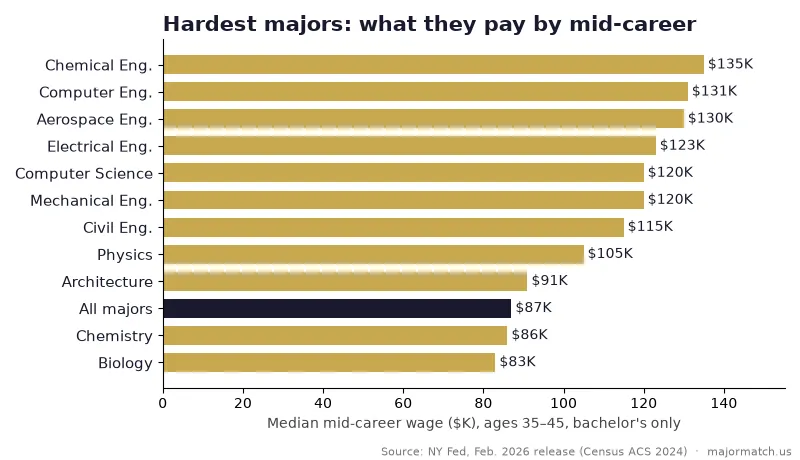
Quick answer: The hardest majors that pay off most are chemical engineering ($135,000 median mid-career pay), computer engineering ($131,000), aerospace engineering ($130,000), electrical engineering ($123,000), and computer science and mechanical engineering ($120,000 each), based on the New York Fed's 2026 release of Census Bureau American Community Survey data. All of them start between $80,000 and $90,000, well above the $58,000 median for all majors. Three hard majors don't pay a premium on a bachelor's alone: chemistry ($86,000 mid-career), biology ($83,000) and nursing ($87,000, though nursing has the lowest underemployment of any major on the list).
Our hardest college majors ranking is the most-read thing we've published. And the question families ask right after reading it is always the same one: okay, but is all that suffering actually worth it?
It's a fair question. Nobody signs up for 20-plus hours of homework a week, organic chemistry or a studio all-nighter because they enjoy pain. They do it because somebody told them it pays. So we checked. We took every major from that ranking and lined it up against what its graduates earn at two points in life: ages 22 to 27, and ages 35 to 45. Then we looked at the jobs those degrees actually feed and what the Labor Department says those jobs pay.
The short version: most hard majors really do pay off. A few don't, at least not on a bachelor's degree alone. And the difference between them isn't how hard they are. It's whether the degree leads straight into a job that needs it.
How did we measure whether a hard major pays off?
We started with the 15 majors in our difficulty ranking and pulled three kinds of government data for each one:
- What graduates earn. Median early-career (ages 22–27) and mid-career (ages 35–45) wages for full-time workers with only a bachelor's degree, from the New York Fed's Labor Market for Recent College Graduates (Feb. 4, 2026 release). Those numbers come from the U.S. Census Bureau's 2024 American Community Survey.
- Whether graduates land degree-level jobs. The same release reports unemployment and underemployment (the share of recent grads working jobs that don't typically need a degree), plus the share who go on to a graduate degree.
- What the destination job pays. The national median annual wage for the most common occupation each major feeds, from the BLS Occupational Employment and Wage Statistics survey (May 2024 national estimates).
Our yardstick for "pays off" is simple: does the major beat the all-majors median of $58,000 early and $87,000 at mid-career? Biomedical engineering isn't broken out separately in the New York Fed table, so for that one we used the U.S. Department of Education's College Scorecard instead. We didn't invent any figure, estimate any GPA or survey anyone ourselves.
Do the hardest majors have the highest salaries?
| Major (difficulty rank) | Early-Career Median | Mid-Career Median | Unemployment | Underemployment | Typical Job: BLS Median Pay |
|---|---|---|---|---|---|
| Chemical Engineering (#2) | $85,000 | $135,000 | 4.7% | 17.9% | Chemical engineers: $121,860 |
| Computer Engineering (#11) | $90,000 | $131,000 | 7.8% | 15.8% | Computer hardware engineers: $155,020 |
| Aerospace Engineering (#3) | $85,000 | $130,000 | 2.2% | 14.7% | Aerospace engineers: $134,830 |
| Electrical Engineering (#4) | $82,000 | $123,000 | 3.2% | 21.1% | Electrical engineers: $111,910 |
| Computer Science (#14) | $87,000 | $120,000 | 7.0% | 19.1% | Software developers: $133,080 |
| Mechanical Engineering (#7) | $80,000 | $120,000 | 4.4% | 20.1% | Mechanical engineers: $102,320 |
| Civil Engineering (#13) | $75,000 | $115,000 | 2.3% | 15.6% | Civil engineers: $99,590 |
| Physics (#6) | $67,000 | $105,000 | 6.6% | 29.1% | Physicists (most hold a PhD): $166,290 |
| Mathematics (#12) | $70,000 | $100,000 | 5.8% | 26.2% | Statisticians: $103,300 |
| Biochemistry (#15) | $52,000 | $100,000 | 2.7% | 42.0% | Biochemists (most hold a PhD): $103,650 |
| Architecture (#1) | $60,000 | $91,000 | 6.8% | 25.7% | Architects (license required): $96,690 |
| Nursing (BSN) (#8) | $70,000 | $87,000 | 2.1% | 12.8% | Registered nurses: $93,600 |
| Chemistry (#9) | $50,000 | $86,000 | 4.3% | 42.8% | Chemists: $84,150 |
| Biology (#10, cell & molecular) | $45,000 | $83,000 | 4.3% | 51.1% | Medical scientists (often PhD/MD): $100,590 |
| Biomedical Engineering (#5) | $64,900* | $94,100* | — | — | Bioengineers: $106,950 |
| All majors (for comparison) | $58,000 | $87,000 | 4.2% | 39.4% | All occupations: $49,500 |
Sources: Federal Reserve Bank of New York, The Labor Market for Recent College Graduates, Outcomes by Major (Feb. 4, 2026 release; U.S. Census Bureau 2024 American Community Survey via IPUMS). Wages are medians for full-time workers with a bachelor's degree only; unemployment and underemployment are for grads aged 22–27. Occupation pay: U.S. Bureau of Labor Statistics, Occupational Employment and Wage Statistics, May 2024 national medians. Cell and molecular biology uses the New York Fed's Biology category. *Biomedical engineering isn't broken out by the New York Fed; figures are College Scorecard median earnings 1 and 4 years after graduation (June 2026 field-of-study file), so they aren't directly comparable.
Click any major in the table to open its free loan-vs-upside calculator, or compare debt and lifetime earnings with your own numbers in the degree loan vs. upside calculator. Then take the assessment to see which of these majors actually fit your teen.
Which of the hardest majors actually pay off?
Sorted by what the data says, not by how hard each major feels. Click any major in the table to run it through our loan-vs-upside calculator with your own costs.
Pays off from day one: the engineering and computing majors
Chemical, computer, aerospace, electrical, mechanical and civil engineering, plus computer science, all start between $75,000 and $90,000 and reach $115,000 to $135,000 by mid-career. That's $17,000 to $32,000 above the all-majors median in year one, and $28,000 to $48,000 above it later. Underemployment sits between 15% and 21%, roughly half the all-majors rate of 39.4%. The degree points straight at a job that requires it, and employers pay for that. Biomedical engineering belongs in this group too: College Scorecard shows bachelor's grads at about $94,100 four years out.
The asterisk on computing: unemployment
Computer engineering (7.8%) and computer science (7.0%) have the highest recent-grad unemployment rates on this list, higher than the 4.2% all-majors rate. The pay is excellent once you're hired. Getting hired has been bumpier lately, so internships matter more than they used to. Our computer science careers guide covers the paths that are still hiring.
Pays off later, with a plan: physics, math and biochemistry
These three reach $100,000 to $105,000 by mid-career, but they start lower ($52,000 to $70,000) and a big share of grads go on to graduate school: 67% in physics and 72% in biochemistry. They pay off for students who either go further in school or aim early at an applied path like data, finance or engineering. Our physics degree jobs guide and math degree careers guide show those routes.
Pays off in security more than salary: nursing
Nursing's mid-career median ($87,000) matches the average degree exactly, so on paper it's no premium. But look at the rest of the row: $70,000 to start, 2.1% unemployment and the lowest underemployment on this entire list at 12.8%. Nursing grads almost all work as nurses. And registered nurses earn a national median of $93,600, with advanced practice roles paying far more. Our nursing degree careers guide walks through them.
Pays off slowly: architecture
Architecture is #1 on our difficulty list and pays the least of the design-and-engineering group: $60,000 early, $91,000 mid-career, with 6.8% unemployment. Becoming a licensed architect also takes supervised work experience and a set of licensing exams after the degree. It pays off for students who love the work. It's a rough deal for students who picked it because it sounded prestigious.
Doesn't pay a premium on a bachelor's alone: chemistry and biology
Both are hard, both are great preparation for medicine, research and pharmacy, and neither beats the average degree at mid-career on a bachelor's alone (chemistry $86,000, biology $83,000). Underemployment is high: 42.8% for chemistry and 51.1% for biology. These majors pay off when they're a step toward something specific, like medical school, a PhD, or a lab or quality-control career you've already lined up internships for.
Is architecture the hardest major, and does it pay off?
By our composite of GPA, study hours and completion rates, yes, architecture ranks as the hardest major. Studio courses run on deadlines, not class hours, and the all-nighter is part of the culture. (We break down the hours in the full difficulty ranking.)
Whether it pays off depends on what you count. The pay is good, not great: $91,000 at mid-career is about 5% above the all-majors median, and the national median for licensed architects is $96,690. In College Scorecard data, architecture grads also carry the most federal debt of any hard major, a median of about $26,400. That combination makes architecture the hard major where fit matters most. A student who lights up in a design studio will likely find the pay fine. A student who's grinding through it for status will probably regret it. Our architecture degree careers guide shows the adjacent paths, like construction management and urban planning, that use the same skills.
Which of these majors fits your teen?
Take the free adaptive assessment (about 15–25 minutes) to see your top 3 major matches, scored with our own proprietary scoring method. The full Pathfinder report is $29 if you want the deeper plan.
Take the Free Assessment →Which hard majors aren't worth it on pay alone?
"Not worth it" is too strong for any major on this list. But if the only reason your teen is choosing a hard major is the paycheck, three of them don't deliver that on a bachelor's alone:
- Biology: $83,000 mid-career and 51.1% underemployment. Biology is a superb pre-med or pre-health major. As a standalone job credential, it's weaker than its reputation.
- Chemistry: $86,000 mid-career and 42.8% underemployment, with 67.5% of grads earning a graduate degree. Chemistry pays when it leads to pharmacy, medicine, a PhD or a specific industry role.
- Nursing: No mid-career premium ($87,000), but this is the one we'd never call a bad bet. It has the lowest underemployment of any major here and near-certain employment.
For the easier side of this question (majors that pay well without the grind), see our easiest college majors that pay well ranking. And if debt is the worry, our companion on the hardest majors with the lowest debt-to-earnings runs the loan math for all 15.
What happens if you start a hard major and switch out?
This is the hidden cost nobody puts in a salary table. Switching from engineering to business in your second year is common and often smart. Switching in your junior year can add semesters, and every semester is more tuition and a later start to earning. Our breakdown of the real cost of switching majors puts numbers on it.
The way to avoid it isn't to dodge hard majors. It's to test fit before you commit. That means taking the intro sequence seriously in the first semester, talking to people who actually work in the field, and checking whether the way your teen thinks matches the work.
How do you know if a hard major will pay off for your teen?
Start with fit, then check the money. Our free assessment scores your teen's strengths and interests against 100 majors using our own proprietary scoring method, so you can see whether an engineering or science major is a natural match or a long shot. Take the top three it suggests, open each one in the Major Earnings Continuum to see the careers and mid-career pay it leads to, then run your real school costs through the degree loan vs. upside calculator.
A hard major your teen fits is one of the best financial decisions a family can make. A hard major they don't fit is one of the most expensive ways to end up in a different major anyway.
Frequently asked questions
What are the hardest majors in college that pay well?
Chemical engineering ($135,000 median mid-career pay), computer engineering ($131,000), aerospace engineering ($130,000), electrical engineering ($123,000), computer science ($120,000) and mechanical engineering ($120,000) are both among the hardest majors and the best-paying, according to New York Fed 2026 data from the Census Bureau's American Community Survey.
Is architecture the hardest major?
In our ranking, yes. Architecture ranks #1 by our composite of GPA, weekly study hours and completion rates. It pays less than engineering, though: $60,000 early-career and $91,000 at mid-career (New York Fed, 2026 release).
Do the hardest majors have the highest salaries?
Mostly. Ten of the 15 hardest majors have mid-career medians of $100,000 or more, versus $87,000 for all majors. The exceptions are architecture ($91,000), nursing ($87,000), chemistry ($86,000) and biology ($83,000).
Is a hard major worth it if you might switch out?
Only if you finish. The salary premium goes to graduates. Research on students who leave STEM found 35% of switchers said weed-out courses directly shaped their decision, so testing fit early is the best protection.
Which hard major has the best job security?
Nursing. Recent nursing grads have 2.1% unemployment and only 12.8% underemployment, the lowest of any major on our list, per the New York Fed's 2026 release.
Which hard majors need grad school to pay off?
Physics, biochemistry and chemistry. Between 67% and 72% of graduates in those fields earn a graduate degree, and the jobs most associated with them (physicist, biochemist) usually require a PhD.
What's the hardest major that pays the most?
Chemical engineering. It's #2 on our difficulty ranking and has the highest mid-career median of any major in the New York Fed data we used: $135,000.
Where does this salary data come from?
Major-level pay is from the New York Fed's Feb. 2026 release, built on 2024 Census Bureau American Community Survey data. Job-level pay is from the Bureau of Labor Statistics' May 2024 Occupational Employment and Wage Statistics.
Sources
- Federal Reserve Bank of New York, The Labor Market for Recent College Graduates: Outcomes by Major (Feb. 4, 2026 release, 2024 ACS data)
- U.S. Bureau of Labor Statistics, Occupational Employment and Wage Statistics, May 2024 national estimates
- U.S. Department of Education, College Scorecard, Most Recent Cohorts Field of Study data (file dated June 10, 2026)
- The New York Times, Surviving Weed-Out Classes in Science May Be a State of Mind (Nov. 16, 2020)
- Weston, Seymour, Koch & Drake, Weed-Out Classes and Their Consequences, in Talking About Leaving Revisited (Springer, 2019)
- Brookings Institution, Who's getting pulled in weed-out courses for STEM majors?