Quick answer
Most biomedical engineering grads start at medical-device companies, designing, testing or getting products cleared, or they take a broader mechanical or manufacturing engineering job. BLS puts the median bioengineer at $109,370 (May 2025). The catch: the job title is small, about 23,800 positions nationwide, so internships matter more here than in most engineering majors.
Key takeaway: biomedical engineers earned a $109,370 median in May 2025, but with only about 23,800 jobs under that title, most graduates start in device quality, regulatory or general engineering roles.
Biomedical engineering sits where a machine shop meets a hospital. Students learn to build things that go inside or alongside a human body: pacemaker leads, knee implants, catheters, imaging software, the plastic housing of an insulin pump. It draws teenagers who were good at calculus and couldn't stop asking how the heart actually works.
It also confuses parents, and for a fair reason. A mechanical engineering degree points at a job called mechanical engineer, and there are about 298,500 of those. Biomedical engineering points at a job title BLS counts at about 23,800. So the real question isn't whether the degree is good. It's what the other eight doors look like. That's what this guide is for.
What Jobs Can You Get With a Biomedical Engineering Degree?
These are the jobs BME graduates are hired into straight out of a bachelor's program. Pay is the national median from the Bureau of Labor Statistics (BLS), May 2025: half of workers earn more, half earn less.
1. Biomedical engineer (R&D or design)
This is the job most students picture. You sit on a team that designs a device, builds prototypes, breaks them on a test bench and fixes what failed. The BLS median is $109,370, and the top 10% earn more than $168,180. The biggest employers are research and development firms, medical equipment makers and hospitals.
2. Quality engineer
Every device has to prove it was made the same way, every time. Quality engineers write the test plans, chase down why one batch failed, and sign the paperwork that lets product ship. It is less glamorous than design and much easier to get hired into, which is why so many BME grads start here.
3. Regulatory affairs specialist
Someone has to convince the U.S. Food and Drug Administration that a new device is safe. Regulatory specialists assemble that case. Engineers who like writing, logic and rules tend to love it, and the skill travels well between companies.
4. Mechanical or manufacturing engineer
Plenty of BME grads take a general engineering job, often at the same device companies. Mechanical engineers earn a median $104,110, and BLS projects 11% growth through 2035, much faster than average.
5. Sales engineer or clinical specialist
These people stand in operating rooms and teach surgeons how to use a new device, or explain it to the hospital that's buying it. BLS lists sales engineers at a median of $124,900. Commission and travel come with it.
6. Clinical engineer (hospital)
Hospitals employ engineers to keep imaging machines, infusion pumps and monitors safe and working, and to help choose new equipment. The pace is real-world and the patients are down the hall.
Which Biomedical Engineering Careers Need More School?
A good share of BME students plan on graduate or professional school from the start. These paths pay well, but they add years.
7. Medical scientist or research engineer
Leading original research usually takes a Ph.D. BLS lists medical scientists at a median of $103,410. The appeal isn't the pay so much as getting to chase your own questions.
8. Physician
BME is a respected pre-med major because it covers physics, chemistry and biology and proves you can handle a heavy load. The risk is GPA. Medical schools weigh grades heavily, and engineering curves are not gentle. BLS lists the median physician at $275,930, after a decade of training. Our pre-med majors guide compares the options.
9. Engineering manager or patent attorney
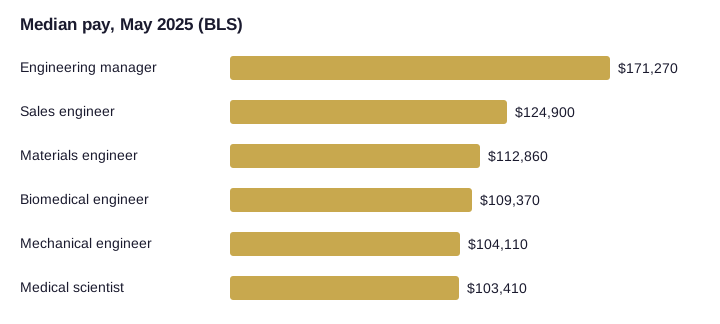
With experience, many engineers move into management. BLS puts architectural and engineering managers at a median of $171,270. Others add a law degree and work on medical-device patents, a niche where an engineering background is close to required.
What Does a Biomedical Engineering Career Actually Look Like?
The clearest picture we found comes from three Texas A&M biomedical engineering alumni profiled by the university's engineering news office in January 2025. All three went to work at Shape Memory Medical, a California device company built on technology from a Texas A&M lab.
Kristen Duckworth started there as a project engineer, moved to quality engineering, and now works in regulatory affairs, keeping government approvals in place for the company's products. She doesn't design devices anymore, and she's fine with that. "Having a background in physiology and engineering allows for a deeper grasp of how our products function," she told the university. She also admitted she didn't have a plan going in: "I didn't know the answers. I didn't have this perfect vision. I just knew I wanted to work in medical devices."
Landon Nash began on a pre-med track and is now the company's director of R&D and strategic partnerships. "I chose biomedical engineering because I wanted to help people, and even though I didn't go into medicine, I still contribute to patient care by developing tools that clinicians use," he said.
That is the honest shape of this degree. One person, three jobs (project, quality, regulatory) inside one company. Another who meant to be a doctor and found the same satisfaction building tools for doctors. Full profile: Texas A&M Engineering, “Shaping the future of aneurysms”.
How Much Do Biomedical Engineering Majors Make?
| Career | Median pay (May 2025) | Top 10% earn more than | Projected growth, 2025–35 | Typical entry education |
|---|---|---|---|---|
| Engineering manager | $171,270 | — | — | Bachelor's + experience |
| Sales engineer | $124,900 | — | — | Bachelor's |
| Materials engineer | $112,860 | — | — | Bachelor's |
| Bioengineer / biomedical engineer | $109,370 | $168,180 | 8% | Bachelor's |
| Mechanical engineer | $104,110 | $164,340 | 11% | Bachelor's |
| Medical scientist | $103,410 | — | — | Ph.D. or M.D. |
Source: U.S. Bureau of Labor Statistics, Occupational Outlook Handbook (updated Aug. 27, 2026): May 2025 median pay and 2025–35 employment projections. Click any occupation for the BLS page. A dash means the figure is not shown in that BLS summary. Pay varies by state, employer and experience.
What Do Biomedical Engineering Majors Study?
The first two years look like any engineering program: calculus through differential equations, physics, chemistry, statics, circuits and programming. Then the biology arrives. Expect physiology, biomechanics, biomaterials, instrumentation, signals and imaging, and a senior design project, often built for a real clinician.
Two things to check when comparing schools. First, ABET accreditation, which matters if your student ever wants a professional engineering license. Second, co-op and internship placement with device companies. A BME graduate with two summers at a device maker is a different job candidate from one with none.
Is Biomedical Engineering a Good Major?
By the money, yes. Our Biomedical Engineering Loan vs Upside calculator starts from Continuum wages of about $92,000 early in a career and $139,000 at mid-career. At its default $50,000 loan (6.5% for 10 years), total repayment is about $68,129. The estimated lifetime earnings gain over a high-school-only path is about $2,399,184, roughly 35.2 times the loan cost. That's an illustration, not a promise, and every input can be changed.
The real tradeoff is focus. BLS projects about 1,200 openings a year for bioengineers and biomedical engineers, versus about 17,800 for mechanical engineers. A student who wants the widest set of options at 22 sometimes majors in mechanical or electrical engineering and adds biomedical electives. A student who already lights up around medicine usually does better in the BME program, where the projects keep them going.
How Will AI Affect Biomedical Engineering Careers?
MajorMatch's AI task-exposure estimate for biomedical engineers is 56%. That number measures how many of the job's tasks AI tools could speed up, not how many jobs disappear. Report writing, literature searches and early design iterations are the most exposed. Bench testing, working with clinicians and owning a device through FDA review are far less so, because somebody has to put their name on the result. Compare majors in our AI-proof majors guide.
Is Biomedical Engineering the Right Major for Your Teen?
It fits the student who enjoys hard math and still wants the work to touch a person. If your teen cares more about the engineering than the biology, look at mechanical engineering. If they mostly want to be a doctor, read our pre-med guide before choosing a major with a brutal GPA curve.
Not sure which of those describes your kid? Take the assessment. It uses our own proprietary scoring method to compare your student's strengths and interests with all 100 majors, including biomedical engineering, and shows the top 3 free.
More Questions Parents Ask
Is biomedical engineering a good major for med school?
It can be: BME covers many pre-med prerequisites and stands out on an application. The risk is GPA, since medical schools weigh grades heavily and engineering courses are graded hard.
Is biomedical engineering a good major for PA or dental school?
Yes, if your student keeps a strong GPA and checks each program's prerequisites, because BME covers most of the science. Biology or health science majors reach the same schools with an easier course load.
How long is a biomedical engineering degree?
A bachelor's in biomedical engineering usually takes four years. Research jobs often add a two-year master's or a five-to-six-year Ph.D.
How hard is a biomedical engineering major?
It's one of the harder majors, with calculus through differential equations, physics, chemistry and engineering design all stacked together. Students who enjoy both math and biology handle it best.
Frequently Asked Questions
What jobs can you get with a biomedical engineering degree?
Common first jobs are design or R&D engineer at a medical-device company, quality engineer, regulatory affairs specialist, manufacturing or mechanical engineer, sales engineer and hospital clinical engineer. With more school, medical scientist, physician and patent attorney are common.
How much do biomedical engineers make?
BLS reports a median of $109,370 for bioengineers and biomedical engineers in May 2025. The top 10% earned more than $168,180.
Is it hard to get a job with a biomedical engineering degree?
It can be harder than in larger engineering fields because BLS counts only about 23,800 bioengineer jobs. Internships and co-ops at device companies make a big difference, and many graduates work in related engineering roles.
Is biomedical engineering good for pre-med?
It covers many prerequisites and stands out, but it is demanding. Medical schools weigh GPA heavily, so pick a major your student can do well in.
Do biomedical engineers need a master's degree?
Not for most entry-level device jobs. Research leadership roles usually need a master's or Ph.D.