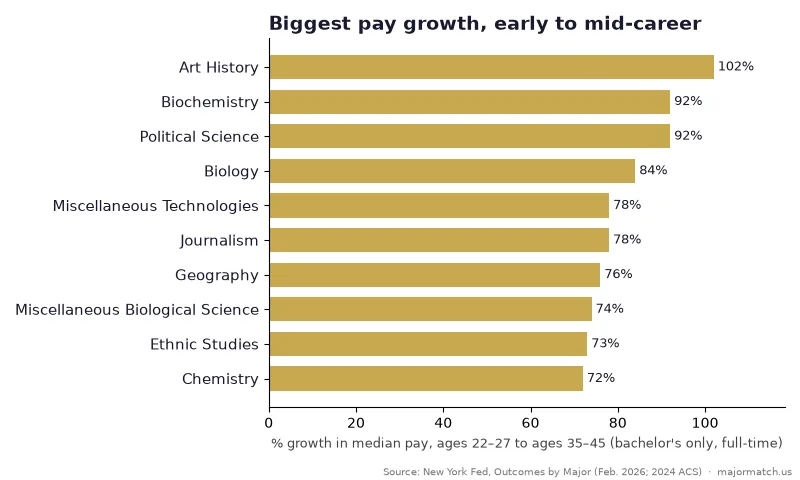
Quick answer: The majors with the biggest pay growth from early career (ages 22–27) to mid-career (35–45) are art history ($45,000 to $91,000, +102%), biochemistry ($52,000 to $100,000, +92%), political science ($52,000 to $100,000, +92%) and biology ($45,000 to $83,000, +84%), based on New York Fed data for bachelor's-only workers. The slowest growth is in education majors, industrial engineering (+20%) and nursing (+24%). The all-majors median grows 50%, from $58,000 to $87,000.
Picture two eighteen-year-olds picking majors. One goes into nursing and starts near $70,000. The other picks political science and starts closer to $50,000. At the graduation party, the nursing grad looks like the obvious winner. Fifteen years later? In the New York Fed's data, the political science grad's typical paycheck has passed the nurse's.
That's the story starting-salary lists can't tell you. Some majors open strong and level off. Others start slow and keep climbing. The New York Fed publishes both numbers for 73 majors, the median pay of bachelor's holders in their 20s and in their late 30s and early 40s, which makes it possible to rank majors by how much their pay grows.
So that's what we did. Below is every major ranked by early-to-mid-career pay growth, plus the majors that add the most actual dollars, and the ones that flatten out.
What is mid-career salary by major, and how did we rank growth?
All figures come from the New York Fed's Labor Market for Recent College Graduates outcomes-by-major table, released February 4, 2026, using 2024 American Community Survey data. Early-career means full-time workers aged 22 to 27. Mid-career means full-time workers aged 35 to 45. Both groups have a bachelor's degree only, so people with a master's, law degree or M.D. are not in these numbers.
Our growth figure is simple: mid-career median divided by early-career median, minus one. Ties go to the higher mid-career pay. We didn't adjust anything.
Two honest caveats. First, this is a snapshot of two age groups in the same year, not the same people tracked over time. Today's 40-year-olds started their careers in a different economy than today's 24-year-olds. Second, we left pharmacy out of the ranking. Its bachelor's-only early-career median is just $40,000, because practicing pharmacists need a Pharm.D. and drop out of a "bachelor's only" count. Its +112% growth would top the list, but it wouldn't mean what the rest of the list means.
Which majors have the biggest salary growth?
| Rank | Major | Early-career (22–27) | Mid-career (35–45) | Growth | Dollar jump |
|---|---|---|---|---|---|
| 1 | Art History | $45,000 | $91,000 | +102% | +$46,000 |
| 2 | Biochemistry | $52,000 | $100,000 | +92% | +$48,000 |
| 3 | Political Science | $52,000 | $100,000 | +92% | +$48,000 |
| 4 | Biology | $45,000 | $83,000 | +84% | +$38,000 |
| 5 | Miscellaneous Technologies | $54,000 | $96,000 | +78% | +$42,000 |
| 6 | Journalism | $49,000 | $87,000 | +78% | +$38,000 |
| 7 | Geography | $50,000 | $88,000 | +76% | +$38,000 |
| 8 | Miscellaneous Biological Science | $46,000 | $80,000 | +74% | +$34,000 |
| 9 | Ethnic Studies | $52,000 | $90,000 | +73% | +$38,000 |
| 10 | Chemistry | $50,000 | $86,000 | +72% | +$36,000 |
| 11 | Performing Arts | $44,000 | $75,000 | +70% | +$31,000 |
| 12 | Animal and Plant Sciences | $46,600 | $79,000 | +70% | +$32,400 |
| 13 | Communications | $52,000 | $88,000 | +69% | +$36,000 |
| 14 | History | $47,500 | $80,000 | +68% | +$32,500 |
| 15 | Marketing | $60,000 | $100,000 | +67% | +$40,000 |
| 16 | Liberal Arts | $45,000 | $75,000 | +67% | +$30,000 |
| 17 | Leisure and Hospitality | $45,000 | $75,000 | +67% | +$30,000 |
| 18 | General Social Sciences | $45,200 | $75,000 | +66% | +$29,800 |
| 19 | Foreign Language | $48,000 | $77,000 | +60% | +$29,000 |
| 20 | Construction Services | $75,000 | $120,000 | +60% | +$45,000 |
| — | All majors | $58,000 | $87,000 | +50% | +$29,000 |
Source: Federal Reserve Bank of New York, The Labor Market for Recent College Graduates, Outcomes by Major (released Feb. 4, 2026; 2024 American Community Survey via IPUMS). Median annual wages for full-time workers with a bachelor's degree only. Growth = mid-career median ÷ early-career median − 1. Pharmacy excluded (see method).
Tap any major in the table to open its free loan-vs-upside calculator, or compare debt and lifetime earnings with your own numbers in the degree loan vs. upside calculator. Then take the assessment to see which of these majors actually fit your teen.
What do the fast-growth majors have in common?
Most of the top 20 start below the all-majors median and then pass it. A few notes on what's driving the climb.
Political science: slow start, six-figure middle
Political science starts at $52,000, below the $58,000 all-majors median, then reaches $100,000, well above the $87,000 all-majors mid-career median. It's a classic "pays off later" major. Run the numbers in the political science calculator.
Art history: the biggest surprise
Art history grows +102%, from $45,000 to $91,000. Treat any single major's number with care, but it shows how far some liberal arts grads travel once they find their lane.
Biology and biochemistry: the bachelor's-only path
Biochemistry (+92%) and biology (+84%) look like rockets. Remember these are bachelor's-only workers. A big share of these grads go on to grad school (72% of working-age biochemistry grads and 64% of biology grads hold a graduate degree), so the people left in this count are a smaller, different group than the major as a whole.
Marketing and finance: high start, still climbing
Not every fast grower starts low. Marketing goes from $60,000 to $100,000 (+67%) and finance from $70,000 to $112,000 (+60%). These fields start high and still keep climbing.
Which majors add the most dollars by mid-career?
Percentages flatter small starting salaries. If you'd rather see the raw raise, here are the 10 biggest dollar jumps. Engineering and the quantitative business fields come back to the top.
| Rank | Major | Early-career | Mid-career | Dollar jump |
|---|---|---|---|---|
| 1 | Chemical Engineering | $85,000 | $135,000 | +$50,000 |
| 2 | Biochemistry | $52,000 | $100,000 | +$48,000 |
| 3 | Political Science | $52,000 | $100,000 | +$48,000 |
| 4 | Art History | $45,000 | $91,000 | +$46,000 |
| 5 | Aerospace Engineering | $85,000 | $130,000 | +$45,000 |
| 6 | Construction Services | $75,000 | $120,000 | +$45,000 |
| 7 | Economics | $72,000 | $115,000 | +$43,000 |
| 8 | Finance | $70,000 | $112,000 | +$42,000 |
| 9 | Miscellaneous Technologies | $54,000 | $96,000 | +$42,000 |
| 10 | Computer Engineering | $90,000 | $131,000 | +$41,000 |
Which of these majors fits your teen?
Take the free adaptive assessment (about 15–25 minutes) to see your top 3 major matches, scored with our own proprietary scoring method. The full Pathfinder report is $29 if you want the deeper plan.
Take the assessment →Which majors start strong but grow slowly?
At the other end, a handful of majors barely move between their 20s and 40s:
| Major | Early-career | Mid-career | Growth |
|---|---|---|---|
| Early Childhood Education | $45,000 | $52,000 | +16% |
| Industrial Engineering | $83,000 | $100,000 | +20% |
| Special Education | $46,000 | $56,000 | +22% |
| Elementary Education | $45,000 | $55,000 | +22% |
| Nursing | $70,000 | $87,000 | +24% |
| General Education | $45,000 | $56,000 | +24% |
| Miscellaneous Education | $48,000 | $60,000 | +25% |
| Medical Technicians | $62,000 | $80,000 | +29% |
Five of the eight are education majors. Public school teachers are usually paid on district salary schedules, where raises come in fixed steps and bigger jumps come from extra credentials or moving into administration. The New York Fed's economists also note that education majors' annual pay typically reflects a nine-month school year, which keeps those totals lower.
Nursing is the useful lesson. It has the lowest underemployment of any major in the same table, and it starts at $70,000. Slow growth from a strong start isn't a bad deal. It's a different deal: security early, fewer big jumps later. Our ranking of majors by underemployment shows that side of the trade.
Does grad school explain the big jumps?
Not directly, because grad-degree holders are excluded from both pay numbers. But it does shape who's left. Majors where most people eventually go to grad school (biochemistry, biology, chemistry, physics) leave a smaller, different group in the bachelor's-only count. That's one reason those majors can show steep growth.
If your teen is heading toward a career that requires grad school, the better question isn't this ranking. It's what the full path costs and pays. Our master's degree ROI guide and the loan vs. lifetime upside calculator can help.
Do men and women see the same salary growth?
No, and the gap shows up exactly in this early-to-mid-career window. Using the same kind of data, New York Fed economists found (using 2009–2013 data) that recent women grads earned about 97 cents on the dollar compared with men in the same major and job, and actually out-earned men in several majors. By ages 35 to 45, men earned about 15% more. In social services, a 16% female wage premium among recent grads turned into a 10% male premium at mid-career.
So when you read a growth number, know that it's an average across very different career paths, including career breaks.
Should you pick a major for its salary growth?
Use it as a tiebreaker, not a compass. Growth tells you which majors reward patience, but a fast-growth major only pays off if your kid sticks with it long enough to get there. A major that fits is the one they'll finish, and finishing is what unlocks the mid-career number.
That's the gap we built the free assessment to close: it uses our own proprietary scoring method to match interests and strengths to majors, so the data in this table is about their shortlist, not someone else's.
Full list: every major ranked by salary growth
Show all 72 ranked majors
| Rank | Major | Early-career | Mid-career | Growth |
|---|---|---|---|---|
| 1 | Art History | $45,000 | $91,000 | +102% |
| 2 | Biochemistry | $52,000 | $100,000 | +92% |
| 3 | Political Science | $52,000 | $100,000 | +92% |
| 4 | Biology | $45,000 | $83,000 | +84% |
| 5 | Miscellaneous Technologies | $54,000 | $96,000 | +78% |
| 6 | Journalism | $49,000 | $87,000 | +78% |
| 7 | Geography | $50,000 | $88,000 | +76% |
| 8 | Miscellaneous Biological Science | $46,000 | $80,000 | +74% |
| 9 | Ethnic Studies | $52,000 | $90,000 | +73% |
| 10 | Chemistry | $50,000 | $86,000 | +72% |
| 11 | Performing Arts | $44,000 | $75,000 | +70% |
| 12 | Animal and Plant Sciences | $46,600 | $79,000 | +70% |
| 13 | Communications | $52,000 | $88,000 | +69% |
| 14 | History | $47,500 | $80,000 | +68% |
| 15 | Marketing | $60,000 | $100,000 | +67% |
| 16 | Liberal Arts | $45,000 | $75,000 | +67% |
| 17 | Leisure and Hospitality | $45,000 | $75,000 | +67% |
| 18 | General Social Sciences | $45,200 | $75,000 | +66% |
| 19 | Foreign Language | $48,000 | $77,000 | +60% |
| 20 | Construction Services | $75,000 | $120,000 | +60% |
| 21 | Finance | $70,000 | $112,000 | +60% |
| 22 | Engineering Technologies | $65,000 | $104,000 | +60% |
| 23 | Environmental Studies | $50,000 | $80,000 | +60% |
| 24 | Mass Media | $50,000 | $80,000 | +60% |
| 25 | Criminal Justice | $50,000 | $80,000 | +60% |
| 26 | Commercial Art & Graphic Design | $50,000 | $80,000 | +60% |
| 27 | Psychology | $45,000 | $72,000 | +60% |
| 28 | Fine Arts | $45,000 | $72,000 | +60% |
| 29 | Economics | $72,000 | $115,000 | +60% |
| 30 | Chemical Engineering | $85,000 | $135,000 | +59% |
| 31 | Theology and Religion | $41,600 | $66,000 | +59% |
| 32 | English Language | $48,000 | $76,000 | +58% |
| 33 | Sociology | $49,900 | $79,000 | +58% |
| 34 | Physics | $67,000 | $105,000 | +57% |
| 35 | Interdisciplinary Studies | $52,000 | $80,000 | +54% |
| 36 | Philosophy | $52,000 | $80,000 | +54% |
| 37 | Civil Engineering | $75,000 | $115,000 | +53% |
| 38 | Advertising and Public Relations | $60,000 | $92,000 | +53% |
| 39 | Aerospace Engineering | $85,000 | $130,000 | +53% |
| 40 | Architecture | $60,000 | $91,000 | +52% |
| 41 | Business Analytics | $72,000 | $109,000 | +51% |
| 42 | Electrical Engineering | $82,000 | $123,000 | +50% |
| 43 | Mechanical Engineering | $80,000 | $120,000 | +50% |
| 44 | General Business | $60,000 | $90,000 | +50% |
| 45 | Earth Sciences | $50,000 | $75,000 | +50% |
| 46 | Information Systems & Management | $67,000 | $100,000 | +49% |
| 47 | Business Management | $56,000 | $82,000 | +46% |
| 48 | Computer Engineering | $90,000 | $131,000 | +46% |
| 49 | Public Policy and Law | $55,000 | $80,000 | +45% |
| 50 | Anthropology | $45,000 | $65,000 | +44% |
| 51 | Mathematics | $70,000 | $100,000 | +43% |
| 52 | Agriculture | $56,000 | $80,000 | +43% |
| 53 | Accounting | $68,000 | $97,000 | +43% |
| 54 | International Affairs | $64,000 | $90,000 | +41% |
| 55 | General Engineering | $75,000 | $105,000 | +40% |
| 56 | Miscellaneous Engineering | $75,000 | $105,000 | +40% |
| 57 | Nutrition Sciences | $50,000 | $70,000 | +40% |
| 58 | Treatment Therapy | $50,000 | $70,000 | +40% |
| 59 | Social Services | $43,000 | $60,000 | +40% |
| 60 | Computer Science | $87,000 | $120,000 | +38% |
| 61 | Secondary Education | $45,300 | $62,000 | +37% |
| 62 | Family and Consumer Sciences | $48,000 | $65,000 | +35% |
| 63 | Miscellaneous Physical Sciences | $60,000 | $81,000 | +35% |
| 64 | Health Services | $50,000 | $67,000 | +34% |
| 65 | Medical Technicians | $62,000 | $80,000 | +29% |
| 66 | Miscellaneous Education | $48,000 | $60,000 | +25% |
| 67 | General Education | $45,000 | $56,000 | +24% |
| 68 | Nursing | $70,000 | $87,000 | +24% |
| 69 | Elementary Education | $45,000 | $55,000 | +22% |
| 70 | Special Education | $46,000 | $56,000 | +22% |
| 71 | Industrial Engineering | $83,000 | $100,000 | +20% |
| 72 | Early Childhood Education | $45,000 | $52,000 | +16% |
Frequently asked questions
What is the average mid-career salary for college graduates?
$87,000. That's the New York Fed's median for full-time workers aged 35 to 45 with a bachelor's degree only, across all majors (2024 data). The early-career median for ages 22 to 27 is $58,000.
Which major has the highest mid-career salary?
Chemical engineering, at $135,000, followed by computer engineering ($131,000) and aerospace engineering ($130,000), in the New York Fed's February 2026 table.
Which majors have the biggest salary growth?
Art history (+102%), biochemistry (+92%), political science (+92%) and biology (+84%) show the largest percentage growth from early career to mid-career among bachelor's-only workers.
Why does nursing pay grow so slowly?
Nursing starts high ($70,000), so there's less room to climb: the bachelor's-only median rises to $87,000 by mid-career, a +24% gain. Bigger raises usually come with advanced practice roles such as nurse practitioner, which require a graduate degree and so aren't counted in bachelor's-only data.
Is this the same people getting raises over time?
No. It compares two age groups in the same year (2024), not the same graduates tracked for 15 years. It's the best public by-major view available, but treat it as a direction, not a promise.
Sources
- Federal Reserve Bank of New York, The Labor Market for Recent College Graduates: Outcomes by Major (released Feb. 4, 2026; 2024 American Community Survey data)
- U.S. Census Bureau, American Community Survey (source data behind the New York Fed's by-major table)
- Abel & Deitz, When College Might Not Be Worth It, Liberty Street Economics, Apr. 2025
- Abel & Deitz, When Women Out-Earn Men, Liberty Street Economics, Aug. 2015