Quick answer: A strong "why this major" essay shows where your interest started, proves it with something specific you've done, explains where you want the major to take you, and connects it to the college. Most versions are short: UT Austin asks for about 250 to 300 words, and Illinois asks for about 150 words per prompt. Specific experiences beat general passion every time.
The "why this major" essay looks easy because it's short. That's exactly what makes it hard: in 150 to 300 words you need to sound like someone who has already done something with this subject, not someone who likes it in theory.
Below are the actual prompts from two large universities, a structure that fits either length, illustrative sample paragraphs with notes, and the mistakes admissions readers see most. If you're still choosing a major, start with our guide to applying undecided instead.
What colleges are actually asking
Wording varies, but the question underneath is the same: why this field, and why are you ready for it? Here are real prompts, quoted from each university's admissions site:
| College | Prompt | Length |
|---|---|---|
| UT Austin | "Why are you interested in the major you indicated as your first-choice major?" (required short answer) | No more than 40 lines, about 250–300 words |
| Illinois (first-year) | "Explain, in detail, an experience you've had in the past 3 to 4 years related to your first-choice major." | About 150 words |
| Illinois (first-year) | "Describe your personal and/or career goals after graduating from Illinois and how your selected first-choice major will help you achieve them." | About 150 words |
| Illinois (undeclared) | "What are your academic interests? Please include 2-3 majors you're considering at Illinois and why." | About 150 words |
| Illinois (transfer) | "Explain your interest in the major you selected. Describe how you have recently developed this interest, inside and/or outside of the classroom, and how this major relates to your professional goals." | 300–400 words |
Notice what Illinois does: it splits the essay into an experience prompt and a goals prompt. That's a useful hint for any version. Colleges want evidence from your past and a direction for your future.
The 4-part structure: spark, proof, direction, fit
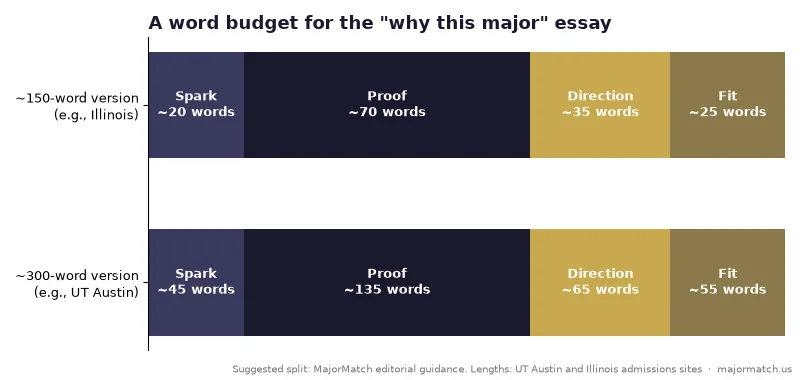
This is the structure we recommend. It isn't a formula colleges publish; it's a way to make sure each sentence answers part of the prompt.
| Part | What it does | ~150 words | ~300 words |
|---|---|---|---|
| Spark | The specific moment or question that pulled you toward the field | 1–2 sentences | 2–3 sentences |
| Proof | What you did about it: a class, project, job, research or self-taught skill, with one concrete detail | 2–3 sentences | 4–5 sentences |
| Direction | What you want to study next or do after college, and why this major is the path | 1–2 sentences | 2–3 sentences |
| Fit | One or two specific features of this college's program you'd use, if the prompt allows | 1 sentence | 2–3 sentences |
How to write it, step by step
- Read the exact prompt. Is it asking about an experience, your goals, or both? Does it mention the college? Answer that question, not a generic one.
- List five moments connected to the field: classes, projects, jobs, books, conversations, problems you tried to solve. Pick the one with the most specific details.
- Write the proof first. Describe what you did in plain language with one concrete detail (a number, a tool, a result, a mistake you fixed).
- Add the spark and direction. Open with the question that started it; close with where you want to take it. Be honest if your goals are still forming.
- Research the fit. Look at the department's own pages: course lists, research programs, labs, co-ops, study-abroad options. Name one or two you'd actually use, and say why.
- Cut to length. Delete any sentence that restates the prompt, praises the field in general, or could appear in another applicant's essay.
- Check consistency. Your essay, activities and intended major should tell the same story. The College Board notes that an essay about loving one subject sits oddly next to an undecided major (BigFuture).
Sample paragraphs, annotated
These samples were written by our editorial team to show the structure. They aren't real applicants' essays, and you shouldn't copy their details. Use them to see how each part works.
Illustrative sample: about 150 words, experience-style prompt (business)
Last spring my aunt's bakery ran out of croissants by 9 a.m. every Saturday and threw out bread every Tuesday. She asked me to help. I spent three weeks logging what sold each hour, then built a spreadsheet that suggested how much to bake each day. Saturday sellouts moved to noon and Tuesday waste dropped by about a third. Those numbers were small, but they made me realize that most business problems are information problems. I want to study business with a focus on operations and analytics so I can learn the formal tools behind what I did by trial and error, starting with the statistics and supply-chain courses I've read about in the program.
Why it works: the spark (a real problem), the proof (three weeks of data, a spreadsheet, a result) and the direction (operations and analytics) are all in under 150 words. The only claim of passion is shown, not stated.
Illustrative sample: about 250 words, "why are you interested" prompt (computer science)
My school's attendance app crashed every Monday morning, so I tried to figure out why. I didn't have access to its code, but I had a question: what breaks when 1,800 students log in at the same minute? That question led me through two free online courses and into building my own version of a check-in tool for our robotics club. The first version froze with just 40 users. Fixing it taught me about databases and why the order of operations matters, and it taught me that I like debugging more than I like finishing. The club has used the tool all year. Computer science is where those questions become a discipline. I want to understand systems that stay reliable when many people depend on them at once, and I'm interested in courses on operating systems and networks, plus the chance to join undergraduate research. Long term, I'd like to work on the software public services run on, like schedules, health portals and school systems, where a crash affects real people's mornings. I've learned enough on my own to know how much I don't know yet, and I want to learn it properly.
Why it works: it opens with a specific problem, shows what the writer built and what went wrong, and ends with a direction that connects to real coursework. It reads like a person, not a brochure. For a school-specific prompt, replace the general course mention with one or two named features from that department's site.
Adapting it for engineering, business, computer science and more
The structure stays the same. What changes is the kind of proof that's most convincing:
| Major | Strong proof looks like | Watch out for |
|---|---|---|
| Engineering | A build, repair, design or competition: what you made, what failed, what you changed | Listing robotics awards without saying what you personally did |
| Computer science | A program or tool you wrote, a bug you tracked down, a course project with a user | Only naming languages you know |
| Business | Running, fixing or measuring something real: a club budget, a job, a small sale | Making money the whole reason |
| Nursing and health | Time around patients or care work, and what you noticed | Only saying you want to help people |
| Humanities and social sciences | A question you investigated: a paper, an interview, a local issue, sources you dug into | Summarizing a book instead of your own thinking |
Earnings can be part of your direction, but they shouldn't be the whole answer. If you mention career goals, keep them specific. The BLS Occupational Outlook Handbook describes what people in each occupation actually do, which helps you name a realistic goal.
Not sure which major to write about?
Take the free adaptive assessment (about 10 to 20 minutes) to see your top 3 major matches, scored with our own proprietary scoring method, and the reasons behind each, useful raw material for this essay. The full Pathfinder report is $29 if you want the deeper plan.
Take the free assessment →Common mistakes that weaken the essay
- Restating the prompt. "I am interested in biology because..." wastes words you don't have.
- Telling instead of showing. "I have always been passionate about" is the most common opening and the least convincing.
- Writing about the field, not you. Paragraphs on why engineering matters to society belong in a textbook.
- Generic praise for the college. "Excellent faculty and world-class resources" applies everywhere. Name something specific, or leave fit out.
- Copying details from the website. A list of course numbers isn't fit. One feature plus why you'd use it is.
- Contradicting the application. Your activities, intended major and essays should line up.
- Ignoring the length. UT Austin limits short answers to 40 lines; Illinois asks for about 150 words. Going far over signals you didn't edit.
- Reusing an essay without changing it. If a different college's name would fit just as well, it's not finished.
If you're applying undecided
Some colleges give undecided applicants their own prompt. Illinois, for example, asks undeclared students for 2 or 3 majors they're considering and why (Illinois). Use the same structure for each interest, more briefly: a spark and a piece of proof for each, then what you want to test in your first year. Our guide to applying to college undecided covers when listing a major matters.
Final checklist before you submit
- It answers the exact prompt, including both parts if there are two.
- It includes at least one concrete detail only you could write.
- Interest is shown through actions, not adjectives.
- Any "fit" detail is specific to this college and something you'd actually use.
- It's within the word or line limit.
- It's consistent with your intended major, activities and other essays.
- Someone who knows you has read it and recognized your voice.
- You've proofread it out loud.
Frequently asked questions
How long should a why this major essay be?
Follow the college's limit. UT Austin asks for no more than 40 lines, about 250 to 300 words, and Illinois asks for about 150 words per prompt. Transfer versions are often longer; Illinois asks transfers for 300 to 400 words.
How do you start a why this major essay?
Start with a specific moment or question that pulled you toward the field, not with a statement that you've always been passionate about it. A concrete first sentence earns the rest of the paragraph.
Can I write about wanting to make money?
You can mention career goals, including financial stability, but don't make pay the only reason. Pair it with what you want to do in the field and evidence that you enjoy the work itself.
Should I mention specific professors or courses?
Only if you have a real reason. One specific course, program or research opportunity you'd actually use, with a sentence on why, is stronger than a list of names.
What if I'm applying undecided?
Answer the college's undecided prompt if it has one. Name two or three real interests, give one piece of evidence for each, and explain what you want to explore first.
Can I reuse the same why this major essay for multiple colleges?
You can reuse the spark and proof, which are about you. Rewrite the fit section for each college, and adjust the length to each prompt.
Sources
- University of Texas at Austin Admissions, Essays & Short Answers
- University of Illinois Urbana-Champaign Undergraduate Admissions, Essay Prompts
- College Board BigFuture, Is it better to pick a major or apply undecided?
- U.S. Bureau of Labor Statistics, Occupational Outlook Handbook
Written and fact-checked by the MajorMatch editorial team. Fees, dates and rules were checked against the sources above on November 24, 2026. Colleges change their policies; confirm details on each school's own site.