Quick answer: At most colleges, applying undecided doesn't hurt your chances. The College Board says so, and schools such as UCLA and Indiana University state that the major you list won't affect admission to their main college. It can matter at universities that admit students directly into engineering, nursing, computer science or other limited programs, where switching in later isn't guaranteed.
"Intended major" is one of the first boxes on a college application, and it causes a surprising amount of stress for students who honestly don't know yet. The worry is that "undecided" reads as unfocused.
For most colleges, it doesn't. But there's an important exception that trips up students every year, and it's worth understanding before you click submit. This guide uses what colleges and the College Board say, plus federal data on how often students change majors anyway.
Does applying undecided hurt your chances?
Usually not. The College Board's guidance: "For most colleges, choosing 'undecided' as your major will not affect your chances of getting accepted" (BigFuture). Colleges back that up in their own words:
- UCLA: for students applying to a major in its College of Letters and Science, "your choice of major will neither help nor hurt your prospects for admission," and "a large number of first-year applicants apply as undeclared" (UCLA Admission). About 1,500 UCLA students are undeclared at any given time.
- Indiana University: lots of incoming students start without declaring a major, and choosing the Undecided or Exploratory option "won't affect your campus admission decision" (Indiana University).
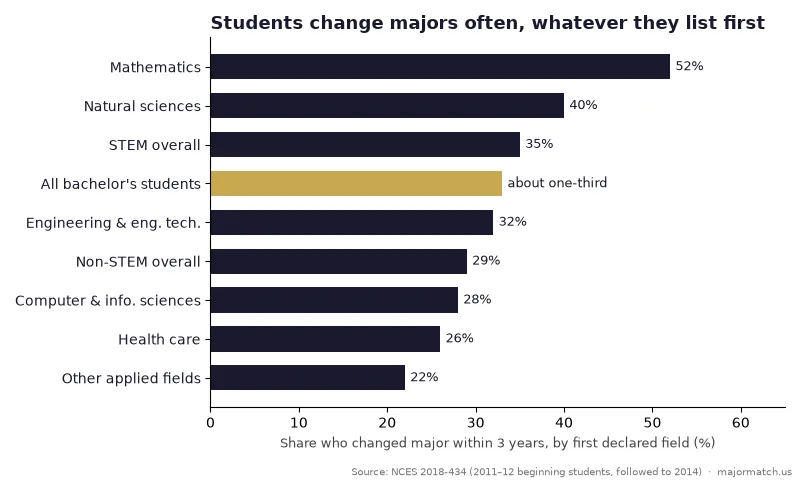
It also helps to know how normal changing course is. Federal data show that about one-third of students in bachelor's degree programs changed their major within three years of enrolling, and about 1 in 10 changed more than once (NCES).
When applying undecided can hurt
The College Board names the exception: selecting undecided "could be harmful if you're choosing a major that requires you to be admitted as a freshman" (BigFuture). At these schools, the major isn't just a label. It's a separate door, often with limited seats.
UC Berkeley's College of Engineering is a clear example. It tells applicants to "apply to the major you wish to pursue as change of major is never guaranteed." Students must complete at least one semester first (two for the most popular majors), apply before their fifth semester, meet GPA and course requirements, and even then may be denied (Berkeley Engineering). For EECS, a change into the major must be the student's first change of major.
Even at UCLA, where the major doesn't affect admission to the College, several professional schools (music, arts and architecture, nursing, and theater, film and television) require supplemental applications with their own deadlines (UCLA).
How colleges use the major you list
Schools use your intended major in different ways, and the application itself often tells you how:
- Separate prompts for undecided students. Illinois gives undeclared applicants their own two essays instead of the first-choice-major essays: one on future career or academic goals, and one asking for 2 or 3 majors you're considering and why (University of Illinois).
- One major reviewed. UCLA reviews first-year applicants for one major only, even though the UC application includes an alternate major for other campuses (UCLA).
- Second-choice majors. Illinois asks for an extra short essay if you list a second-choice major (Illinois).
- A short window to change your mind. After applying to UCLA, changing majors within the College of Letters and Science isn't allowed; changes into the College or into some schools are allowed only until set dates (UCLA).
Undecided or intended major? A quick decision guide
| Your situation | What to do |
|---|---|
| You might want engineering, nursing, computer science or another program that admits by major | Apply to that major at schools that admit directly. Apply undecided only where switching in later is realistic. |
| You're torn between two majors in the same college (say, history and English) | Either choice is fine. List the one you've done more with, or apply undecided. |
| You honestly have no idea yet | Choose undecided or exploratory, and show curiosity in your essays. Many schools have a dedicated option. |
| Your essays and activities all point to one field | List that field. The College Board notes an undecided major can look odd next to an essay about your love for one subject. |
| You're thinking of listing a less popular major to get in, then switching | Don't. At competitive programs, switching in is often not guaranteed. |
How to write about being undecided
Being undecided is fine. Sounding unfocused is the problem. Look at Illinois's undeclared prompts: they ask about goals and about 2 or 3 specific majors you're considering (Illinois). That's a good template for any school:
- Name two or three real interests, not "I like a lot of things."
- Show one thing you've done in each: a class, a project, a job, a book you went deep on.
- Say what you want to test in your first year, such as an intro course in each field, a research program or a club.
- Connect to the school: an exploratory program, a first-year seminar, or flexible requirements that make exploring practical.
Illustrative example (written by our editorial team, not a real applicant's essay):
"I'm choosing between economics and environmental science. In economics class I built a spreadsheet tracking how gas prices changed my family's monthly budget; in environmental science I spent a summer testing creek water for a county program. Both made me want to understand how people make decisions about scarce resources. In my first year, I want to take intro courses in both and find out which questions I want to spend four years on."
For the version of this essay that asks about a specific major, see our guide to the why this major essay.
Mistakes to avoid
- Using a "backdoor" major. Listing a less competitive major to get in, then planning to switch, can strand you if the program you want doesn't take internal transfers.
- Mismatched essays. An undecided major plus an essay entirely about wanting to be an engineer sends a confusing signal.
- Not reading each school's major policy. The same box means different things at different universities.
- Ignoring second-choice and alternate majors. They can matter at schools that admit by major.
- Treating undecided as permanent. You'll have to declare eventually, often by the end of sophomore year. Plan for it.
If you're admitted undecided: what happens next
Undecided students take general requirements and intro courses while they explore, then declare. Our guide to how to declare a major covers deadlines and steps, and undeclared major pros and cons has a two-semester plan.
Change is normal whichever box you check. Among students who first declared mathematics, about 52% switched within three years, the highest rate of any field NCES tracked (NCES).
Undecided is fine. Stuck is optional.
If you don't know where to start, take the free adaptive assessment (about 10 to 20 minutes) to see your top 3 major matches, scored with our own proprietary scoring method. It gives you real candidates to name on applications. The full Pathfinder report is $29 if you want the deeper plan.
Take the free assessment →Frequently asked questions
Is it better to apply undecided or with a major?
At most colleges it makes no difference to admission. Apply with a major if you're fairly sure, or if the program you want admits students by major. Apply undecided if you genuinely are.
Is it easier to get into college undecided?
There's no evidence it's easier. Most colleges say the major you list neither helps nor hurts. At schools that admit by major, undecided and a competitive major are separate pools, so the comparison doesn't really apply.
Does applying undecided hurt your chances at competitive schools?
It can at schools where certain majors, often engineering, computer science, nursing or business, admit students directly. UC Berkeley Engineering, for example, says changing into a major later is never guaranteed.
Can I change my major after I apply?
Sometimes, and only within limits. UCLA, for instance, doesn't allow changes within its College of Letters and Science after you apply, and allows some other changes only until set dates. After you enroll, most schools let you declare or change through an advising process.
What should I write for the intended major question if I'm undecided?
Choose the school's undecided or exploratory option if it has one, and use any short-answer space to name two or three specific interests and what you've done in each.
How many college students change their major?
About one-third of students in bachelor's degree programs changed majors within three years of enrolling, according to NCES, and about 1 in 10 changed more than once.
Sources
- College Board BigFuture, Is it better to pick a major or apply undecided?
- UCLA Undergraduate Admission, Choosing a Major as a First-Year
- Indiana University, How to Apply: Admissions FAQs
- Berkeley Engineering, Change of major
- University of Illinois Urbana-Champaign Undergraduate Admissions, Essay Prompts
- NCES, Beginning College Students Who Change Their Majors Within 3 Years of Enrollment (NCES 2018-434)
Written and fact-checked by the MajorMatch editorial team. Fees, dates and rules were checked against the sources above on November 24, 2026. Colleges change their policies; confirm details on each school's own site.