Quick answer: If you're deferred from early decision, you haven't been admitted or denied. The college will review you again with regular decision applicants, and at schools such as Penn and Vanderbilt you're released from the binding early decision agreement. If you're rejected, the decision is final for this year. Either way, finish your other applications now.
Early decision results usually arrive in mid-December. Penn, for example, tells early decision applicants to expect a decision then (Penn Admissions). Three outcomes are possible: admitted, deferred to regular decision, or not admitted.
Admitted is simple: you're going. The other two are not, and they call for different plans. This guide covers both, using what colleges themselves say about deferrals, rejections and updates.
What does "deferred from early decision" mean?
A deferral means the college hasn't made a final decision. Penn describes it this way: "you have not yet been admitted, but we would like to review your application again as a regular decision applicant" (Penn Admissions). Vanderbilt says a deferral "indicates that the application may be competitive for admission in the Regular Decision pool" (Vanderbilt).
Two things change once you're deferred:
- The binding agreement usually ends. Penn, Vanderbilt and Bucknell all state that deferred early decision applicants are released from the binding commitment (Penn, Vanderbilt, Bucknell). Read your own letter to confirm your school's policy.
- Your decision moves to the regular decision timeline. Penn releases regular decisions in late March (Penn); Bucknell notifies deferred applicants on or before April 1 (Bucknell).
What are your chances after a deferral?
Honestly, it depends on the school, and most colleges don't publish the number. The ones that do give a useful reality check:
| College | What it reports about deferred applicants |
|---|---|
| Bucknell | Typically less than 25% of deferred early decision candidates are later offered admission in regular decision. |
| Georgia Tech | About 20% of deferred students were ultimately accepted in recent years (Georgia Tech defers from early action, not early decision). |
For context on why early decision matters at all: in NACAC's most recent published national figures (fall 2018 admissions), colleges with early decision accepted 61% of their early decision applicants, versus 49% of all applicants (NACAC, State of College Admission). That gap is why a deferral stings. It doesn't mean the door is closed, but it does mean you should plan as if you're applying elsewhere, because you are.
What to do if you're deferred: a 7-step plan
- Read the portal letter twice and follow it exactly. Colleges differ. Georgia Tech asks deferred students to complete a Deferred Supplemental Form and send midyear grades by set dates (Georgia Tech). Others give no form at all.
- Confirm you're released from early decision. If your letter says so, you're free to apply to and commit to other colleges.
- Finish your other applications now. Many regular decision deadlines fall in early January (Penn's is January 5, per its glossary). Don't let a deferral eat the week you needed to finish them.
- Send midyear grades as soon as they're available. Vanderbilt asks deferred students to have their counselor send first-semester grades (Vanderbilt), and Penn requires midyear reports from deferred applicants (Penn). Strong senior grades are the clearest update you can give.
- Send one real update, if the college invites it. Bucknell asks for updated grades and "any new extracurricular or personal achievements" (Bucknell). New means since you applied: a new award, a finished project, a leadership role, a new test score if the school accepts one.
- Don't flood the office. Georgia Tech says it won't consider additional letters of recommendation from deferred students and doesn't offer meetings (Georgia Tech). Extra letters, repeated emails or calls don't help when a school says it doesn't want them.
- Get your financial aid forms in. Regular decision schools have their own aid deadlines. See our CSS Profile guide and FAFSA guide.
How to write a letter of continued interest (with a template)
A letter of continued interest (often called a LOCI) is a short note telling a college you still want to attend and what's new since you applied. Send one only if the college accepts updates; some schools route updates through a specific form instead.
Keep it to one page, or a few short paragraphs if it's a form field. A simple structure:
- One sentence of thanks and a clear statement of interest. If the school is truly your first choice and you'd enroll if admitted, say so. Only say it if it's true.
- What's new since you applied. Two or three specific updates with results, not adjectives.
- One or two specific reasons this college fits, such as a program, a course sequence or a research opportunity you'd actually use.
- A short close with your full name, birth date and application ID if the college uses one.
Fill-in template (replace everything in brackets):
Dear [College] Admissions Committee,
Thank you for continuing to consider my application. [College] remains my first choice, and I would enroll if admitted.
Since I applied in November, [specific update with a result, e.g., what you built, won, led or completed]. I also [second update].
I am especially excited about [specific program, course or opportunity] because [one concrete reason tied to something you have done].
Sincerely,
[Full name], [date of birth], [application ID]
Rejected from early decision: what now?
A rejection is final for this admissions cycle. Penn says that if you're not admitted, "our decision is final for this application cycle regardless of whether you applied early decision or regular decision" (Penn), and Vanderbilt says there is no process for appealing admissions decisions (Vanderbilt). So skip the appeal letter and put the energy here:
- Take a day. It's a real disappointment, and it doesn't measure your worth.
- Rebalance your list. Make sure it includes schools where your grades and scores sit in the middle or top of the admitted range, not just reaches.
- Decide on Early Decision II. Some colleges, such as Vanderbilt, offer a second binding round (ED II) with a later deadline. Use it only for a school you'd happily attend and can afford.
- Reuse essays carefully. Your personal essay can travel. "Why us" and "why this major" answers need rewriting for each school. Our guide to the why this major essay shows how.
- Keep the long game in mind. Transferring later is a real path for many students. See our college transfer guide and community college transfer strategy.
Should you apply Early Decision II after a deferral or rejection?
ED II works like early decision, with a later deadline: it's binding if you're admitted. That makes it powerful and risky at the same time. Ask three questions before you apply:
- Would you choose this school over the one that deferred you? If you're admitted ED II, you commit to that school and withdraw your other applications, including the one where you were deferred.
- Can your family afford it? Run the college's net price calculator first, because a binding admission leaves little room to compare aid offers.
- Is your application stronger now? New grades or achievements since November can make ED II a better shot than ED I was.
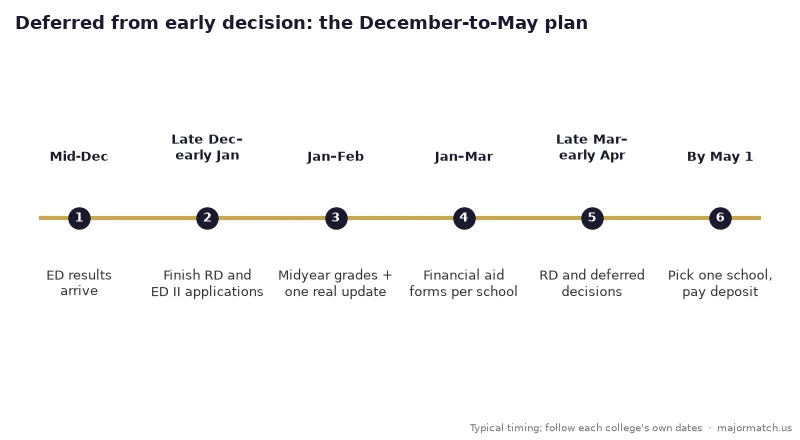
Deferred applicant timeline: December to May
| When | What to do |
|---|---|
| Mid-December | Early decision results arrive. Read the deferral letter and note every instruction and date. |
| Late December to early January | Finish and submit regular decision and any ED II applications. Many deadlines fall in early January. |
| January to February | Midyear grades go out through your counselor. Submit any deferral form or update the college invites. |
| January to March | File financial aid forms for each school by its own deadline. |
| Late March to early April | Regular decision results arrive, including decisions on deferred applications. |
| By May 1 (check each school) | Compare offers and aid, then submit one enrollment deposit. |
Rebuilding the list? Start with the major.
Schools are easier to choose when the major is clearer. Take the free adaptive assessment (about 10 to 20 minutes) to see your top 3 major matches, scored with our own proprietary scoring method. The full Pathfinder report is $29 if you want the deeper plan.
Take the free assessment →For parents: how to help without making it worse
- Let your teen read the decision first, and react second.
- Help with logistics: a calendar of remaining deadlines, aid forms and midyear grades.
- Don't contact the admissions office on your student's behalf. Updates should come from the student or the school counselor.
- Keep the other schools in the conversation. Excitement about real options is the best antidote to a December setback.
- If the major question is part of the uncertainty, the free MajorMatch assessment can help your teen focus the rest of the list on schools strong in the right fields.
Frequently asked questions
Is being deferred from early decision a bad sign?
Not necessarily. It means the college wants to compare you with the regular decision pool. Vanderbilt says a deferral indicates the application may be competitive in that pool. Odds vary by school, though; Bucknell reports that typically under 25% of deferred early decision candidates are later admitted.
Does a deferral release you from the early decision agreement?
At many schools, yes. Penn, Vanderbilt and Bucknell all say deferred early decision applicants are released from the binding commitment. Check your own letter to confirm.
Can you appeal an early decision rejection?
Generally no. Penn says its decisions are final for the cycle, and Vanderbilt says it has no appeals process. Focus on other applications, ED II, or a future transfer instead.
Should I send a letter of continued interest after being deferred?
Only if the college accepts updates. Keep it short, include genuinely new achievements, and say the school is your first choice only if it's true. Follow any instructions about forms or portals.
Can I apply Early Decision II after being deferred?
Usually, yes, if you've been released from the first agreement. ED II is binding, so if you're admitted you must withdraw your other applications, including the one where you were deferred.
What percentage of deferred students get accepted?
It varies by college and most don't publish it. Bucknell says typically less than 25% of deferred ED candidates; Georgia Tech reports about 20% of its deferred (early action) students in recent years.
Sources
- Penn Admissions, After You've Applied (decision types, midyear reports, timing)
- Penn Admissions, Admissions Glossary (deferred admission, regular decision deadline)
- Vanderbilt University Undergraduate Admissions, Frequently Asked Questions
- Bucknell University, Frequently Asked Questions About Admissions (deferral information)
- Georgia Tech Undergraduate Admission, Next Steps for Deferred Students
- NACAC, State of College Admission (2018–19 Admission Trends Survey, early decision statistics)
Written and fact-checked by the MajorMatch editorial team. Fees, dates and rules were checked against the sources above on November 24, 2026. Colleges change their policies; confirm details on each school's own site.