Quick answer: The CSS Profile is the College Board's financial aid application that colleges and scholarship programs use to award their own, non-federal aid. It doesn't replace the FAFSA. The 2027–28 Profile opened October 1, 2026, costs $25 for the first school and $16 for each additional one, and is free if your family's adjusted gross income is $100,000 or less.
If a college on your teen's list asks for the "CSS Profile," it wants more financial detail than the FAFSA collects before it hands out its own grant money. It's a separate form with its own fee and its own deadlines, which is why it catches so many families off guard in the fall of senior year.
This guide covers the 2027–28 CSS Profile, for students starting college in fall 2027. Every fee, date and rule below comes from the College Board, Federal Student Aid, or a college's own financial aid office, and each one is linked so you can check it.
What is the CSS Profile?
The CSS Profile is an online application, run by the College Board, that "colleges and scholarship programs use to award non-federal institutional aid" (College Board). In plain terms: it's how many private colleges, and some scholarship programs, decide how much of their own grant money your family gets.
It's a big pool of money. The College Board says the Profile unlocks access to more than $14 billion in non-federal aid each year (College Board). Each college runs your answers through its own formula, so the same Profile can produce very different offers at different schools.
Most students complete it in the fall of senior year. The Profile opens October 1 each year (College Board), and the 2027–28 version opened on October 1, 2026 (Columbia University financial aid).
Who needs to file the CSS Profile?
Only students applying to a college or scholarship program that requires it. The College Board's advice is simple: check each college's information to see whether it asks for the Profile, using the list of participating schools and programs (College Board). Then confirm on the college's own financial aid page, because that page also lists the school's deadline and any extra documents.
Three situations catch families most often:
- You only need it for some schools. Many public universities rely on the FAFSA alone. If one private college on the list requires the Profile, you send it to that college, not to everyone.
- Divorced or separated parents. Some colleges require a separate Profile from the noncustodial parent (College Board). Columbia, for example, requires a CSS Profile from both biological or adoptive parents if they are no longer together (Columbia).
- Scholarship programs. A few private scholarship programs use the Profile too, so check the requirements of any outside scholarship your teen applies for.
How much does the CSS Profile cost? Fee waivers explained
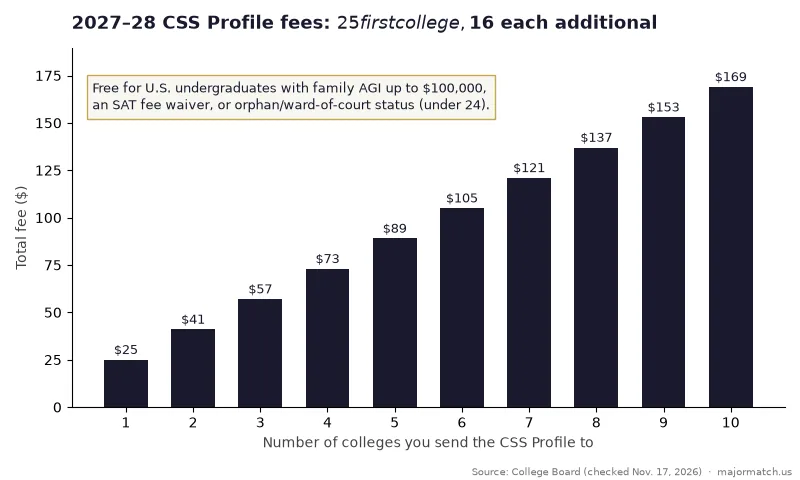
The CSS Profile costs $25 for the first college and $16 for each additional college (College Board). You pay when you submit, by credit or debit card. Here's what that adds up to:
| Colleges you send it to | Total fee (no waiver) |
|---|---|
| 1 | $25 |
| 2 | $41 |
| 3 | $57 |
| 5 | $89 |
| 8 | $137 |
| 10 | $169 |
Many families pay nothing. Undergraduate students living in the U.S. can submit the CSS Profile for free if (College Board):
- their family's adjusted gross income is up to $100,000,
- the student qualified for an SAT fee waiver, or
- the student is an orphan or ward of the court under age 24.
The waiver covers all application and reporting fees. To get credit for an SAT fee waiver, sign in to the Profile with the same College Board account the student used for the SAT (BigFuture). A noncustodial parent living in the U.S. can also file free if that parent's family adjusted gross income is up to $100,000 (College Board). International families should ask each college about fee waivers.
When is the CSS Profile deadline for 2027–28?
There isn't one national deadline. Each college sets its own, and the College Board says to submit by midnight Eastern Time on your earliest priority filing date (College Board). The College Board's BigFuture guide recommends starting at least two weeks before that earliest date (BigFuture).
Colleges often set an earlier aid deadline for early decision and early action applicants than for regular decision, so the earliest date on your list is usually tied to your earliest application. A simple way to plan:
| When | What to do |
|---|---|
| Now (the 2027–28 Profile opened Oct. 1, 2026) | List every college and scholarship that requires the Profile, with its aid deadline. Gather tax and bank documents. |
| 2+ weeks before your earliest aid deadline | Start the Profile. You can save and come back to it. |
| By midnight ET on your earliest priority date | Submit, adding every college that requires it. Add more colleges later from your dashboard. |
| After you submit | Watch your dashboard and email for document requests, such as uploads through IDOC. |
The FAFSA runs on a different clock. The 2027–28 FAFSA accepts applications no earlier than October 1, 2026 and no later than June 30, 2028, but state and college deadlines can be as early as October 1, 2026 (Federal Student Aid, 2027–28 FAFSA form). Our FAFSA guide walks through that form.
CSS Profile vs. FAFSA: what's the difference?
The two forms do different jobs, and colleges that require the Profile almost always want the FAFSA too.
| CSS Profile | FAFSA | |
|---|---|---|
| Run by | The College Board | U.S. Department of Education |
| Used for | A college's or program's own (non-federal) aid | Federal grants, loans and work-study, plus many state and college programs |
| Who requires it | Only colleges and programs that choose to use it | Needed for federal aid at any college |
| Cost | $25 for the first college, $16 for each additional; free with a fee waiver | Free |
| Deadline | Set by each college | Federal deadline June 30, 2028; state and college deadlines are earlier |
| The family home | Colleges using the Profile can ask about it and apply their own formula | Not counted: FAFSA investments "do not include the home you live in" |
| Divorced or separated parents | Some colleges require a Profile from each parent | Follows federal rules for which parent reports |
The College Board puts it plainly: for federal aid, you must complete the FAFSA (College Board). The Profile adds to it; it never replaces it.
Aid offers differ by school. So does the payoff of a major.
Take the free adaptive assessment (about 10 to 20 minutes) to see your teen's top 3 major matches, scored with our own proprietary scoring method. The full Pathfinder report is $29 if you want the deeper plan.
Take the free assessment →How to fill out the CSS Profile, step by step
- Confirm which schools need it. Use the College Board's participating list, then each college's aid page, and write down every deadline.
- Gather documents. The College Board says to have your most recently completed tax returns, W-2s and other records of current-year income, records of untaxed income and benefits, assets, and bank statements on hand (College Board). For most families filing for 2027–28, the most recent completed return is the 2025 return.
- Sign in with the student's College Board account. Using the same account the student used for the SAT saves time and applies any SAT fee waiver. Noncustodial parents create their own separate account (College Board).
- Fill in the student section, then the parent section. You don't have to finish in one sitting. You can save and return.
- Add your colleges and submit. Submit time is based on Eastern Time. If you don't qualify for a fee waiver, you pay when you submit (College Board).
- Check your dashboard. It shows your receipt and next steps, such as uploading documents through the Institutional Documentation Service (IDOC). You can also add colleges at any time (College Board).
Common CSS Profile mistakes (and how to avoid them)
- Waiting for the deadline day. Submit early enough to handle a document request or a second parent's Profile.
- Answering student questions as the parent. The College Board says one of the most common parent mistakes is answering "Student Status" questions about themselves instead of about the student (College Board).
- Typos in the student's name, birth date or Social Security number. If those don't match across the student's and parent's applications, they won't link properly when sent to schools, which can delay aid (College Board).
- Assuming the FAFSA covers it. If a college requires both, you need both.
- Forgetting the noncustodial parent. If a college requires a second Profile, the student's aid file isn't complete until that parent submits.
- Ignoring IDOC requests. Missing documents can hold up an aid offer even after the Profile is in.
- Sending it to schools that don't need it. Each extra college is another $16 unless you have a fee waiver.
What happens after you submit?
Each college that receives your Profile runs it through its own aid formula. Some will ask for more documents, usually through IDOC. Aid offers typically arrive with or soon after admission decisions, so early decision and early action applicants often see an offer in the winter, and regular decision applicants in the spring.
When offers come in, compare them on net cost, meaning what you'll actually pay after grants and scholarships, not the size of the total package. Loans and work-study are not free money. If your family's finances have changed since the tax year on the form, contact the aid office and ask how it handles special circumstances.
One more number to weigh: what the degree is likely to pay back. Our lifetime upside calculator compares a loan against expected earnings by major.
Frequently asked questions
Is the CSS Profile required?
Only by colleges and scholarship programs that use it. Check the College Board's participating list and each college's financial aid page. The FAFSA is still needed for federal aid.
How much does the CSS Profile cost for 2027–28?
$25 for the first college and $16 for each additional college. It's free for U.S. undergraduates whose family adjusted gross income is up to $100,000, who qualified for an SAT fee waiver, or who are orphans or wards of the court under 24.
When is the CSS Profile due?
Each college sets its own deadline. Submit by midnight Eastern Time on your earliest priority date, and start at least two weeks before it. The 2027–28 Profile opened October 1, 2026.
Do I need to file both the FAFSA and the CSS Profile?
Usually, yes, if a college requires the Profile. The Profile is for a college's own aid; the FAFSA is required for federal grants, loans and work-study.
What tax year does the 2027–28 CSS Profile use?
The College Board asks for your most recently completed tax returns plus records of current-year income. For most families filing in late 2026, that's the 2025 return. The 2027–28 FAFSA also uses 2025 tax information.
Do both divorced parents have to fill out the CSS Profile?
At some colleges, yes. Those schools require a separate Profile from the noncustodial parent, who creates their own College Board account. That parent can file free if their family adjusted gross income is up to $100,000.
Can I add a college after I submit the CSS Profile?
Yes. You can add colleges from your dashboard at any time. Each added college costs $16 unless you have a fee waiver.
Sources
- College Board, About CSS Profile
- College Board, CSS Profile home (non-federal aid; divorced or separated families)
- College Board, What is the cost of the CSS Profile?
- College Board, CSS Profile Fee Waivers
- College Board, CSS Profile: Getting Started (documents and deadlines)
- College Board, Complete the Application
- College Board, CSS Profile Information for Parents
- College Board BigFuture, How to Complete the CSS Profile
- College Board, CSS Profile Participating Institutions and Programs
- Federal Student Aid, 2027–28 FAFSA Form (July 1, 2027–June 30, 2028)
- Columbia University Financial Aid, 27-28 CSS Profile (ED, domestic)
Written and fact-checked by the MajorMatch editorial team. Fees, dates and rules were checked against the sources above on November 24, 2026. Colleges change their policies; confirm details on each school's own site.