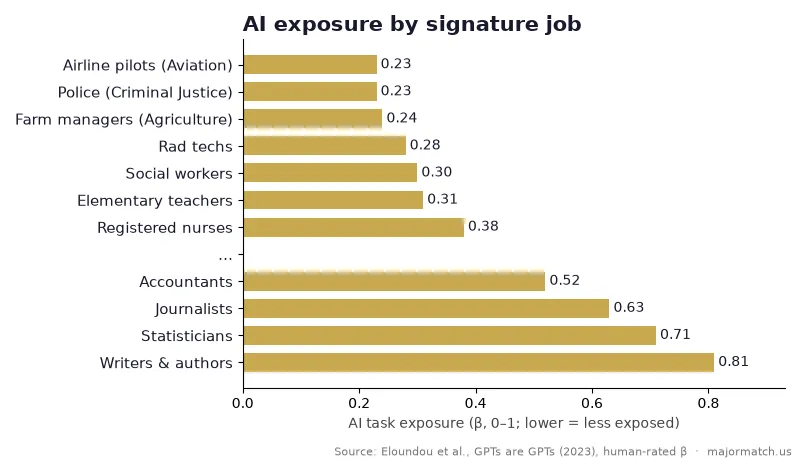
Quick answer: The majors AI is least likely to replace lead to hands-on, in-person or safety-critical work: aviation (pilots), criminal justice (police), agriculture, radiologic science, social work and elementary education. In the OpenAI and University of Pennsylvania study GPTs are GPTs, these jobs have some of the lowest shares of tasks that AI can speed up, with exposure scores of 0.23 to 0.31 versus 0.81 for writers and 0.71 for statisticians. Low exposure isn't a guarantee, but it's the best evidence we have.
Every parent we talk to asks some version of the same question now: Will this degree still be worth anything in ten years? It's a fair worry. The honest answer is that nobody knows exactly what AI will do to the job market, and anyone who tells you otherwise is selling something.
What we can do is look at the best published research on which jobs AI can actually help do, task by task, and work backward to the majors that lead to those jobs. That's what this ranking is. It doesn't predict layoffs. It shows where the work is most and least exposed to the AI tools that exist today. For a broader, judgment-based list, see our guide to AI-proof college majors.
How did we measure which majors AI is least likely to replace?
The exposure score comes from GPTs are GPTs by Tyna Eloundou, Sam Manning, Pamela Mishkin and Daniel Rock (OpenAI, OpenResearch and the University of Pennsylvania, 2023). Researchers rated every task in the U.S. Department of Labor's O*NET database by whether a large language model, or software built on one, could cut the time to do it by at least half. We use the paper's human-rated "β" score from the published occupation-level data. It runs from 0 (no tasks exposed) to 1 (every task exposed). Lower means less exposed.
The match: for each major we picked the signature occupation most graduates aim for. That mapping is our editorial judgment, and real grads go many places. Pay is the May 2024 national median from the BLS Occupational Employment and Wage Statistics survey. Underemployment for recent grads is from the New York Fed (Feb. 2026 release).
What exposure means: exposure is about tasks, not jobs. A nurse's charting can be sped up by AI; starting an IV can't. The study's authors and Pew Research Center both say directly that exposure doesn't tell you whether jobs will be lost or gained.
Which 13 majors is AI least likely to replace?
| Rank | Major | Signature job | AI exposure (β, 0–1) | Median pay (BLS, May 2024) | Underemployment (NY Fed) |
|---|---|---|---|---|---|
| 1 | Aviation | Airline pilots, copilots and flight engineers | 0.23 | $226,600 | — |
| 2 | Criminal Justice | Police and sheriff's patrol officers | 0.23 | $76,290 | 65.8% |
| 3 | Agriculture | Farmers, ranchers and agricultural managers | 0.24 | $87,980 | 57.1% |
| 4 | Radiologic Science | Radiologic technologists | 0.28 | $77,660 | 47.0%* |
| 5 | Social Work | Child, family and school social workers | 0.30 | $58,570 | 30.1%* |
| 6 | Elementary Education | Elementary school teachers | 0.31 | $62,340 | 16.2% |
| 7 | Exercise Science | Physical therapists (with a DPT) | 0.34 | $101,020 | — |
| 8 | Secondary Education | High school teachers | 0.34 | $64,580 | 21.7% |
| 9 | Mechanical Engineering | Mechanical engineers | 0.37 | $102,320 | 20.1% |
| 10 | Civil Engineering | Civil engineers | 0.38 | $99,590 | 15.6% |
| 11 | Nursing | Registered nurses | 0.38 | $93,600 | 12.8% |
| 12 | Communication Disorders | Speech-language pathologists (with a master's) | 0.39 | $95,410 | — |
| 13 | Construction Management | Construction managers | 0.40 | $106,980 | 17.9%* |
| — | For contrast: English | Writers and authors | 0.81 | $72,270 | 48.5% |
| — | For contrast: Mathematics/Statistics | Statisticians | 0.71 | $103,300 | 26.2% |
| — | For contrast: Journalism | Reporters and journalists | 0.63 | $60,280 | 43.3% |
| — | For contrast: Accounting | Accountants and auditors | 0.52 | $81,680 | 21.2% |
Sources: AI exposure = human-rated β from Eloundou et al., GPTs are GPTs (2023), occupation-level data; pay = BLS OEWS May 2024 national median annual wage; underemployment = New York Fed, Feb. 2026 release (recent grads 22–27). *Closest New York Fed category: Medical Technicians (radiologic science), Social Services (social work), Construction Services (construction management). Ranked on unrounded scores. Major-to-job mapping by MajorMatch.
Click any major in the table to open its free loan-vs-upside calculator, or compare debt and lifetime earnings with your own numbers in the degree loan vs. upside calculator. Then take the assessment to see which of these majors actually fit your teen.
What makes each of these majors hard for AI to replace?
Notice the pattern: almost every job near the top involves a body, a place or a person who has to trust you face to face.
1. Aviation (pilots, 0.23)
The highest-paying job on this list by far, at a $226,600 median for airline pilots. Pilots already work alongside heavy automation, and the job is defined by being the accountable human in the cockpit. Air traffic controllers score 0.31.
2. Criminal Justice (police, 0.23)
Patrol work is physical, unpredictable and legally accountable in a way software isn't. The catch is the job market for the degree itself: the New York Fed shows 65.8% of recent criminal justice grads underemployed, the highest of any major. Detectives, who need more investigative judgment, score 0.30 and earn a median of $93,580.
3. Agriculture (farm and ranch managers, 0.24)
Weather, animals, equipment and land don't fit in a chat window. Agricultural managers earn a median of $87,980, though the New York Fed shows 57.1% underemployment for recent agriculture grads, many of whom work in family or field roles.
4. Radiologic Science (rad techs, 0.28)
Positioning a patient, operating imaging equipment and keeping someone calm inside an MRI tube are hands-on tasks. AI reads more images every year, which shifts some work toward radiologists, but the technologist still has to get the image.
5. Social Work (0.30)
Home visits, crisis calls and court appearances are human work. Paperwork is exposed, and many social workers would welcome the help. Pay is the lowest on this list at $58,570, which is worth weighing honestly.
6. Elementary Education (0.31)
Twenty-five eight-year-olds need a person in the room. AI can draft lesson plans, but it can't run recess. The New York Fed shows 16.2% underemployment for elementary education grads, one of the lowest rates of any major.
7. Exercise Science (physical therapists, 0.34)
Physical therapy is hands-on and pays well ($101,020 median), but it requires a doctorate (DPT) after the bachelor's. Exercise physiologists, who don't need one, also score 0.34 but earn a median of $58,160.
8. Secondary Education (0.34)
Slightly more exposed than elementary teaching, since high school work involves more grading and written content, but still firmly in-person.
9. Mechanical Engineering (0.37)
Designing and testing physical things keeps engineers grounded in the real world. AI will speed up the calculations and drafting, not the responsibility for whether the part fails.
10. Civil Engineering (0.38)
Roads, bridges and water systems need licensed engineers to sign off. Civil engineering grads have 15.6% underemployment and a $99,590 median.
11. Nursing (RNs, 0.38)
Charting and care plans are exposed; bedside care isn't. With 3.28 million registered nurses (the largest occupation on this list) and only 12.8% underemployment for nursing grads, it's the safest combination of low exposure and strong demand here. Nurse practitioners score 0.31.
12. Communication Disorders (speech-language pathologists, 0.39)
Working with a child who stutters or a stroke survivor relearning words is personal, clinical work. It requires a master's degree, and the $95,410 median reflects that.
13. Construction Management (0.40)
Running a job site means people, weather, inspections and subcontractors. It's also one of the best majors on our return on investment ranking.
Which majors are most exposed to AI?
The contrast rows in the table tell the story. Writers and authors score 0.81, statisticians 0.71, journalists 0.63, and accountants 0.52. Software developers sit at 0.45 on the human-rated measure. These are jobs built around reading, writing, analyzing and producing text or code, exactly what today's language models do well.
That doesn't make these majors bad bets. Statisticians earn a $103,300 median, and accounting grads have low underemployment. It means the day-to-day work is more likely to change, and graduates will need to be the person who uses the tools well. Pew found something similar: in 2022, 27% of workers with a bachelor's degree or more were in the most AI-exposed jobs, versus 12% of those with only a high school diploma, and the most exposed jobs paid more on average ($33 an hour vs. $20).
Which of these majors fits your teen?
Take the free adaptive assessment (about 15–25 minutes) to see your top 3 major matches, scored with our own proprietary scoring method. The full Pathfinder report is $29 if you want the deeper plan.
Take the Free Assessment →Will AI actually replace these jobs?
Nobody can say for sure, and we won't pretend to. The GPTs are GPTs authors estimated that about 80% of U.S. workers could have at least 10% of their tasks affected by large language models, and about 19% could see at least half their tasks affected. That's a big change to how work gets done. Whether it means fewer jobs, different jobs or more productive workers is a separate question the research doesn't answer.
What the data does support: majors that lead to hands-on, licensed, in-person or safety-critical work are less exposed today. That's why so many of them are in healthcare, education, engineering and the trades. If your teen is drawn to those fields, AI is one more reason to feel good about it. If they're drawn to writing or analysis, AI is a reason to pair the major with practical, people-facing skills, not to abandon it.
Are hard majors safer from AI?
Not automatically. Some of the hardest majors on our difficulty ranking, like mechanical and civil engineering, are low-exposure. Others, like mathematics, lead to high-exposure analyst work. And some of the least exposed paths, like elementary education or social work, are not considered hard majors at all. Exposure follows the type of work, not the difficulty of the degree.
How should AI risk factor into choosing a major?
As one input, not the whole decision. A low-exposure major your teen hates is still a bad fit. Start with strengths and interests, then use AI exposure as a tiebreaker between majors that both fit.
Our free assessment does the first part. It matches your teen to 100 majors using our own proprietary scoring method, then you can compare the top picks here and in our AI career risk guide. Run the leading choice through the loan vs. upside calculator to see whether the cost makes sense.
Frequently asked questions
Which business degrees is AI least likely to take over?
Business paths that run people and operations are less exposed than analysis-heavy ones: medical and health services managers score 0.37 and general and operations managers 0.39, versus 0.58 for marketing managers and 0.52 for accountants.
What are the most AI-proof degrees for students who love math?
Engineering. Mechanical (0.37) and civil engineers (0.38) score far below statisticians (0.71) on AI task exposure, because their work ends in physical, licensed decisions.
Which engineering degree is most AI-proof?
Among major engineering fields, mechanical engineering has the lowest exposure score (0.37), just ahead of civil (0.38) and electrical (0.41), in the 'GPTs are GPTs' data.
What are human-centric majors for the AI era?
Nursing, elementary education, social work and communication disorders (speech-language pathology) lead to care-and-teaching jobs with exposure scores between 0.30 and 0.39, below most office work.
Which college majors are least likely to be replaced by AI?
Majors that lead to hands-on, in-person or safety-critical jobs: aviation (pilots), criminal justice (police), agriculture, radiologic science, social work and elementary education have the lowest AI task exposure in the OpenAI/University of Pennsylvania 'GPTs are GPTs' data, with scores from 0.23 to 0.31 on a 0–1 scale.
Which majors are most at risk from AI?
Majors that feed writing and analysis jobs show the highest exposure: writers and authors (0.81), statisticians (0.71), journalists (0.63) and accountants (0.52). Exposure means AI can speed up many of the tasks; it doesn't mean the jobs will disappear.
Is nursing safe from AI?
Registered nurses score 0.38 on AI task exposure, below most office jobs. Bedside care is hard to automate, and nursing grads have only 12.8% underemployment, the lowest of any major in the New York Fed's data.
Is computer science safe from AI?
Software developers score 0.45 on the human-rated exposure measure, the middle of the range. Coding tasks are increasingly AI-assisted, which is changing entry-level work. It's still a high-paying field ($133,080 median for software developers in May 2024).
What does 'AI exposure' mean?
It's the share of a job's tasks that a large language model or software built on one could do at least twice as fast with the same quality, as rated in the 2023 'GPTs are GPTs' study. It measures how much the work could change, not whether the job will exist.
Sources
- Eloundou, Manning, Mishkin & Rock (OpenAI / University of Pennsylvania), GPTs are GPTs: An Early Look at the Labor Market Impact Potential of Large Language Models (2023)
- GPTs are GPTs occupation-level exposure data (GitHub)
- Pew Research Center, Which U.S. Workers Are More Exposed to AI on Their Jobs? (July 2023)
- U.S. Bureau of Labor Statistics, Occupational Employment and Wage Statistics, May 2024 national estimates
- Federal Reserve Bank of New York, The Labor Market for Recent College Graduates: Outcomes by Major (Feb. 4, 2026 release, 2024 ACS data)
- U.S. Bureau of Labor Statistics, Occupational Outlook Handbook