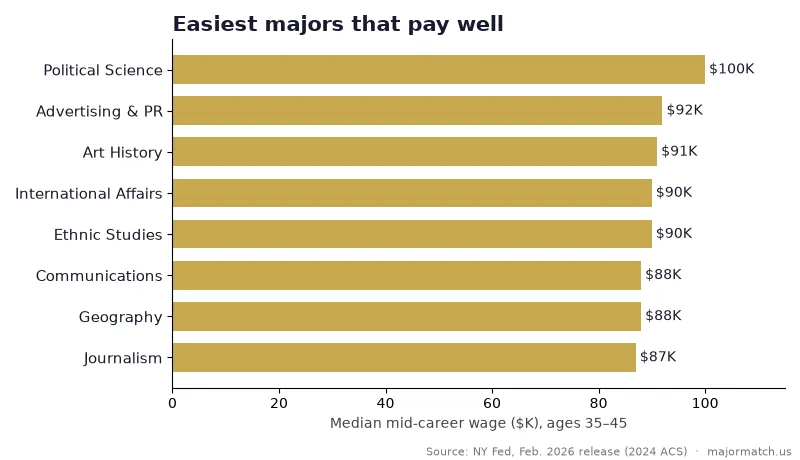
Quick answer: The easiest majors that still pay well are political science ($100,000 median mid-career pay), advertising and public relations ($92,000), art history ($91,000), international affairs ($90,000) and ethnic studies ($90,000), based on the New York Fed's 2026 outcomes-by-major data. None requires a calculus or lab-science sequence. The catch: about 4 in 10 to 6 in 10 recent grads in these fields work jobs that don't need a degree, so the internship you land matters more than the diploma.
Every parent has heard some version of this at the kitchen table: I just want a major I can actually pass. That's not laziness. It's a kid who's honest about where they shine, and who has watched a friend fail out of calculus in November of freshman year.
So here's the question this list answers: if you skip the hardest stuff (the calculus sequence, the organic chemistry labs, the 20-hour studio weeks), which majors still lead to a real paycheck? We took the New York Fed's newest outcomes-by-major table and pulled out every major that normally doesn't make you climb that wall. Then we ranked them by what graduates earn in mid-career, ages 35 to 45. If you want the other end of the spectrum, our hardest college majors ranking is the mirror image of this one.
How did we decide which majors count as "easy"?
"Easy" is a loaded word, so here's exactly what we mean. A major made this list only if it typically does not require a calculus sequence or a multi-semester lab-science sequence to graduate. That's our editorial screen, based on how these degrees are usually structured at U.S. four-year schools. Your school's catalog is the final word, and some programs (especially business-school versions) add one applied math course.
Then we ranked the survivors by one number: median mid-career wage for full-time workers with only a bachelor's degree, from the New York Fed Labor Market for Recent College Graduates release of February 4, 2026, which uses 2024 American Community Survey data. Ties go to the higher early-career wage. We also show underemployment, the share of recent grads (ages 22 to 27) working in jobs that typically don't require a degree, because an easy major with a 60% underemployment rate is a different bet than one at 40%.
What we did not do: invent GPAs, survey students ourselves or guess at study hours. Every number in the table comes straight from the New York Fed file.
What are the 12 easiest majors that pay well?
| Rank | Major | Mid-Career Median (35–45) | Early-Career Median (22–27) | Unemployment (recent grads) | Underemployment (recent grads) |
|---|---|---|---|---|---|
| 1 | Political Science | $100,000 | $52,000 | 4.5% | 48.7% |
| 2 | Advertising & Public Relations | $92,000 | $60,000 | 5.7% | 38.1% |
| 3 | Art History | $91,000 | $45,000 | 6.7% | 45.3% |
| 4 | International Affairs | $90,000 | $64,000 | 6.1% | 45.2% |
| 5 | Ethnic Studies | $90,000 | $52,000 | 4.9% | 49.6% |
| 6 | Communications | $88,000 | $52,000 | 3.9% | 53.0% |
| 7 | Geography | $88,000 | $50,000 | 1.6% | 43.0% |
| 8 | Journalism | $87,000 | $49,000 | 2.3% | 43.3% |
| 9 | Public Policy & Law | $80,000 | $55,000 | 2.2% | 45.5% |
| 10 | Interdisciplinary Studies | $80,000 | $52,000 | 3.9% | 45.2% |
| 11 | Criminal Justice | $80,000 | $50,000 | 3.6% | 65.8% |
| 12 | History | $80,000 | $47,500 | 4.3% | 50.1% |
| — | All majors (for comparison) | $87,000 | $58,000 | 4.2% | 39.4% |
Source: Federal Reserve Bank of New York, The Labor Market for Recent College Graduates, Outcomes by Major, released Feb. 4, 2026 (2024 American Community Survey, IPUMS). Wages are medians for full-time workers with a bachelor's degree only. Unemployment and underemployment are for grads aged 22–27. "Easy" screen (no calculus or lab-science sequence) is MajorMatch's editorial judgment; check your school's catalog.
Click any major in the table to open its free loan-vs-upside calculator, or compare debt and lifetime earnings with your own numbers in the degree loan vs. upside calculator. Then take the assessment to see which of these majors actually fit your teen.
Why does each major land where it does?
A quick, honest note on each one. Click any major in the table to run its numbers in our loan-vs-upside calculator.
1. Political Science: $100,000 by mid-career
The top earner on this list, and the reason is mostly what happens after the degree. More than half of political science grads (52.7%) go on to earn a graduate degree, often law or public policy, and the ones who stop at a bachelor's still land in government, consulting, lobbying and campaign work. The tradeoff is a slow start: $52,000 early on, below the all-majors median of $58,000.
2. Advertising & Public Relations: $92,000
The best early-career number among the true "no calculus" majors at $60,000, and the lowest underemployment on the list at 38.1%. This is a portfolio major. The students who do well walk out with real campaigns, client work and an internship that turned into a reference.
3. Art History: $91,000
The surprise of the list. Early pay is modest ($45,000) but mid-career pay jumps, partly because nearly half (47.8%) earn a graduate degree and move into museum leadership, auction houses, law or arts administration. It's a small field, so treat the mid-career number as a ceiling you have to climb toward, not a promise.
4. International Affairs: $90,000
The strongest starting pay here, $64,000, which beats the all-majors median. The 6.1% unemployment rate is the warning sign. Language skills, a study-abroad semester and a federal or nonprofit internship separate the grads who launch from the ones who wait.
5. Ethnic Studies: $90,000
Ties international affairs at mid-career. Graduates spread into education, law, social policy, nonprofit leadership and HR, and about half go on to graduate school. It's a writing-and-reading-heavy major, which is "easy" only if that's where your teen already lights up.
6. Communications: $88,000
One of the most popular majors in the country, and the underemployment rate (53.0%) shows why it has a reputation as a fallback. The ones who do well treat it like a trade: they build a writing or video portfolio and specialize early. Our communications degree jobs guide walks through 15 real paths.
7. Geography: $88,000
The quiet winner. Lowest unemployment on this list at 1.6%, and GIS (mapping software) skills are in steady demand at utilities, city planning offices and logistics firms. Students who pair it with a GIS certificate tend to have the easiest job search on this list.
8. Journalism: $87,000
Low unemployment (2.3%) and a solid mid-career number, which surprises people. Journalism grads often end up in communications, content strategy and PR rather than newsrooms. It also tops a well-known regret survey, which we unpack in our regret ranking.
9. Public Policy & Law: $80,000
A $55,000 start and 2.2% unemployment make this one of the steadier picks. It's a natural pipeline into law school, government analyst roles and nonprofits.
10. Interdisciplinary Studies: $80,000
Flexible by design, which is both the appeal and the risk. It works best for students who can explain, in one sentence, what they built the degree to do.
11. Criminal Justice: $80,000
Same mid-career pay as history, but the highest underemployment on this list by far at 65.8%. Many graduates work in roles like corrections or security that don't require the degree. Our criminal justice careers guide shows which paths actually use it.
12. History: $80,000
The lowest early-career pay here at $47,500, but more than half of history grads (51.4%) earn a graduate degree, and many end up in law, education and government. Strong writers do best.
What's the catch with easy majors that pay well?
Look at the last column of the table again. Eleven of these twelve majors have an underemployment rate above the all-majors average of 39.4% (advertising and PR, at 38.1%, is the lone exception). That's the real price of "easy." The degree alone doesn't sort you into a professional job the way a nursing license or an engineering degree does.
Here's an illustrative scenario (not a real student): two communications majors graduate from the same school in the same year. One spent two summers running social media for a local hospital and has a portfolio link in her email signature. The other has a 3.6 GPA and nothing to show an employer. On paper they have the same degree. In practice, the first one is the $88,000-by-mid-career story and the second one is part of the 53% working a job that didn't need college.
The easy majors reward students who add one hard thing on purpose: an internship, a certificate (GIS, Google Analytics, a second language), or a clear plan for graduate school.
Which of these majors fits your teen?
Take the free adaptive assessment (about 15–25 minutes) to see your top 3 major matches, scored with our own proprietary scoring method. The full Pathfinder report is $29 if you want the deeper plan.
Take the Free Assessment →Do easy majors really pay less than hard ones?
Usually, yes, at least at the start. The top of our hardest majors ranking is dominated by engineering, and the New York Fed data backs that up: chemical engineering grads start at $85,000 and reach $135,000 mid-career. None of the majors here start above $64,000.
But the gap shrinks with time. Political science reaches $100,000 by mid-career, which is the same as mathematics in the same dataset. Pay for easy majors tends to ramp later, because it depends more on what you do after graduation. For the full year-one picture across every field, see our starting salary by major guide.
How do you know if an easier major is the right call?
Pick it for the right reason. "I don't want to suffer" is a fine starting point, but it's a bad finishing point. The students who thrive in these majors usually like reading, arguing, writing or people, and the work feels natural rather than merely survivable.
That's what our free assessment is for. It scores your teen's strengths and interests against 100 majors using our own proprietary scoring method, then shows where an easier major is a genuine fit and where it's just a hiding place. If math is the specific worry, our list of highest-paying majors without heavy math adds business and health options that ask for one light math course.
Frequently asked questions
What majors don't require much math but still pay well?
Political science ($100,000 median mid-career pay), advertising and public relations ($92,000), international affairs ($90,000) and communications ($88,000) all typically skip the calculus sequence, according to New York Fed 2026 data.
Which easy major pays over $60,000 right out of college?
Only two majors on our list clear $60,000 early-career: international affairs ($64,000) and advertising and public relations ($60,000), per the New York Fed's 2026 release.
What majors are like political science and psychology but less math-heavy?
International affairs, public policy and law, history and communications share political science's reading-and-writing focus and usually require only one general-education math class. Psychology majors typically take statistics.
What are the highest-paying creative majors that are easy?
Advertising and public relations leads at $92,000 median mid-career pay, followed by art history ($91,000) and commercial art and graphic design ($80,000), based on New York Fed data.
What is the easiest major that pays well?
In the New York Fed's 2026 outcomes-by-major data, political science has the highest mid-career median pay ($100,000) among majors that don't typically require a calculus or lab-science sequence. Advertising and public relations is close behind at $92,000 and has the best early-career pay of the group at $60,000.
Which easy major has the lowest unemployment?
Geography, at 1.6% for recent graduates aged 22 to 27, followed by public policy and law (2.2%) and journalism (2.3%), according to the New York Fed's Feb. 2026 release.
Are easy majors a waste of money?
Not on the evidence. Every major on this list reaches at least $80,000 median pay by ages 35 to 45. The risk is underemployment: 38% to 66% of recent grads in these fields work jobs that don't require a degree, so internships and a clear plan matter more than in a licensed field like nursing.
How did MajorMatch define an easy major?
A major qualified if it typically doesn't require a calculus sequence or a multi-semester lab-science sequence. That's an editorial screen, not a survey. We then ranked majors by the New York Fed's median mid-career wage.
What's the hardest major, for comparison?
Engineering majors dominate the top of our hardest-majors ranking, led by architecture and chemical engineering. They also pay the most early on.