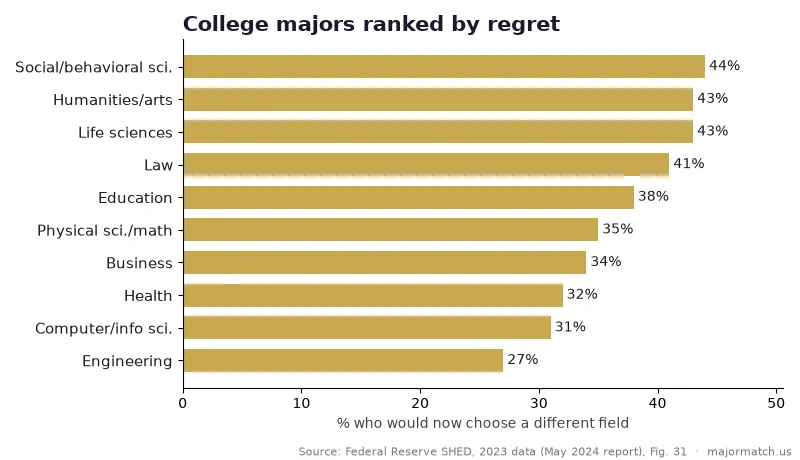
Quick answer: In the Federal Reserve's survey of U.S. adults, the majors with the most regret are social and behavioral sciences (44% would choose a different field), humanities and arts (43%) and life sciences (43%). The majors with the least regret are engineering (27%), computer and information sciences (31%) and health (32%). Across all fields, 35% of graduates say they'd pick a different major. ZipRecruiter's survey of job-seeking grads points the same way, with journalism (87%) and sociology (72%) most regretted.
Ask a room full of adults whether they'd pick the same major again and you'll get a lot of laughter, then a lot of very specific stories. One wishes she'd done nursing. One wishes he'd done anything but finance. The Federal Reserve actually asks this question, in a nationally representative survey of more than 11,000 adults, and the answers are remarkably consistent.
This post ranks every major group from most regretted to least, using the Fed's numbers as the backbone and ZipRecruiter's job-seeker survey for individual majors. We also show where the regret seems to come from, because "would choose differently" usually tracks one thing more than any other: how easily the degree turned into a good job.
Where does the regret data come from?
Main ranking: the Federal Reserve's Economic Well-Being of U.S. Households in 2023 report (published May 2024), Figure 31, "Would now choose a different field of study." It covers adults who enrolled in education beyond high school, grouped by their most recent program. It's the most recent Fed report with the by-field breakdown, and the most rigorous regret data we know of.
Individual majors: ZipRecruiter's November 2022 survey of more than 1,500 job-seeking college graduates, as reported by CNBC. It's narrower (people who were job hunting at the time), so we use it for detail, not as the main ranking.
Context: underemployment rates for recent grads from the New York Fed's Feb. 2026 outcomes-by-major release, to show whether regret lines up with the job market. We didn't run our own survey, and we don't extrapolate these numbers to individual schools.
Which majors have the most and least regret?
| Rank (most → least regret) | Field of study | Would choose a different field | Examples of majors in this group |
|---|---|---|---|
| 1 | Social / behavioral sciences | 44% | Sociology, psychology, political science, anthropology |
| 2 | Humanities / arts | 43% | English, history, fine arts, music |
| 3 | Life sciences | 43% | Biology, biochemistry, environmental science |
| 4 | Law | 41% | Legal studies, pre-law, law degrees |
| 5 | Education | 38% | Elementary and secondary education |
| 6 | Undeclared / other | 37% | — |
| 7 | Physical sciences / math | 35% | Chemistry, physics, mathematics |
| 8 | Business / management | 34% | Finance, accounting, marketing |
| 8 | Vocational / technical training | 34% | Trades and technical certificates |
| 10 | Health | 32% | Nursing, health sciences, pharmacy |
| 11 | Computer / information sciences | 31% | Computer science, information systems |
| 12 | Engineering | 27% | Mechanical, civil, electrical engineering |
| — | All fields | 35% | — |
Source: Board of Governors of the Federal Reserve System, Economic Well-Being of U.S. Households in 2023 (May 2024), Figure 31. Among adults who enrolled in education beyond high school; grouped by most recent educational program. Example majors are MajorMatch's illustration of each group.
Click any major in the table to open its free loan-vs-upside calculator, or compare debt and lifetime earnings with your own numbers in the degree loan vs. upside calculator. Then take the assessment to see which of these majors actually fit your teen.
Which individual majors do grads regret most and least?
The Fed groups majors broadly. ZipRecruiter's 2022 survey of job-seeking graduates names specific majors. We've added the New York Fed's underemployment rate for recent grads (the share working jobs that don't need a degree) wherever there's a matching major.
| Most regretted major | Would choose differently | Underemployment (NY Fed) | Least regretted major | Would choose same again | Underemployment (NY Fed) |
|---|---|---|---|---|---|
| 1. Journalism | 87% | 43.3% | 1. Computer & information sciences | 72% | 19.1% (computer science) |
| 2. Sociology | 72% | 52.0% | 2. Criminology | 72% | 65.8% (criminal justice) |
| 3. Liberal arts & general studies | 72% | 54.6% | 3. Engineering | 71% | 14.7%–31.7% |
| 4. Communications | 64% | 53.0% | 4. Nursing | 69% | 12.8% |
| 5. Education | 61% | 16.0%–28.1% | 5. Health | 67% | 45.1% (health services) |
| 6. Marketing management & research | 60% | 49.3% (marketing) | 6. Business administration & management | 66% | 52.6% |
| 7. Medical / clinical assisting | 58% | — | 7. Finance | 66% | 27.8% |
| 8. Political science & government | 56% | 48.7% | 8. Psychology | 65% | 48.3% |
| 9. Biology | 52% | 51.1% | 9. Construction trades | 65% | — |
| 10. English language & literature | 52% | 48.5% | 10. Human resources management | 58% | — |
Sources: ZipRecruiter survey of 1,500+ job-seeking graduates, Nov. 2022, as reported by CNBC and BestColleges; underemployment from the New York Fed, Feb. 2026 release (2024 ACS), recent grads aged 22–27. Ranges show the spread across the Fed's education or engineering sub-majors.
Why do graduates regret some majors more than others?
The Fed puts it plainly: the share who'd change their field "is broadly consistent with patterns for how people see the relative costs and benefits of their education." In the same survey, 73% of engineering grads said the benefits of their education exceeded the costs, the highest of any field. Regret tracks payoff.
You can see it in the right-hand columns of the table. The most regretted majors cluster around 43% to 55% underemployment. Nursing (12.8%) and computer science (19.1%) sit near the bottom. When a degree leads straight to a job that needs it, people rarely wish they'd done something else.
There's one fascinating exception: criminology. ZipRecruiter found 72% of criminology grads would choose it again, tied for the most loyal major, even though the New York Fed shows criminal justice grads with the highest underemployment rate in its entire dataset (65.8%). Our best read is that many of these grads wanted careers like policing or corrections that don't require the degree, and they're doing exactly the work they set out to do. Regret isn't only about money. It's also about whether the job matches the person.
Which of these majors fits your teen?
Take the free adaptive assessment (about 15–25 minutes) to see your top 3 major matches, scored with our own proprietary scoring method. The full Pathfinder report is $29 if you want the deeper plan.
Take the Free Assessment →Has major regret changed recently?
The shape holds, but the specifics shift. In ZipRecruiter's 2025 Graduate Survey of more than 3,000 recent and soon-to-be grads, just over one in five recent grads said they regret their major, and the most-regretted list among recent grads was led by interdisciplinary or general studies (46.2%), followed by mathematics or statistics (33.7%) and public health (30.2%). Computer science also showed up on that list (25.8%), a sign of the tougher entry-level tech market. Smaller samples make these single-major numbers jumpy, which is why we lean on the Fed's larger survey for the main ranking.
Are hard majors less regretted?
Often, yes. Engineering is the least regretted field in the Fed data, and it also dominates our hardest majors ranking. But the students answering the survey are the ones who finished. Those who switched out of engineering after a brutal sophomore year aren't counted as engineering grads at all. Difficulty doesn't cause satisfaction; finishing a degree that pays off does.
If you're weighing a major in the high-regret groups, that's not a reason to drop it. It's a reason to plan the bridge to a job early. Our deeper guides on the most regretted college majors and the least regretted college majors go field by field.
How can your teen avoid major regret?
Here's an illustrative scenario, not a real family: a junior loves her psychology class and wants to major in it. Her parents worry about the 44% regret number. The useful move isn't to steer her away. It's to ask two questions now: what job does she picture at 25, and does that job need a graduate degree? If the answer is "therapist" and "yes," she's choosing a six-to-seven-year path, and that's a very different plan from a four-year one.
Our free assessment is built for exactly this moment. It scores your teen against 100 majors with our own proprietary scoring method and flags majors that fit their strengths, not just their current favorite class. Then run the leading choice through the loan vs. upside calculator so the cost side is clear before anyone signs anything.
Frequently asked questions
Is math usually a regretted major?
About average. In the Federal Reserve survey, 35% of physical sciences and math grads would choose a different field, the same as the all-fields rate. ZipRecruiter's 2025 survey found 33.7% of recent math or statistics grads regret their major.
What is the most regretted STEM major?
Life sciences, such as biology. 43% of life-science grads in the Federal Reserve survey would choose a different field, versus 27% in engineering. Biology was 52% in ZipRecruiter's 2022 survey.
Do people regret physics or astrophysics degrees?
Physics falls in the Fed's physical sciences and math group, where 35% would choose a different field, right at the overall average. No large survey reports astrophysics on its own.
What are the most and least regretted majors?
Most regretted: social and behavioral sciences (44%), humanities and arts (43%) and life sciences (43%). Least regretted: engineering (27%), computer and information sciences (31%) and health (32%), per the Federal Reserve.
Which college major is regretted the most?
In the Federal Reserve's survey, social and behavioral sciences are the most regretted field group: 44% of adults who studied them would choose a different field. In ZipRecruiter's 2022 job-seeker survey, journalism was the most regretted individual major at 87%.
Which college major has the least regret?
Engineering. Only 27% of engineering grads in the Fed's survey would choose a different field, and 73% say the benefits of their education exceeded the costs, the highest of any field.
What percent of college graduates regret their major?
35% of adults who pursued education after high school said they would choose a different field of study, according to the Federal Reserve's report on 2023 data. ZipRecruiter's 2022 survey of job-seeking grads put it at 44%.
Is computer science still a low-regret major?
Mostly. It's the second-least regretted field in the Fed data (31%), and 72% of computer science grads in ZipRecruiter's 2022 survey would choose it again. ZipRecruiter's 2025 survey did list it among recent grads' more-regretted majors (25.8%), reflecting a tougher entry-level market.
Does regret mean a major was a bad choice?
Not necessarily. Regret tracks how easily the degree turned into a good job. Planning internships, a graduate-school path or a specific first job lowers the risk in any field.
Sources
- Federal Reserve Board, Economic Well-Being of U.S. Households in 2023 (SHED), Figure 31, published May 2024
- CNBC, The top 10 most-regretted college majors (ZipRecruiter survey of 1,500+ job-seeking graduates, Nov. 2022)
- BestColleges, Almost Half of Job-Seeking College Graduates Regret Their Major (ZipRecruiter 2022 findings)
- ZipRecruiter Economic Research, Graduate Survey 2025
- Federal Reserve Bank of New York, The Labor Market for Recent College Graduates: Outcomes by Major (Feb. 4, 2026 release, 2024 ACS data)