Quick answer: Start with a shortlist, not a verdict. Score each major on fit, earnings, extra schooling, and finish-ability. Use a real assessment and published labor data to test the list. Keep the conversation about evidence, and leave the final call with your teen unless the plan is financially unworkable.
This site already has guides for the hard parts of the conversation: how to help without starting a fight, scripts that do not backfire, and what to look for in a college major quiz. Those pages are about tone, timing, and tools. They are not a decision framework.
This one is. Families searching 'help teen choose college major' often already know they should be supportive, and they still do not have a process. They oscillate between 'follow your passion' and 'pick the highest salary,' or they wait until applications are due and then panic. A decision guide is just a way to make the criteria visible, put a few majors on one page, and test them before anyone gets dug in.
It is meant to sit next to, not replace, the parent hub and the year-by-year college-prep timeline. Use those for when to do what. Use this for how to decide.
What criteria should parents use to help a teen choose a major?
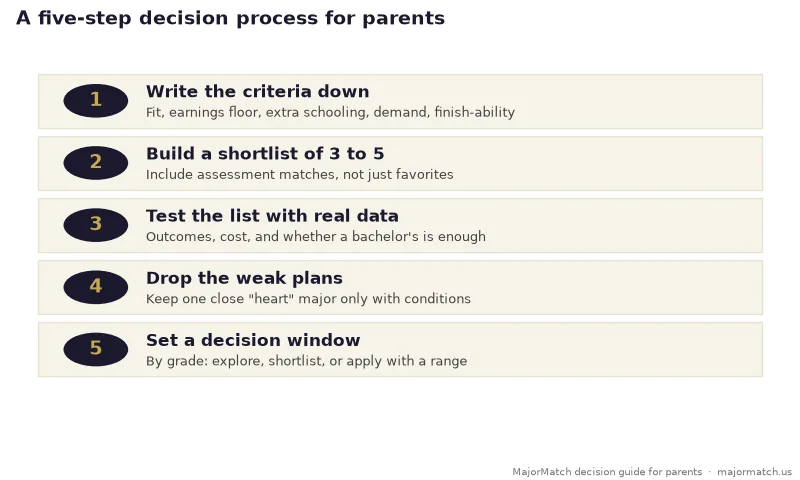
Five questions are enough. If a major cannot get a clear answer on each, it does not belong on the final list yet.
- Fit: can they do this, and will they stay with it? Interest matters, and so does ability in the skills the major actually uses (math, writing, lab work, working with people). A student who likes the idea of medicine and avoids chemistry is not ready to treat pre-med as a plan. A structured assessment that includes ability and interest — not just a four-minute quiz — is the fastest way to get this out of guesswork. See Are College Major Quizzes Accurate? and how a Holland Code maps to majors.
- Earnings floor: what do graduates typically earn if the path goes 'fine, not spectacular'? You are not trying to maximize salary at all costs. You are trying to avoid a plan that only works if everything breaks right. Look at early-career and mid-career medians, and at underemployment, from sources such as the New York Fed college labor-market data. The Major Earnings Continuum is a free way to browse that landscape.
- Time and credentials: is a bachelor's the end, or the start? Biology, chemistry, and psychology often lead to graduate or professional school. Nursing, accounting, and many engineering fields are more bachelor's-complete, with licensing instead of another degree. If the target job typically needs a master's or a doctorate, write the extra years and cost into the plan now.
- Demand and resilience: is there a job at the other end, and how exposed is it? You do not need a forecast of the next decade. You do need to know whether the occupation is small and crowded, growing, or already showing weak outcomes for recent graduates. Pair that with your teen's backup: a related major, a minor, or a career that uses the same skills.
- Finish-ability: will they complete it at the campus and cost you are actually choosing? A high-paying major your teen will abandon in year two is an expensive detour. Switching has a real cost; see the cost of switching majors. The loan-versus-upside calculator is the right place to test whether a given campus and major still make sense if earnings land near the median, not the 90th percentile.
How do you build and test a shortlist of majors?
Three to five majors is the right size. One is a verdict masquerading as a process. Twelve is a mood board.
Step 1 — Collect, don't vote. Write down every major your teen is considering, plus one or two that a counselor, a class they like, or an assessment has suggested and they have not taken seriously. Parents may add a candidate. They may not veto the list at this stage.
Step 2 — Get a structured read. Have your teen take a serious assessment and put the top matches on the list, even if they were not already there. The MajorMatch assessment takes about 10–20 minutes, is free for the top 3 matches, and is built for families to use at home. If the school already ran an aptitude tool such as YouScience, keep that report and add it as a second column; see YouScience alternatives if you are starting from scratch.
Step 3 — Score the list on the five criteria. A simple table is enough: major, fit (high/medium/low, with a one-line reason), early- and mid-career pay, extra schooling or licensure, and a note on finish-ability. You are looking for majors that are at least medium on fit and above your family's earnings floor, or high on fit with a deliberate plan to cover a weaker earnings floor (for example, a teaching major in a state with strong aid, or a biology major with a clear professional-school plan).
Step 4 — Kill politely. Drop majors that fail on two or more criteria with no plan to fix the gap. Keep one 'heart' major if it is close, and say what would have to be true (a specific career, a backup skill, a cost cap) for it to stay.
Step 5 — Set a decision window, not a personality test. A 10th grader needs exploration dates, not a locked major. An 11th grader needs a shortlist before campus tours and senior-year courses. A 12th grader who is still wide open can apply undeclared or to a related set of majors at the same school; see undeclared major pros and cons. The college-prep timeline has the year-by-year version of this.
How should parents use salary data without taking over the decision?
Salary data is for screening and for honesty. It is not a permission slip to pick the major yourself.
A useful way to talk about it: 'Here is the early-career median, and here is the mid-career median, for people who stopped at a bachelor's. If you want a career that usually needs a graduate degree, here is that path too. Which of these still feels like a life you want?' A less useful way: 'This one makes $20,000 more, so that's what you're doing.'
Two common traps. First, comparing a physicist's occupational median (a job that typically requires a doctorate) with a biologist's bachelor's-only early-career wage. Those are different kinds of numbers; highest-paying science majors walks through the difference. Second, treating a high median as a promise. Medians hide a wide spread, and they assume the student finishes and works full time in the field.
When the numbers show a plan is financially unworkable at the colleges you can actually pay for, say so. That is parenting, not hijacking. When the numbers are acceptable and the fight is really about status or an old family script, step back. Questions to ask before a college major and what to do when parents disagree are for those moments.
What is the parent's job in this decision — and what is not?
The parent's job is to supply process, information, and a budget reality. The teen's job is to do the work: take the assessment, look at the data, talk to people in the field, and own the choice.
Helpful moves: sit with them while they fill in the shortlist table; tour a lab or a workplace; introduce a relative who does the work (and let your teen ask the questions); agree on a date to revisit the list. Unhelpful moves: quietly calling a counselor to change the plan, treating your own major as the default, or making the family dinner a cross-examination. Those patterns are the subject of mistakes parents make and what I wish I'd known — both written from the parent side.
If you want a tool in the room, use it as a shared object, not a gavel. Take the free assessment, look at the top 3 together, and open the Continuum on the same majors. Use the optional $29 Pathfinder only if you want the full write-up for a counselor meeting or a family discussion. The assessment is designed so a parent can be involved without taking the test for them.
What should we do this week?
A one-week version of the process, if the decision is starting to feel urgent:
- Write a shortlist of three to five majors on one page, with a blank column for each of the five criteria.
- Have your teen take the free MajorMatch assessment (about 10–20 minutes) and add the top matches to the list if they are not already there.
- Look up each remaining major on the Major Earnings Continuum and, if cost is a concern, run the loan-versus-upside calculator.
- Have one conversation using a script from The College Major Talk With Your Teen — about the table, not about character.
- Set the next check-in date, and put the year-by-year tasks on the parent timeline.
If you are still early (9th or 10th grade), stretch the same steps over a semester and spend more time on classes, activities, and exposure than on a final label. The process is the same. The deadline is not.
Want a shortlist based on more than a hunch?
Take the free adaptive assessment (about 10 to 20 minutes) to see your top 3 major matches, scored with our own proprietary scoring method. The full Pathfinder report is $29 if you want the deeper plan.
Take the assessment →Frequently asked questions
How can parents help a teen choose a college major without taking over?
Run a process, not a campaign. Agree on the criteria (fit, earnings floor, extra schooling, demand, finish-ability), build a shortlist of three to five majors, test it with an assessment and published outcome data, and leave the final call with your teen unless the plan is financially unworkable.
When should a teen decide on a college major?
A 10th grader needs a shortlist and exploration, not a lock-in. An 11th grader should have a shortlist before campus visits and senior courses. A 12th grader can still apply undeclared or to a related set of majors. Use the parent college-prep timeline for year-by-year tasks.
What is the most important factor in choosing a college major?
Fit you can finish, at a cost you can carry, with an earnings floor your family can live with. Salary by itself, or passion by itself, is a weak rule. The useful work is putting those factors on the same page for a few specific majors.
Should parents use a college major quiz?
Use a serious assessment, not a four-minute entertainment quiz. Look for a tool that states what it measures, gives you a result you can reread, and does not require you to invent the labor-market context yourself. The MajorMatch assessment takes about 10–20 minutes and returns free top 3 matches; the optional Pathfinder report is $29.
What if my teen has no idea what to major in?
That is a normal starting point, not a crisis. Build the shortlist from classes they already like, careers they can describe, and the top matches from an assessment. Stay undeclared or loosely declared if they are a senior and the shortlist is still related. See our undeclared-major guide and 'I don't know what to major in.'
How do I bring salary into the conversation without a fight?
Show early- and mid-career medians as a floor and a path, and ask which still look like a life they want. Do not use a single occupational median as a order. If the plan is genuinely unaffordable at the colleges you can pay for, say that as a budget fact, not as a judgment of the major.