Quick answer: Take a Holland Code career test if you want a plain-language map of work interests. Use the official O*NET Interest Profiler when you want a pure RIASEC result at no cost. Use a major assessment when you also want those interests scored against college majors, salary context, and a shortlist you can act on. Do not pick a major from three letters alone.
Parents and students looking for a Holland Code career test, or a RIASEC college major quiz, are usually trying to get one thing: a vocabulary for 'what kind of work would I actually like' that is more serious than a five-minute entertainment quiz.
The framework is old, well studied, and still widely used in counseling and in the federal career tools. John Holland grouped work interests into six types. Most people are a mix, so the result is written as a three-letter code (for example, IAS or SEC) for the three types that fit best. The official public instrument in the United States is the O*NET Interest Profiler, maintained by the National Center for O*NET Development and sponsored by the U.S. Department of Labor, Employment and Training Administration. You can also take it through My Next Move.
What the code does not do is tell you which major will pay the bills, whether you can finish the coursework, or whether a given career is hiring. That is the gap this page is for: a clear map from each type to college majors, plus an honest account of what to do after you have a code.
What is a Holland Code (RIASEC) career test?
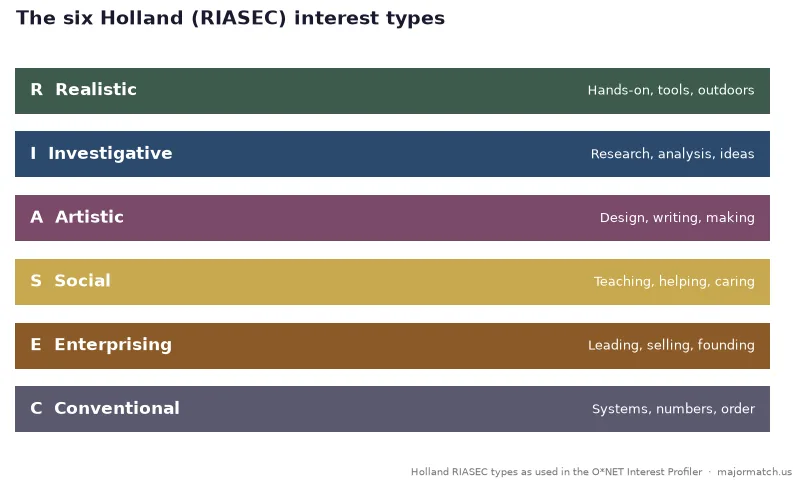
A Holland Code career test asks how much you would like different kinds of work, then scores you on six interest types, often abbreviated RIASEC:
- Realistic (R) — Doers. Hands-on work, tools, machines, plants, animals, or the outdoors.
- Investigative (I) — Thinkers. Research, analysis, theories, and solving problems with data or ideas.
- Artistic (A) — Creators. Design, writing, music, performance, and open-ended making.
- Social (S) — Helpers. Teaching, counseling, nursing, coaching, and other work with people.
- Enterprising (E) — Persuaders. Leading, selling, starting projects, and influencing decisions.
- Conventional (C) — Organizers. Systems, records, numbers, procedures, and reliable detail work.
The O*NET Interest Profiler short form is a standardized interest inventory, not a personality type test and not a measure of skill. The O*NET program publishes a technical manual for the instrument; counselors have used Holland's model for decades because the six types are easy to explain and map onto a large set of occupations in O*NET.
A typical result looks like IAS or RCE. The first letter is the strongest interest, the second and third fill out the picture. Adjacent types on the RIASEC hexagon (for example, Investigative and Artistic, or Enterprising and Conventional) often appear together. Opposite types (Realistic and Social, or Investigative and Enterprising) can still show up in one person, and that combination is useful information, not an error.
Which college majors fit each Holland type?
These are typical major neighborhoods, not assigned seats. Plenty of engineers have Artistic or Social codes, and plenty of teachers score Investigative. Use the list to start a shortlist, then check the actual major and the work it leads to.
| RIASEC type | What it points to | Example college majors | Careers the majors often lead to |
|---|---|---|---|
| Realistic (R) | Building, fixing, operating, working outdoors or with things | Mechanical, civil, or electrical engineering; construction management; agriculture; environmental science; aviation; information technology | Engineer, technician, electrician, surveyor, farm or land manager, pilot, IT support |
| Investigative (I) | Research, analysis, science, and theory | Biology, chemistry, physics, biochemistry, mathematics, statistics, data science, computer science, economics, psychology (research) | Scientist, analyst, physician (after professional school), software developer, researcher |
| Artistic (A) | Design, writing, performance, and open-ended projects | Graphic design, film, English, journalism, architecture, interior design, music, fine arts, communications (creative tracks) | Designer, writer, editor, architect, producer, content or brand roles |
| Social (S) | Teaching, caring, counseling, and community work | Education, nursing, social work, psychology, counseling, human development, public health, special education, communication disorders | Teacher, nurse, counselor, social worker, therapist (often with a graduate degree) |
| Enterprising (E) | Leading, selling, founding, and persuading | Business, marketing, finance, entrepreneurship, political science, public relations, hospitality management, real estate | Manager, sales lead, marketer, founder, campaign or public-affairs roles |
| Conventional (C) | Organizing information, procedures, and reliable systems | Accounting, finance, management information systems, logistics or supply chain, actuarial science, business analytics, office administration | Accountant, analyst, actuary, logistics planner, auditor, operations specialist |
Three-letter codes are more useful than a single letter. An IAS student may thrive in architecture, scientific illustration, or data journalism — not only in a pure science lab or a pure studio. An SEC student may like nursing leadership, school counseling with a heavy paperwork load, or human resources. If the first two letters disagree with a major your teen is already set on, that is a prompt to look closer, not an order to switch.
For majors that are especially people-facing or especially solitary, see Best College Majors for Extroverts and Best College Majors for Introverts. Interest type and social energy are related, but they are not the same thing.
What a Holland Code cannot tell you?
Interest is one signal. It is a weak signal when it is the only one.
- It does not measure aptitude. A student can be strongly Investigative and still struggle with the math in physics or the memorization in pre-med. A Realistic score does not mean someone can complete an engineering curriculum. That is why serious major decisions also look at ability in relevant domains. See Aptitude Test vs. Personality Test for Choosing a College Major.
- It does not rank majors by outcomes. A high Artistic score will not tell you the underemployment rate in fine arts or the licensure path in architecture. Pair any code with labor-market context — the Major Earnings Continuum and, when you have a shortlist, the loan-versus-upside calculator.
- It can freeze a teenager too early. Interests shift, especially between 10th grade and the second year of college. Treat the code as a current map, not a lifelong label.
- Short entertainment quizzes are not the official instrument. A 20-question viral quiz may use RIASEC language without the Interest Profiler's item design or scoring. If accuracy matters, use the official Profiler or a documented assessment that states which model it uses. More on that in Are College Major Quizzes Accurate?.
How do you take a Holland Code test and actually use the result?
A practical sequence:
- Take a documented inventory. The official, free option is the O*NET Interest Profiler. It is an interest inventory, and it will give you a RIASEC profile you can write down.
- Write the three-letter code and the majors it suggests from the table above. Keep it to a shortlist of five or six, not a new identity.
- Add aptitude and persistence. If a suggested major is math-heavy, check whether the coursework is realistic. If it is a long professional path, check whether your teen will stick with it.
- Add outcomes. Look up early- and mid-career pay, unemployment, and whether graduate school is typical for that major.
- Talk about the result as information, not a verdict. Parents: a useful line is "This is one view of what you are drawn to — let's see how it lines up with classes you already like." A less useful line is "You're a Social type, so you should be a teacher."
MajorMatch is not a standalone Holland-only quiz, and we do not administer the O*NET instrument. The adaptive assessment (about 10–20 minutes) includes Holland RIASEC interests as one layer, together with ability domains and persistence, then returns a ranked list of majors. The top 3 matches are free; the optional Pathfinder full report is $29. Methodology is on Our Science. If you already have an O*NET or school RIASEC result, keep it and compare it with the major shortlist — do not throw either one away.
Want a major shortlist, not just a three-letter code?
Take the free adaptive assessment (about 10 to 20 minutes) to see your top 3 major matches, scored with our own proprietary scoring method. The full Pathfinder report is $29 if you want the deeper plan.
Take the assessment →How is a Holland Code different from aptitude tests or personality tests?
People often search "Holland Code career test" and "personality career quiz" as if they were the same tool. They are not.
- Interest inventories (Holland / RIASEC, including the O*NET Interest Profiler) ask what you would like to do.
- Aptitude batteries (for example, many school-administered tools such as YouScience) ask what you can do, often with timed exercises. See YouScience alternatives for high school and our YouScience vs MajorMatch comparison.
- Personality frameworks (Big Five, and informal type quizzes) describe tendencies such as how you recharge or how you make decisions. They can inform work style. They are a poor standalone major picker. See Personality Type and College Major.
The most expensive mistake is collecting four labels that disagree and then ignoring all of them. The most useful approach is to keep each result in its lane: interests, abilities, and outcomes, then decide.
Frequently asked questions
What is a Holland Code career test?
It is an interest inventory based on John Holland's six RIASEC types: Realistic, Investigative, Artistic, Social, Enterprising, and Conventional. The result is usually a three-letter code showing your strongest interests, which you can map to college majors and careers.
What is the official Holland Code test?
In the United States, the public official instrument is the O*NET Interest Profiler, from the National Center for O*NET Development and sponsored by the U.S. Department of Labor, Employment and Training Administration. It is free on O*NET and on My Next Move.
Can a Holland Code tell me what to major in?
It can narrow the field. It cannot finish the decision. Pair the code with aptitude, the actual coursework, and labor-market data (pay, unemployment, whether graduate school is typical) before you treat it as a plan.
Is MajorMatch a Holland Code quiz?
MajorMatch includes Holland (RIASEC) interests as one layer of a ~10–20 minute adaptive assessment, together with ability and persistence. It is not a standalone copy of the O*NET Interest Profiler, and it does not administer that instrument. You get a free top 3 major matches; the optional Pathfinder report is $29.
What does a three-letter code like IAS or RCE mean?
The first letter is your strongest interest type, and the next two complete the profile. IAS is Investigative-Artistic-Social. RCE is Realistic-Conventional-Enterprising. The mix matters more than any single letter.
Are free RIASEC quizzes accurate?
The official O*NET Interest Profiler is a documented, free interest inventory. Short viral quizzes that use the same six letters may not use the same items or scoring. If you need a result you can take to a counselor, start with the official Profiler or an assessment that states its model clearly.
Sources
- O*NET Interest Profiler (National Center for O*NET Development; U.S. Department of Labor, Employment and Training Administration)
- My Next Move: O*NET Interest Profiler
- O*NET Interest Profiler Manual (technical documentation)
- MajorMatch, Our Science — methodology (proprietary matching; includes RIASEC as one layer)