Quick answer: If the school already gave you YouScience, keep it and add a major shortlist. If you need an aptitude-style alternative and the school will not run YouScience, ask the counselor what the district actually licenses before you buy anything. If you need a result tonight that maps to college majors, take a direct-to-family assessment and compare it with any school results you already have.
Families usually land on 'YouScience alternatives' for one of three reasons. The school never bought it. The school ran it, and the report still does not answer 'which majors should we plan around.' Or a parent is trying to buy something comparable at home and cannot tell aptitude tests from interest inventories from major quizzes.
This page is a comparison, not a takedown. YouScience's core idea is sound: interest alone can miss a student who has never been exposed to a field they might be wired for. Timed aptitude exercises for things like spatial and sequential reasoning exist for that reason. The limits are practical — access often depends on a district license, the sitting is long, and an aptitude profile is not the same thing as a ranked list of majors with wage and unemployment context a family can use the same night.
For a direct head-to-head with MajorMatch, see YouScience vs MajorMatch. For a wider menu of packages, including CliftonStrengths, Birkman, and Highlands, see Career Assessment Packages for High School Students. This post stays on the narrower question: what to use if YouScience is not available, not sufficient, or not the right tool for a major decision.
When is YouScience the right tool — and when is it not?
YouScience is built around aptitude: timed 'brain game' style exercises rather than a simple 'I like people / I like data' questionnaire. In schools it is often embedded in career and technical education or counseling workflows. Public materials and counseling practice commonly put consumer or school pricing in a $29–$49 band, but what a family actually pays — or whether they can buy it independently — depends on the district's license. Verify that with the school or the vendor. We do not invent star ratings or traffic claims for YouScience or for any alternative.
YouScience is a strong fit when:
- The school already administered it, and you have an aptitude profile to take into counselor or CTE meetings.
- You specifically want a measure of ability, not just stated interests.
- The family is willing to work through a longer sitting (often about 60–90 minutes or more) to get that aptitude layer.
It is a weaker fit, or needs a companion tool, when:
- You do not have school access and cannot confirm a straightforward home purchase path or price.
- The question you need answered tonight is 'which two or three college majors should we plan coursework around,' including pay and job context.
- A parent or student needs a shorter, family-owned process that does not depend on a school portal.
If the school already ran it, keep the report. An alternative in that case is usually an addition, not a replacement.
What are the main YouScience alternatives, and what does each measure?
These tools are not interchangeable. The useful way to compare them is by signal (aptitude, interest, strengths, or major fit), access (school vs. family), time, and output.
| Tool | What it measures | Typical access | Typical time | What you can do with the result |
|---|---|---|---|---|
| YouScience | Aptitude (timed exercises) | Often school-administered or licensed; home purchase varies | Often 60–90+ minutes | Aptitude language for CTE and counselor meetings; career/education mapping |
| O*NET Interest Profiler | Holland (RIASEC) interests | Free, official, no school login — U.S. Department of Labor / O*NET | Shorter interest inventory | A three-letter interest code you can map to occupations and majors |
| Truity Holland Code Career Test | Holland (RIASEC) interests | Direct-to-public; free and paid depths vary — confirm on the vendor site | Varies by version | An interest profile similar in kind to O*NET; not an aptitude battery |
| CareerExplorer | Career interests and related questionnaires | Used by some schools and by families online; licensing and price vary — confirm with the vendor | Typically longer than a short quiz | Career suggestions from interests; not a substitute for an aptitude battery |
| Naviance (and similar school platforms) | College and career planning inside a school system | School license only | Ongoing, not a single sitting | Course planning and college applications; see Naviance vs MajorMatch |
| CliftonStrengths (Gallup) | Talents / strengths themes | Paid, direct-to-public or school/coaching packages | Shorter than a full aptitude battery | Language for how a student works; it does not rank college majors |
| College Board BigFuture | Career and college exploration | Free, public | Self-paced exploration | College and career browsing; not an aptitude test |
| MajorMatch.us | Ability domains + Holland RIASEC interests + persistence, scored against college majors | Direct-to-family, no school portal | About 10–20 minutes adaptive | Free top 3 major matches; optional $29 Pathfinder; Major Earnings Continuum and parent timeline |
Two additions are worth stating plainly. First, we do not have independently verified list prices for every competitor on every channel, and those prices change. Confirm with the vendor or the district before you budget. Second, 'alternative' does not mean 'the same test, cheaper.' An interest inventory will not reproduce YouScience's aptitude scores, and a major-fit assessment will not reproduce a 60-minute aptitude battery. Choose the signal you are missing.
For a deeper look at Holland specifically, see Holland Code Career Test: RIASEC and College Majors. For aptitude versus personality more broadly, see Aptitude Test vs. Personality Test.
How should a family choose among YouScience alternatives?
Work backwards from the decision you need to make.
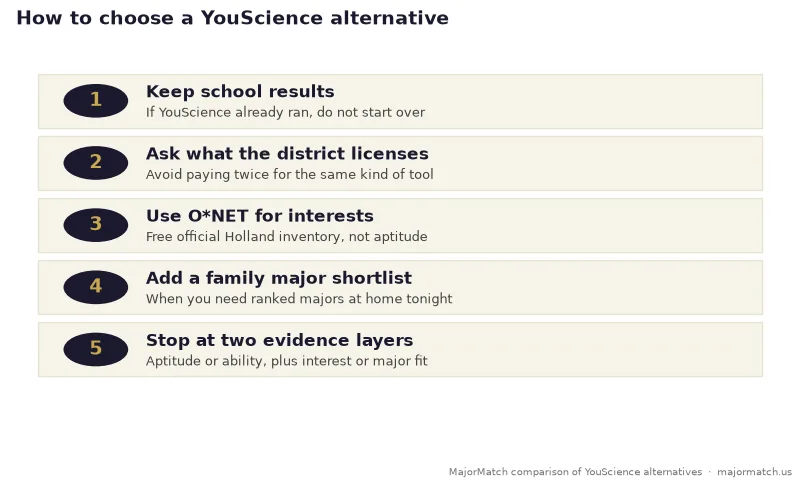
- If the school already ran YouScience — do not buy a second aptitude battery just to have one. Keep the school report. Add a major shortlist and outcomes (pay, typical education, whether graduate school is common) so the aptitude language turns into a plan.
- If you want aptitude and the school will not offer YouScience — ask the counselor what the district already licenses (YouScience, Naviance, Xello, CareerExplorer, or something else) before paying out of pocket. Buying a consumer version without checking school access is the usual way families spend twice.
- If you want a free, official interest profile — take the O*NET Interest Profiler. It is a documented Holland inventory, not an aptitude test.
- If you need a family-owned major shortlist — use a direct-to-family assessment that states what it measures and what you get without a school login. MajorMatch is built for that: about 10–20 minutes, free top 3 majors, optional $29 Pathfinder, plus the free Major Earnings Continuum and parent college-prep timeline.
- If you are collecting tools — stop at two evidence layers (one aptitude or ability, one interest or major fit) and a set of outcome numbers. A third and fourth label usually adds noise.
Parents who are shopping because they want a 'quiz for parents' may also want College Major Quiz for Parents, which is about how to use any result without taking the decision over.
Where MajorMatch fits — and where it does not
MajorMatch is a direct-to-family college major assessment. It is not YouScience, it does not administer YouScience's instruments, and it is not trying to be a 90-minute aptitude battery. The sitting is shorter (about 10–20 minutes, adaptive). It scores ability domains, Holland RIASEC interests, and persistence, then ranks college majors. You see the top 3 matches for free. The optional Pathfinder report is a one-time $29 — no subscription and no school portal.
That is the right tool when the family's job is to leave the evening with a shortlist and a way to look at pay and paths. It is the wrong tool if what you actually need is a school-official aptitude record for a CTE program that already standardized on YouScience. In that case, use the school tool for the school process, and use MajorMatch (or the O*NET Profiler) as the family layer.
Methodology is on Our Science. Pricing is on Pricing. If you want the side-by-side in more detail, use YouScience vs MajorMatch.
Need a major shortlist you can use at home tonight?
Take the free adaptive assessment (about 10 to 20 minutes) to see your top 3 major matches, scored with our own proprietary scoring method. The full Pathfinder report is $29 if you want the deeper plan.
Take the assessment →Frequently asked questions
What is a good alternative to YouScience for high school students?
It depends on what you need. For a free official interest profile, use the O*NET Interest Profiler. For a family-owned college major shortlist, use a direct-to-family assessment such as MajorMatch (free top 3, optional $29 Pathfinder). If you need another aptitude battery because the school will not run YouScience, ask the counselor what the district already licenses before you buy.
Is YouScience an aptitude test or an interest inventory?
YouScience is an aptitude-forward battery: timed exercises aimed at what a student can do. A Holland Code or RIASEC quiz is an interest inventory: what a student would like to do. They answer different questions, and one is not a full substitute for the other.
Can we use MajorMatch if our school already gave us YouScience?
Yes. Keep the school aptitude results. Use MajorMatch when you want a ranked major shortlist, free top 3 matches, and labor context the family controls at home. Compare the two; do not throw the school report away.
How much does YouScience cost if we are not going through a school?
Public materials and school practice commonly put family-facing or school pricing in a $29–$49 range, but access and price depend on district licensing and the vendor's current channels. Confirm with your school or with YouScience. We do not treat that range as a checkout price.
Is CareerExplorer or Truity the same as YouScience?
No. Truity's widely used Holland Code test is an interest inventory. CareerExplorer is also interest-and-career oriented. Neither is a drop-in replacement for YouScience's aptitude battery, even if all three get mentioned in the same 'best career quiz' lists.
How long does MajorMatch take compared with YouScience?
MajorMatch's adaptive assessment typically takes about 10–20 minutes. YouScience sittings are often described as 60–90 minutes or more. The extra time on an aptitude battery can be worth it when you need that signal; it is not required for a first major shortlist.
Sources
- YouScience — official site (product positioning and current access/pricing should be verified with the vendor or your district)
- My Next Move / O*NET Interest Profiler (U.S. Department of Labor, Employment and Training Administration)
- O*NET Interest Profiler overview
- Truity Holland Code Career Test
- CareerExplorer
- Gallup CliftonStrengths
- College Board BigFuture
- MajorMatch, YouScience vs MajorMatch (access, time, and output comparison)
- MajorMatch, Our Science — methodology