Quick answer: Most colleges ask students to declare a major by the end of sophomore year, or before they reach about 60 credits. To declare, check the major's requirements, meet with an advisor, file the school's declaration form (often with a course plan) and get the department's approval. Competitive majors may require prerequisites, a minimum GPA or a separate application first.
"Declare your major" sounds like one form. At most colleges it's actually a short checklist: meet the major's entry requirements, plan your courses, get an advisor's sign-off, and file before a deadline. Miss a step and the change may not take effect until the next term.
This guide explains when you need to declare, the steps that apply at most four-year colleges, and what's at stake if you wait too long. Rules vary by school, so we show real policies from several universities and tell you exactly where to check your own.
What does it mean to declare a major?
Declaring a major means officially entering a degree program. Once you're in, you complete that major's required courses (at UNC Greensboro, at least 27 credit hours in the field) on top of general education, and the major appears on your transcript (UNC Greensboro catalog).
Declaring isn't permanent. At Stanford, for example, "you can change your major at any time before graduation, assuming you can fulfill the requirements" (Stanford Academic Advising). Plenty of students do: about one-third of bachelor's degree students change majors within three years of enrolling (NCES).
When do you have to declare a major?
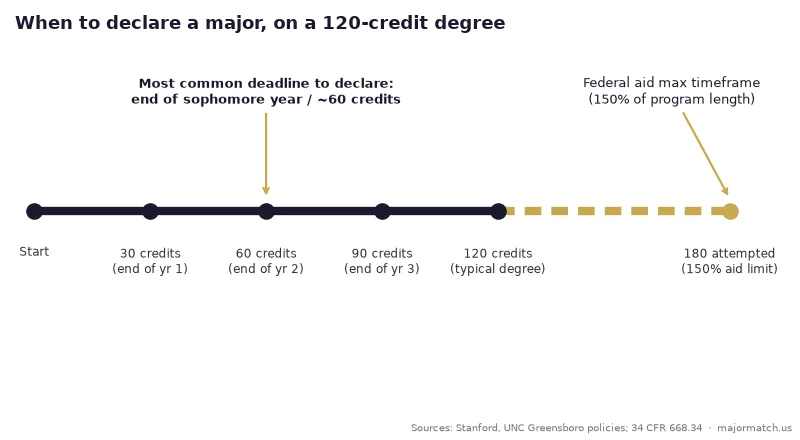
The most common rule is by the end of sophomore year, or around 60 credits, which is the halfway point of a typical 120-credit degree. Here's how that looks at real schools:
| School | Rule |
|---|---|
| Stanford | Declare any time in the first or second year; must declare by the end of sophomore spring. Transfers entering as juniors have until the end of junior year. |
| UNC Greensboro | Must declare and be accepted into a major before completing 60 credits. Transfers entering with more than 60 credits must declare before their first term. Students with 60+ credits can't switch back to Exploratory/Undecided. |
| UC Berkeley Engineering | Students are admitted to a major; changing majors requires at least one semester (two for the most popular majors) and an application before the fifth semester begins. |
| UCLA | Students admitted as undeclared can declare or change a major by contacting the department, at New Student Session, or with a counselor. |
Your college's rule is in its academic catalog, usually under "academic policies" or "declaring a major." Look for three things: the deadline (by credits or by term), whether some majors require an application, and when a declaration takes effect.
How to declare a major: step by step
- Find the department's "declaring the major" page. Stanford notes that "just about every department" has one, and that the process varies by department (Stanford).
- Check entry requirements. Some majors require specific courses, a minimum GPA or an application. A "pre-major" status isn't the same as admission: at UNC Greensboro, a pre-major "does not guarantee acceptance into the associated major" (UNCG).
- Run a degree audit. Use your school's degree audit or planning tool to see which courses you've taken already count toward the major.
- Meet an advisor. Bring a draft course plan through graduation. For capped majors, ask what happens if you're not admitted.
- Complete the paperwork. At Stanford, that means a program sheet charting your major courses, approved by a faculty advisor, then a final step in the student system. Some departments add a short essay or a peer-advisor meeting (Stanford).
- Get department approval and confirm the major shows in your student record.
- Check the effective date. At UNC Greensboro, declarations after the term deadline (typically 14 days after the start of fall or spring) take effect the next semester (UNCG).
- Update anything tied to your major, such as a scholarship that requires a specific field, or a program cohort.
Declaring into a competitive or capped major
Some majors have more students who want in than seats. Engineering, computer science, nursing and business are common examples, though it varies by school. UC Berkeley's College of Engineering shows how strict this can get:
- Students must complete at least one semester first, and the most heavily subscribed majors may require two.
- Applications are due before the fifth semester begins, with no exceptions after that.
- Students must make satisfactory progress in their current major (at least two technical courses toward it every semester) and meet GPA and course minimums that vary by major.
- A change into EECS must be the student's first change of major.
- Meeting the criteria isn't a guarantee: without a realistic plan to finish on time, the change is denied.
(Berkeley Engineering). If your target major works like this, take the gateway courses in your first year, aim above the minimum GPA, apply in the first window you're eligible, and have a related backup major ready.
Not sure which major to declare?
Take the free adaptive assessment (about 10 to 20 minutes) to see your top 3 major matches, scored with our own proprietary scoring method, before the deadline makes the choice for you. The full Pathfinder report is $29 if you want the deeper plan.
Take the free assessment →What waiting too long can cost
Declaring late isn't just paperwork. It can push back graduation, and federal aid has limits:
- The 150% rule. To keep federal student aid, undergraduates must finish within a maximum timeframe of no more than 150% of the program's published length (34 CFR 668.34). For a 120-credit degree, that means about 180 attempted credits. Courses that don't count toward your eventual major still count as attempted.
- Pell Grant lifetime limit. Lifetime Pell eligibility is capped at 600%, the equivalent of six full-year scheduled awards, or roughly 12 full-time semesters (FSA Handbook 2026–27).
- Extra semesters cost real money. Average published tuition and fees at public four-year colleges are $12,290 a year for in-state students in 2026–27, and $46,350 at private nonprofit four-years, before housing (College Board). Each added semester is roughly half of that, plus living costs.
Our cost of switching majors calculator estimates what a late switch adds, and the real cost of switching majors walks through the math.
Still undecided? How to choose before the deadline
If the deadline is coming and you're still unsure, narrow the field in a structured way:
- Shortlist two or three majors using the classes you've done best in and enjoyed most.
- Compare requirements side by side. Which courses overlap? A major that shares prerequisites with your backup keeps options open.
- Talk to two juniors or seniors in each major about the upper-level courses, not just the intro.
- Look at outcomes: what graduates do and earn. Our Major Earnings Continuum maps majors to careers and mid-career pay.
- Decide, then commit for a semester. Stanford's advice is to try a major out by declaring and getting involved in the department; you can change if it's not the right fit.
More help: how to choose a college major and undeclared major pros and cons.
Declaring a double major or a minor
Schools define these differently, so read your catalog. At UNC Greensboro, a double major means completing two majors under one degree (for example, a B.A. in music and political science), with one diploma and both majors on the transcript. Simultaneous degrees are two different degrees (such as a B.A. and a B.S.), with two diplomas. A minor is an optional secondary field (UNCG).
Declare the primary major first, then add the second major or minor once you've confirmed the combined plan fits in your remaining terms. See double major vs. minor for the trade-offs.
Declaration checklist
- I know my school's declaration deadline (term or credit count).
- I've read the department's "declaring the major" page.
- I've completed, or am enrolled in, the gateway courses.
- My GPA meets the major's minimum, with room to spare if the major is capped.
- I've run a degree audit and drafted a plan through graduation.
- I've met with an advisor and know who signs off.
- I've submitted the form or application before the deadline, not during finals week.
- I've confirmed the major shows in my student record and when it takes effect.
- I have a backup major if this one has limited seats.
Frequently asked questions
When do you declare a major in college?
Most colleges ask students to declare by the end of sophomore year, or before about 60 credits. Stanford's deadline is the end of sophomore spring; UNC Greensboro requires acceptance into a major before completing 60 credits.
Can you declare a major freshman year?
Usually, yes. Many schools let you declare as soon as you meet the major's requirements, and some admit you directly into a major. Stanford lets students declare any time in the first or second year.
Is declaring a major permanent?
No. Most colleges let you change majors if you can still complete the new major's requirements, and about a third of bachelor's students change majors within three years. Changing late can add semesters, though.
What happens if you don't declare a major by the deadline?
It depends on the school, so check your catalog. At UNC Greensboro, for example, students with 60 or more credits can't move back to Exploratory/Undecided, and declarations after the term deadline take effect the following semester.
Does declaring a major late affect financial aid?
It can. Federal aid requires finishing within 150% of your program's published length, about 180 attempted credits for a 120-credit degree, and lifetime Pell eligibility is capped at roughly 12 full-time semesters.
How long does it take to declare a major?
The form itself is quick, but approvals can take a few weeks. Stanford advises not leaving it to the last minute, since advisors may not be available during finals week.
Sources
- Stanford University Academic Advising, Declaring Your Major
- UNC Greensboro Undergraduate Catalog, Majors, Minors, Double Majors and Simultaneous Degrees Policy
- Berkeley Engineering, Change of major
- UCLA Undergraduate Admission, Choosing a Major as a First-Year
- 34 CFR 668.34, Satisfactory academic progress (eCFR)
- Federal Student Aid Handbook 2026–27, Vol. 7, Ch. 8: Pell Grant Lifetime Eligibility Used
- NCES, Beginning College Students Who Change Their Majors Within 3 Years of Enrollment (NCES 2018-434)
- College Board, Trends in College Pricing 2026: Highlights
Written and fact-checked by the MajorMatch editorial team. Fees, dates and rules were checked against the sources above on November 24, 2026. Colleges change their policies; confirm details on each school's own site.