Quick answer: Pick the major by the career's entry route. If the career needs a professional degree (lawyer, doctor, dentist, vet, PA, physical therapist), choose a major you'll do well in and finish the prerequisites. If employers or licensing boards expect a specific degree (nurse, engineer, accountant, dental hygienist), choose that exact major. The Bureau of Labor Statistics says no specific undergraduate degree is required for medical school.
"I want to be a physical therapist. What should I major in?" It's one of the most common questions students ask, and the answer is often not what they expect. Many careers don't have a matching major at all.
At most colleges, "pre-law" and "pre-PT" aren't majors at all. They're advising tracks. Other careers are the opposite: you can't become a nurse or an engineer without that exact degree. Knowing which kind of career you're aiming for changes how you should pick a major.
This guide covers 25 careers students search for most. It uses the Bureau of Labor Statistics' Occupational Outlook Handbook "How to Become One" sections and May 2025 pay data, plus the veterinary schools' own applicant guide. Sources are linked throughout and listed at the end.
What major do you need for the career you want?
Here are 25 careers, what to major in for each, and what comes after college. Each career name links to its official Bureau of Labor Statistics profile.
| Career | What to major in | What you need after college | Specific major required? | Median pay (May 2025) |
|---|---|---|---|---|
| Lawyer | Any major. Common: legal studies, history, social science | Law degree (J.D.) and a bar exam | No | $159,670 |
| Doctor (physician) | Any major with premed courses. Common: biology, physical science | Medical school (4 years), then 3 to 9 years of residency | No | $275,930 |
| Dentist | Any major with science courses. Biology is often preferred | Dental school (DDS or DMD) and a license | No | $176,110 |
| Pharmacist | Biology, chemistry or a health field (at least 2 years of prerequisites) | Doctor of Pharmacy (Pharm.D.) and a license | No | $140,910 |
| Physician assistant | Biology or a health field, with science coursework | Master's from an accredited PA program, plus patient-care experience | No | $135,880 |
| Nurse practitioner | Nursing (BSN) | Master's or doctorate in nursing and national certification | Yes | $132,300 |
| Veterinarian | Any major with prerequisites. Most applicants: animal science or biology | Doctor of Veterinary Medicine (DVM) | No | $130,100 |
| Physical therapist | Kinesiology, exercise science or a health field, with anatomy, chemistry and physics | Doctor of Physical Therapy (DPT, about 3 years) | No | $102,760 |
| Occupational therapist | Any major, with biology and psychology coursework | Master's in occupational therapy and a license | No | $100,330 |
| Psychologist | Psychology, education or social science | Master's or doctorate (Ph.D. or Psy.D.) and a license | No | $99,110 |
| Therapist (mental health counselor) | Psychology, social services or social science | Master's degree, supervised internship and sometimes a state license | No | $59,350 |
| Social worker | Social work (BSW) for entry-level jobs | MSW for clinical work (any bachelor's accepted) | Yes, for entry jobs | $61,780 |
| School counselor | Psychology or education are common | Master's in school counseling and a state credential | No | $64,330 |
| High school teacher | Education or the subject you will teach | State teaching certification or license | Often | $72,040 |
| Registered nurse | Nursing (BSN), or an associate's degree in nursing | Licensing exam | Yes | $97,550 |
| Dental hygienist | Dental hygiene (associate's; programs usually take 3 years) | State license | Yes | $98,100 |
| Ultrasound tech (sonographer) | Sonography (associate's degree or certificate) | Certification or license in some states | Yes | $96,590 |
| Software developer | Computer science or a related field, such as engineering or math | Nothing required; internships help | Usually | $135,980 |
| Mechanical engineer | Mechanical engineering or mechanical engineering technology | License if you offer services to the public | Yes | $104,110 |
| Accountant or CPA | Accounting or a related field, such as business | CPA exam and state requirements to become a CPA | Usually | $83,680 |
| Marketing manager | Marketing, business or communications | Several years of related work experience | No | $166,790 |
| Human resources specialist | Human resources, business or communications | Nothing required | No | $75,940 |
| Airline pilot | Any major. Common: transportation, engineering, business | Flight training, flight hours and an FAA airline transport pilot certificate | No | $232,140 |
| Forensic scientist | Physical science, biology or forensic science | On-the-job training | No | $72,060 |
| Police officer | No specific major; some agencies require college | Police academy and on-the-job training | No | $77,310 |
Pay is the national median for May 2025. Doctor pay is for all physicians and surgeons. Nurse practitioner pay is the BLS Employment Projections figure for nurse practitioners. Police pay covers police and detectives. Sources: U.S. Bureau of Labor Statistics, Occupational Outlook Handbook and Employment Projections Table 1.2; AAVMC VMCAS 2025 Applicant Guide (veterinarians).
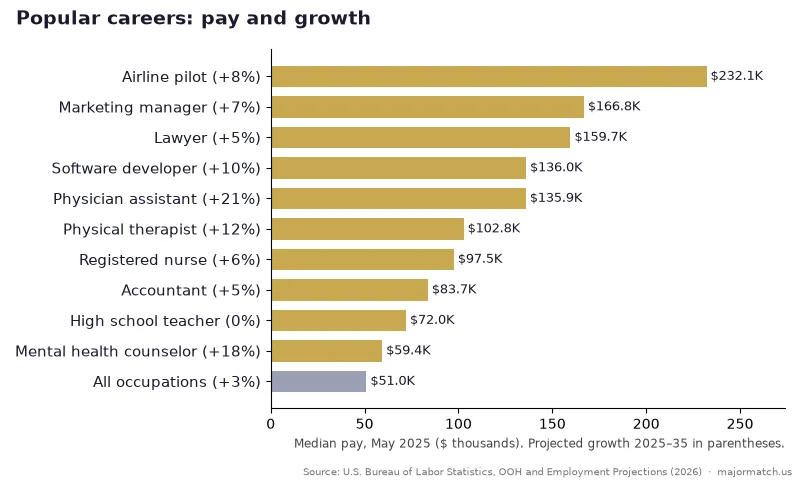
Every career on the list pays above the $50,980 median for all workers. The lowest-paid, mental health counselors at $59,350, is also one of the fastest-growing: BLS projects 18% growth from 2025 to 2035, six times the 3% average.
Which careers let you choose any major?
Most careers that require a professional or graduate degree care more about prerequisites, grades and experience than about your major's name. In BLS's words:
- Doctors: "No specific undergraduate degree is required to enter an M.D. or D.O. program," though most applicants study biology, physical science or health fields (BLS).
- Lawyers: "Most law schools do not require a specific bachelor's degree for entry." Common fields include legal studies, history and social science (BLS).
- Dentists: "Although no specific undergraduate major is required, programs may prefer applicants who have a bachelor's degree in a science, such as biology" (BLS).
- Occupational therapists: admission to OT programs requires a bachelor's degree, "although it may not need to be in a particular subject" (BLS).
- Veterinarians: the VMCAS 2025 Applicant Guide says "Your choice of major is not a factor in veterinary school admissions."
- Airline pilots: they typically need a bachelor's degree "in any field," plus flight training and FAA certificates (BLS).
The catch is the prerequisite list. Medical, dental, PA and PT programs all expect a block of science courses, usually biology, chemistry and physics. You can major in English and still apply, but you'll need to fit those classes into your schedule. A science major does that for you, which is why so many applicants choose one.
Which careers need a specific major?
For these careers, the degree itself is the entry ticket, because employers or licensing boards expect it:
- Registered nurse: a bachelor's in nursing (BSN), an associate's in nursing or a nursing diploma, then a licensing exam. BLS notes that hospitals may require a bachelor's (BLS). Nurse practitioners build on that with a master's.
- Engineer: mechanical engineers typically need a bachelor's in mechanical engineering or engineering technology (BLS). See our engineering majors ranked by pay and jobs.
- Accountant: a bachelor's in accounting or a related field such as business. CPAs also pass a national exam and meet state rules (BLS).
- Dental hygienist and sonographer: both start with an associate's degree in that field and pay a median of about $96,000 to $98,000. See the highest-paying 2-year degrees.
- Social worker: a bachelor's in social work (BSW) is "the most common requirement for entry-level nonclinical social worker positions." A master's (MSW) is needed for clinical work, and MSW programs accept a bachelor's "in almost any field" (BLS).
- Teacher: public school teachers need a state license, and many states require high school teachers to major in the subject they teach (BLS).
If you're drawn to one of these, it pays to decide early. Switching into nursing or engineering late can add semesters, because the course sequences are long.
Not sure which career, or which major, fits you?
Take the free adaptive assessment (about 10 to 20 minutes) to see your top 3 major matches, scored with our own proprietary scoring method. The full Pathfinder report is $29 if you want the deeper plan.
Take the assessment →What should I major in to become a doctor, dentist, PA or physical therapist?
Choose a major that covers the science prerequisites and that you can earn strong grades in. Biology and chemistry are the most common picks. Kinesiology and exercise science are popular for physical therapy, and BLS notes that PT programs often admit students with degrees in recreation and fitness or health fields.
The bigger factors are grades, entrance exams and hands-on experience. PA programs, for example, typically want applicants with direct patient care experience, such as work as a medical assistant or EMT. Plan on a long road: BLS says physicians need four years of medical school after college, then three to nine years of residency, and DPT programs typically last three years.
For side-by-side detail, see our guides to the best pre-med majors, what you can do with a kinesiology degree and what you can do with a pharmacy degree.
What should I major in to become a therapist or psychologist?
Psychology is the most common choice, but it's not the only one. BLS lists psychology, public policy and social services, and social science as common undergraduate fields for mental health counselors, who typically need a master's degree and a supervised internship (BLS).
Psychologists need more school. Clinical and counseling psychologists typically need a Ph.D. or Psy.D., and graduate programs usually admit students with a bachelor's in psychology, education or social science (BLS). Social work is a third route: a master's in social work leads to licensed clinical social work, and it accepts almost any bachelor's.
Read more in what you can do with a psychology degree and what you can do with a social work degree.
What should I major in to become a lawyer?
Any major works. BLS says becoming a lawyer usually takes seven years of full-time study after high school: four years of college and three years of law school. Law schools look closely at grades and the LSAT, so pick a major that builds reading, writing and argument skills and that you'll do well in.
Political science, history, philosophy, English and economics are all common. Our best pre-law majors guide compares them, and is pre-law worth it? covers the cost of law school and the pay that follows.
What if you don't know which career you want yet?
Then don't start with the career. Start with what you're good at and what you enjoy, and look for majors that keep several of the careers above open. Biology keeps medicine, dentistry, PA and vet school on the table. Psychology keeps counseling, social work and HR open. Business and communications lead to marketing, sales and management.
It's also fine to start college undecided. Our guide to the pros and cons of an undeclared major explains how to use your first year well.
If you want a starting point, take the assessment. It looks at your interests and strengths with our proprietary scoring and returns your top 3 major matches, so you can see which careers on this list fit you before you commit.
Frequently asked questions
Do you need a specific major to go to medical school?
No. The Bureau of Labor Statistics says no specific undergraduate degree is required to enter an M.D. or D.O. program. Most applicants study biology, physical science or a health field, and every applicant needs the required science courses.
What major do you need to be a lawyer?
Any major. Most law schools do not require a specific bachelor's degree. Common choices include legal studies, history, political science and other social sciences, followed by three years of law school.
What should I major in to become a physical therapist?
Kinesiology, exercise science, biology or another health field are common, as long as you complete prerequisites such as anatomy, chemistry and physics. You then need a Doctor of Physical Therapy degree, which typically takes three years.
What major do you need to be a therapist?
Psychology is most common, but social services and other social sciences also work. Mental health counselors typically need a master's degree and a supervised internship, and some need a state license.
What major do you need to be a teacher?
Education or the subject you plan to teach. Public school teachers need a state license, and many states require high school teachers to major in a content area such as math or science.
Which careers require a specific college major?
Registered nursing, engineering, accounting, dental hygiene, sonography and entry-level social work usually require a matching degree, because employers or licensing boards expect that specific degree.
Sources
- U.S. Bureau of Labor Statistics, Employment Projections Table 1.2: Occupational projections, 2025–35, and worker characteristics, 2025
- U.S. Bureau of Labor Statistics, Occupational Outlook Handbook: Lawyers
- U.S. Bureau of Labor Statistics, Occupational Outlook Handbook: Physicians and Surgeons
- U.S. Bureau of Labor Statistics, Occupational Outlook Handbook: Dentists
- U.S. Bureau of Labor Statistics, Occupational Outlook Handbook: Pharmacists
- U.S. Bureau of Labor Statistics, Occupational Outlook Handbook: Physician Assistants
- U.S. Bureau of Labor Statistics, Occupational Outlook Handbook: Nurse Anesthetists, Nurse Midwives, and Nurse Practitioners
- U.S. Bureau of Labor Statistics, Occupational Outlook Handbook: Veterinarians
- U.S. Bureau of Labor Statistics, Occupational Outlook Handbook: Physical Therapists
- U.S. Bureau of Labor Statistics, Occupational Outlook Handbook: Occupational Therapists
- U.S. Bureau of Labor Statistics, Occupational Outlook Handbook: Psychologists
- U.S. Bureau of Labor Statistics, Occupational Outlook Handbook: Substance Abuse, Behavioral Disorder, and Mental Health Counselors
- U.S. Bureau of Labor Statistics, Occupational Outlook Handbook: Social Workers
- U.S. Bureau of Labor Statistics, Occupational Outlook Handbook: School and Career Counselors and Advisors
- U.S. Bureau of Labor Statistics, Occupational Outlook Handbook: High School Teachers
- U.S. Bureau of Labor Statistics, Occupational Outlook Handbook: Registered Nurses
- U.S. Bureau of Labor Statistics, Occupational Outlook Handbook: Dental Hygienists
- U.S. Bureau of Labor Statistics, Occupational Outlook Handbook: Diagnostic Medical Sonographers
- U.S. Bureau of Labor Statistics, Occupational Outlook Handbook: Software Developers, Quality Assurance Analysts, and Testers
- U.S. Bureau of Labor Statistics, Occupational Outlook Handbook: Mechanical Engineers
- U.S. Bureau of Labor Statistics, Occupational Outlook Handbook: Accountants and Auditors
- U.S. Bureau of Labor Statistics, Occupational Outlook Handbook: Advertising, Promotions, and Marketing Managers
- U.S. Bureau of Labor Statistics, Occupational Outlook Handbook: Human Resources Specialists
- U.S. Bureau of Labor Statistics, Occupational Outlook Handbook: Airline and Commercial Pilots
- U.S. Bureau of Labor Statistics, Occupational Outlook Handbook: Forensic Science Technicians
- U.S. Bureau of Labor Statistics, Occupational Outlook Handbook: Police and Detectives
- American Association of Veterinary Medical Colleges, VMCAS 2025 Applicant Guide