Quick answer: For a teen who loves animals, pick the major by the job they want. To become a veterinarian, choose animal science or biology and finish the vet school prerequisites. For wildlife, choose zoology or wildlife biology. For hands-on clinic work in two years, choose veterinary technology. The Bureau of Labor Statistics projects 9% growth for both veterinarians and vet techs from 2025 to 2035, triple the 3% average.
"My kid loves animals. What should they major in?" is one of the most common questions parents ask, and it's a good one. A love of animals often lasts, and it can point to real careers that pay well.
The catch is that "working with animals" covers jobs with very different paths. Some need eight years of school. Some need two. Some need no degree at all. And the major that's best for a future veterinarian isn't the best one for a future wildlife biologist.
This guide uses the Bureau of Labor Statistics' Occupational Outlook Handbook (May 2025 pay, 2025–35 projections), the New York Fed's outcomes by major, the veterinary schools' own applicant guide, and the federal DHS STEM list. Sources are linked throughout and listed at the end.
What are the best college majors for animal lovers?
Five majors lead most directly to careers with animals:
| Major | What it's best for | Typical careers | Watch out for |
|---|---|---|---|
| Animal science | Pre-vet, livestock, animal nutrition and breeding, agribusiness | Veterinarian (with a DVM), animal scientist, farm and ranch management, feed and animal health sales | Heavy focus on farm animals at many schools |
| Zoology or animal biology | Wild and exotic animals, animal behavior, research | Zoologist, wildlife biologist, zoo and aquarium science roles | Research jobs often need a master's; few openings each year |
| Wildlife biology / fisheries and wildlife | Field work, conservation, state and federal agencies | Wildlife biologist, fish and wildlife technician, conservation roles | Competitive, often seasonal entry-level work |
| Biology | Keeping vet school, med school and research all open | Veterinarian (with a DVM), lab and research roles, health careers | Broad degree; plan the animal experience yourself |
| Veterinary technology (2 or 4 years) | Hands-on clinical care, fastest route to working with animals | Veterinary technician or technologist | Lower pay ceiling; credentialing exam required |
Pick by the kind of animal work your teen pictures. Clinics and pets point to pre-vet or vet tech. Farms and livestock point to animal science. Wild animals and the outdoors point to zoology or wildlife biology. If they aren't sure yet, biology keeps the most doors open, including vet school and medical school.
Related paths are worth a look too. Environmental science leads to conservation work (see what you can do with an environmental science degree). Food science and agriculture connect animals to the food supply.
Which jobs working with animals pay well?
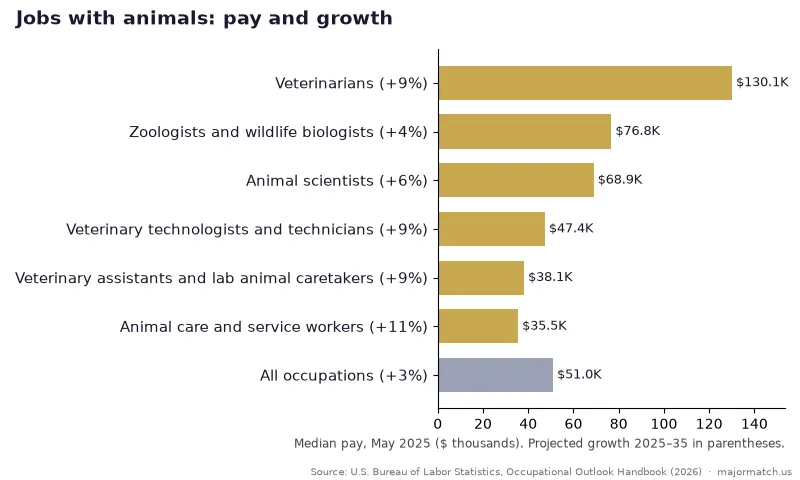
Here are the main animal careers, with figures from the Bureau of Labor Statistics. Each career name links to its official profile.
| Career | Median pay (May 2025) | Projected growth, 2025–35 | Openings per year | Typical entry education |
|---|---|---|---|---|
| Veterinarians | $130,100 | 9% | 3,100 | Doctor of Veterinary Medicine (DVM) |
| Zoologists and wildlife biologists | $76,780 | 4% | 1,400 | Bachelor's (master's for higher-level jobs) |
| Animal scientists | $68,940 | 6% | — | Bachelor's (master's or Ph.D. for many research jobs) |
| Veterinary technologists and technicians | $47,380 | 9% | 13,400 | Associate's (technicians) or bachelor's (technologists) |
| Veterinary assistants and lab animal caretakers | $38,150 | 9% | 23,200 | High school diploma |
| Animal care and service workers | $35,530 | 11% | 69,400 | High school diploma |
| All occupations | $50,980 | 3% | — | — |
Animal scientists are a subgroup of agricultural and food scientists. BLS does not publish their openings separately. Source: U.S. Bureau of Labor Statistics, Occupational Outlook Handbook (May 2025 wages, 2025–35 projections).
The pattern is clear. The more school a job needs, the more it pays. Veterinarians are the only animal career in the table well above $100,000, and the top 10% earn more than $215,700. Zoologists and wildlife biologists and animal scientists earn above the $50,980 median for all workers. Clinic and care jobs pay less, but they are growing fast and have the most openings by far.
What should you major in to become a veterinarian?
Any major works if you complete the prerequisites. The VMCAS 2025 Applicant Guide, published by the association of veterinary colleges, says plainly: "Your choice of major is not a factor in veterinary school admissions." It also notes that most applicants major in either animal science or biology.
What vet schools do care about is the prerequisite courses (a mix of biology, chemistry, math, social science and humanities), grades, and hands-on animal and veterinary experience. BLS adds that some schools prefer candidates who have studied agriculture or worked with animals on a farm, at a stable or in a shelter.
Plan on a long road. The applicant guide says a DVM typically takes eight years of education after high school: four years of college, then a four-year veterinary program. Admission is competitive, and veterinarians must also pass a national licensing exam. In return, veterinarians earn a median $130,100, and BLS projects 9% job growth from 2025 to 2035.
The pre-vet path looks a lot like pre-med. If your teen is torn between animals and people, our guide to the best pre-med majors covers the human-medicine side.
Not sure which animal path fits your teen?
Take the free adaptive assessment (about 10 to 20 minutes) to see your top 3 major matches, scored with our own proprietary scoring method. The full Pathfinder report is $29 if you want the deeper plan.
Take the assessment →Animal science vs. zoology vs. biology: which major is better?
None is better overall. They train students for different animal work:
- Animal science is often housed in a college of agriculture. It focuses on domestic animals and livestock: nutrition, breeding, genetics and health. It's a classic pre-vet major and leads to agriculture and animal health jobs.
- Zoology (or animal biology) studies animals as a branch of biology, including wild and exotic species and animal behavior. It's the more natural fit for zoo, aquarium and research careers.
- Biology is the broadest choice. It covers the vet school prerequisites and keeps medicine, research and health careers open. See what you can do with a biology degree.
On outcomes, the New York Fed groups animal science with plant science. Recent graduates (ages 22 to 27) in that group earn a median $46,600, rising to $79,000 at mid-career (ages 35 to 45). Biology grads start at $45,000 and reach $83,000. Both start below the $58,000 median for all majors, which is why the career plan matters more than the major's name.
Do you need a degree to work with animals?
Not always. Several animal jobs need only a high school diploma, and they have the most openings:
- Animal care and service workers (kennel staff, groomers, pet sitters, trainers): median $35,530, with about 69,400 openings a year and 11% projected growth. Caretakers earn a median $35,360 and trainers $39,990.
- Veterinary assistants and laboratory animal caretakers: median $38,150, about 23,200 openings a year.
A two-year degree is the next step up. Veterinary technicians need an associate's degree in veterinary technology and must pass a credentialing exam. They earn a median $47,380. Technologists usually hold a 4-year bachelor's degree. If two-year paths interest your teen, see our list of the highest-paying 2-year degrees.
These jobs are a smart way to test the interest before committing to a major. Vet schools value this kind of experience, too.
Is animal science a good major?
Yes, if it leads to a specific plan. Employment is strong: the New York Fed puts recent-graduate unemployment for animal and plant sciences at 2.5%, below the 4.2% average for all majors.
The weak spot is underemployment. 54% of recent grads in the group work in jobs that don't require a degree, compared with 39% across all majors. That's the risk for students who love animals but don't aim at vet school, research or an agriculture career.
Graduate school is part of the picture. 37% of animal and plant science majors go on to earn a graduate degree, and BLS says many animal scientist jobs prefer or require a master's or Ph.D. To see how the numbers work out with student loans, try our animal and plant sciences loan vs. upside calculator or the biology version.
Is animal science a STEM major?
Yes. Animal sciences (CIP 01.0901), zoology/animal biology (26.0701), animal behavior and ethology (26.0708), wildlife biology (26.0709) and wildlife, fish and wildlands science (03.0601) are all on the federal DHS STEM Designated Degree Program List. The veterinary technology program code (01.8301) is not. See what majors are considered STEM for how the list works.
Which animal major fits your teen?
Loving animals is a start, but the day-to-day work is what decides whether a career fits. A few questions help sort it out:
- Do they like science classes, especially biology and chemistry? Vet school, animal science and zoology all rest on them.
- Can they handle the hard parts? BLS notes that veterinarians euthanize animals and that vet tech and caretaker jobs can be physically and emotionally demanding.
- Do they want the outdoors or a clinic? Wildlife work is often field-based. Clinical work happens indoors with people and pets.
- How long do they want to be in school? Two years for vet tech, four for zoology or animal science, eight for a DVM.
An interest is only one piece. A teen who loves animals but also enjoys data, teaching or business may be happier in a different major with animals on the side. We cover that trade-off in why "follow your passion" is expensive advice.
If you're not sure, take the assessment. It looks at your teen's interests and strengths with our proprietary scoring and returns their top 3 major matches, so you can see whether an animal major, biology or something else fits best.
Frequently asked questions
What are the best college majors for animal lovers?
Animal science, zoology (animal biology), wildlife biology, biology and veterinary technology lead most directly to careers with animals. Pick by the job: animal science or biology for vet school, zoology or wildlife biology for wild animals, and vet tech for hands-on clinic work.
What are the highest-paying jobs working with animals?
Veterinarians lead with a median $130,100 (May 2025), followed by zoologists and wildlife biologists ($76,780) and animal scientists ($68,940), according to the Bureau of Labor Statistics. Veterinary technicians earn a median $47,380.
What should I major in to become a veterinarian?
Any major works if you complete the prerequisites. The VMCAS 2025 Applicant Guide says choice of major is not a factor in veterinary school admissions, and that most applicants major in animal science or biology.
Can you become a vet with a biology degree?
Yes. Biology is one of the two most common majors for vet school applicants, along with animal science. BLS notes that applicants typically have a bachelor's degree in a field such as biology, plus required science coursework.
Is animal science a good major?
It is if it leads to a plan such as vet school, research or an agriculture career. New York Fed data shows 2.5% unemployment for recent animal and plant science grads, but 54% underemployment and a $46,600 median early-career wage.
Do you need a degree to work with animals?
No for many jobs. Animal care and service workers and veterinary assistants typically need a high school diploma and earn median pay of $35,530 and $38,150. Vet technicians need an associate's degree, and veterinarians need a DVM.
Sources
- U.S. Bureau of Labor Statistics, Occupational Outlook Handbook: Veterinarians (May 2025 pay; 2025–35 projections)
- U.S. Bureau of Labor Statistics, Occupational Outlook Handbook: Zoologists and Wildlife Biologists
- U.S. Bureau of Labor Statistics, Occupational Outlook Handbook: Agricultural and Food Scientists (animal scientists)
- U.S. Bureau of Labor Statistics, Occupational Outlook Handbook: Veterinary Technologists and Technicians
- U.S. Bureau of Labor Statistics, Occupational Outlook Handbook: Veterinary Assistants and Laboratory Animal Caretakers
- U.S. Bureau of Labor Statistics, Occupational Outlook Handbook: Animal Care and Service Workers
- American Association of Veterinary Medical Colleges, VMCAS 2025 Applicant Guide
- Federal Reserve Bank of New York, The Labor Market for Recent College Graduates: Outcomes by Major (released Feb. 4, 2026; 2024 American Community Survey data)
- U.S. Department of Homeland Security, DHS STEM Designated Degree Program List (last updated July 22, 2024)