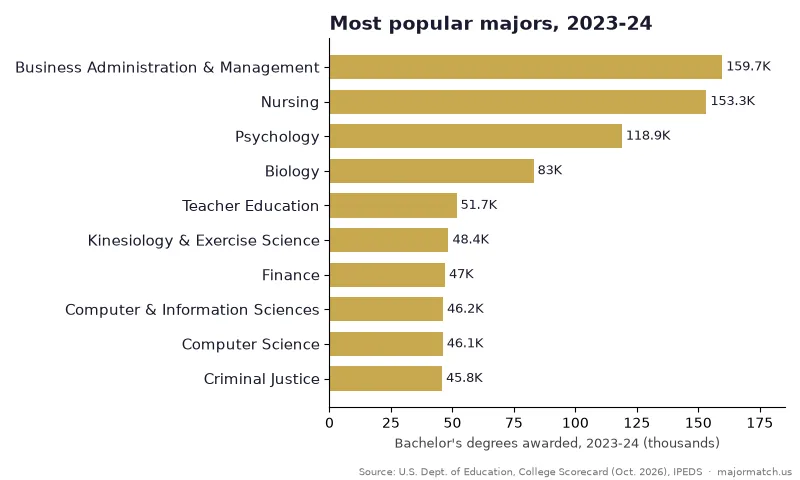
Quick answer: The most popular college majors, by bachelor's degrees awarded in 2023-24, are business administration and management (159,702), nursing (153,340), psychology (118,927), biology (83,041) and teacher education (51,651), according to U.S. Department of Education College Scorecard data updated October 15, 2026. Those five fields account for 27.5% of all bachelor's degrees. Count computer science's two federal codes together (92,340) and it would rank fourth.
Ask a room of high school seniors what they're majoring in and you'll hear the same handful of answers over and over. Business. Nursing. Psychology. Bio, "for pre-med." It can feel like everyone is picking from the same short menu.
They mostly are. Out of 392 fields with bachelor's programs in the federal data, the top 20 produce 56% of all graduates. We ranked them using the College Scorecard's newest field-of-study file, which counts the bachelor's degrees reported by every college that takes federal student aid, and then put the New York Fed's pay numbers next to each one.
Popular doesn't mean right for your kid. But knowing where everyone else is headed tells you something about competition, about which majors are growing, and about how much a common degree actually pays.
How did we rank the most popular majors?
The ranking uses one number: bachelor's degrees awarded in academic year 2023-24, summed across every college in the U.S. Department of Education's College Scorecard "Most Recent Data by Field of Study" file (updated October 15, 2026). Those counts come from the federal IPEDS completions survey. Majors are grouped by four-digit federal CIP code, the government's standard way of classifying fields of study. That's why computer science shows up as two separate rows: "computer and information sciences, general" and "computer science" are different codes.
The "change" column compares 2023-24 to 2022-23 at the same set of programs, so a college that's missing one year doesn't skew it. Pay comes from the closest matching major in the New York Fed's February 2026 outcomes-by-major table (2024 Census data). Teacher education and kinesiology don't have a clean match there, so we left their pay blank rather than guess.
What are the 20 most popular college majors?
| Rank | Major | Bachelor's degrees (2023-24) | Share of all | Change vs. 2022-23 | Early-career pay | Mid-career pay |
|---|---|---|---|---|---|---|
| 1 | Business Administration & Management | 159,702 | 7.7% | -0.8% | $56,000 | $82,000 |
| 2 | Nursing (RN) | 153,340 | 7.4% | -0.1% | $70,000 | $87,000 |
| 3 | Psychology | 118,927 | 5.8% | +1.2% | $45,000 | $72,000 |
| 4 | Biology | 83,041 | 4.0% | -2.8% | $45,000 | $83,000 |
| 5 | Teacher Education (grade levels, e.g. elementary) | 51,651 | 2.5% | +0.2% | — | — |
| 6 | Kinesiology & Exercise Science | 48,417 | 2.3% | +0.4% | — | — |
| 7 | Finance | 46,953 | 2.3% | -1.0% | $70,000 | $112,000 |
| 8 | Computer & Information Sciences | 46,192 | 2.2% | +4.6% | $87,000 | $120,000 |
| 9 | Computer Science | 46,148 | 2.2% | +5.0% | $87,000 | $120,000 |
| 10 | Criminal Justice | 45,807 | 2.2% | -4.7% | $50,000 | $80,000 |
| 11 | Marketing | 44,871 | 2.2% | +0.6% | $60,000 | $100,000 |
| 12 | Communication & Media Studies | 43,556 | 2.1% | -2.3% | $52,000 | $88,000 |
| 13 | Accounting | 40,816 | 2.0% | -2.8% | $68,000 | $97,000 |
| 14 | Political Science | 39,672 | 1.9% | -3.5% | $52,000 | $100,000 |
| 15 | Liberal Arts & General Studies | 38,238 | 1.9% | +1.4% | $45,000 | $75,000 |
| 16 | Economics | 34,393 | 1.7% | -4.4% | $72,000 | $115,000 |
| 17 | Mechanical Engineering | 33,346 | 1.6% | -1.4% | $80,000 | $120,000 |
| 18 | English | 26,315 | 1.3% | -3.6% | $48,000 | $76,000 |
| 19 | General Business | 25,919 | 1.3% | +1.9% | $60,000 | $90,000 |
| 20 | Fine & Studio Arts | 24,445 | 1.2% | +2.2% | $45,000 | $72,000 |
| — | All bachelor's degrees | 2,063,353 | 100% | — | $58,000 | $87,000 |
Sources: U.S. Department of Education, College Scorecard, Most Recent Data by Field of Study (updated Oct. 15, 2026; IPEDS completions, AY 2023-24 vs. 2022-23 at matching programs). Pay: Federal Reserve Bank of New York, Outcomes by Major (Feb. 4, 2026; 2024 ACS), closest matching major, median for full-time bachelor's-only workers aged 22–27 (early) and 35–45 (mid). "—" = no clean match.
Tap any major in the table to open its free loan-vs-upside calculator, or compare debt and lifetime earnings with your own numbers in the degree loan vs. upside calculator. Then take the assessment to see which of these majors actually fit your teen.
What are the top 5 most popular majors?
Together, these five account for 27.5% of every bachelor's degree awarded in 2023-24. Here's what each one actually leads to.
1. Business administration and management: 159,702
The default major for students who want a job and aren't sure which one. It's a fine choice with a plan, but it's also broad: New York Fed data show 52.6% of recent business management grads work in jobs that don't need a degree, versus 21.2% for accounting. If your teen is leaning business, picking a concentration matters. Is a business degree worth it? goes deeper.
2. Nursing: 153,340
Nursing is the most direct path on this list: you graduate, pass the licensing exam and work as a nurse. It has the lowest underemployment of any major in the New York Fed table (12.8%) and an early-career median of $70,000. See what you can do with a nursing degree.
3. Psychology: 118,927
Psychology is popular for good reasons, but a bachelor's alone pays less than most on this list ($45,000 early career). It's a launchpad: 52% of working-age psychology grads hold a graduate degree. Here's what you can do with a psychology degree.
4. Biology: 83,041
Biology is the classic pre-med and pre-health major, and it's also where many science plans quietly change. Its bachelor's-only early-career median is $45,000, but it nearly doubles by mid-career ($83,000). Our guide asks whether a biology degree is worth it.
5. Teacher education: 51,651
This federal code covers teacher-prep programs by grade level, such as elementary, early childhood and secondary education. The New York Fed tracks those majors separately: elementary education grads have very low underemployment (16.2%) and an early-career median of $45,000.
Is computer science still one of the most popular majors?
Yes, and it's bigger than the table makes it look. The federal codes split it in two: "computer and information sciences, general" (46,192 degrees) and "computer science" (46,148). Combined, that's 92,340 bachelor's degrees, enough to rank fourth, ahead of biology. Both codes also grew year over year (+4.6% and +5.0%),
The job market is tougher than the enrollment numbers suggest, though. In the New York Fed's 2024 data, recent computer science grads had 7.0% unemployment, well above the 4.2% all-majors rate, even though their early-career pay ($87,000) is among the highest. More grads competing for fewer junior roles is the trade-off. See what you can do with a computer science degree.
Which of these majors fits your teen?
Take the free adaptive assessment (about 15–25 minutes) to see your top 3 major matches, scored with our own proprietary scoring method. The full Pathfinder report is $29 if you want the deeper plan.
Take the assessment →Which popular majors are growing, and which are shrinking?
Among majors with at least 10,000 bachelor's degrees a year, here's the one-year change from 2022-23 to 2023-24 at matching programs. One year is a short window, so treat it as a signal, not a trend.
| Field (federal CIP name) | Degrees 2023-24 | Change vs. 2022-23 |
|---|---|---|
| Computer/Information Technology Administration and Management | 14,773 | +25.4% |
| Management Sciences and Quantitative Methods | 13,758 | +15.9% |
| Computer Science | 46,148 | +5.0% |
| Computer and Information Sciences, General | 46,192 | +4.6% |
| Research and Experimental Psychology | 19,130 | +4.2% |
| … | ||
| Mathematics | 17,367 | -9.9% |
| Social Work | 18,657 | -8.2% |
| Public Health | 17,902 | -6.7% |
| Human Development, Family Studies, and Related Services | 10,050 | -6.4% |
| Sociology | 24,388 | -6.1% |
Top 5 risers and top 5 decliners among fields with 10,000+ bachelor's degrees. Source: College Scorecard field-of-study file (Oct. 15, 2026), matching programs only.
The pattern is hard to miss: tech and quantitative management fields grew, while several social science, public health and math fields shrank. Criminal justice, already the most underemployed major in the New York Fed data, fell 4.7%.
Do the most popular majors pay well?
Some do, some don't. Among the top 20 with a New York Fed match, the highest mid-career medians belong to computer science and mechanical engineering ($120,000 each), then economics ($115,000). The lowest are psychology and fine arts ($72,000 each). Psychology is the third most popular major in America and sits near the bottom of the list on pay.
That's not a reason to avoid it. It's a reason to go in with a plan. Every major in the table links to its own free loan-vs-upside calculator, so you can check what a degree costs against what it's likely to pay.
What are the most popular fields of study overall?
If you zoom out from individual majors to broad fields, business is even more dominant. In the NCES's Digest of Education Statistics, business accounted for 375,418 of the 2,015,035 bachelor's degrees awarded in 2021-22, about 18.6%. Health professions came next (263,765), then social sciences and history (151,109), biological and biomedical sciences (131,462), psychology (129,609), engineering (123,017) and computer and information sciences (108,503).
Is a popular major a safe choice?
Popular means proven demand from students, not guaranteed demand from employers. The top five include the major with the lowest underemployment in the country (nursing) and one where about half of recent grads work jobs that don't need a degree (business management, 52.6%). Popularity tells you a path is well-worn. It doesn't tell you it fits.
The better test is fit plus a plan. A degree only pays off if it gets finished, so the major has to suit the student, not just the headlines. That's what our free assessment is for: it scores interests and strengths with our own proprietary scoring method and shows your top 3 majors free.
Frequently asked questions
What is the most popular college major in 2026?
Business administration and management. Colleges awarded 159,702 bachelor's degrees in it in 2023-24, the newest year in the federal College Scorecard data, just ahead of nursing at 153,340.
What are the top 5 most popular majors?
Business administration and management, nursing, psychology, biology and teacher education, by bachelor's degrees awarded in 2023-24. Together they make up 27.5% of all bachelor's degrees.
Is computer science a popular major?
Yes. Federal data split it into two codes; combined they produced 92,340 bachelor's degrees in 2023-24, which would rank fourth, and both codes grew from the year before.
Which popular major pays the most?
Among the 20 most popular majors, computer science and mechanical engineering have the highest mid-career median pay ($120,000) in New York Fed data, followed by economics ($115,000).
Is the most popular major the best major?
Not necessarily. Popularity reflects what students choose, not what fits a particular student or what employers need most. Business management, for example, is very popular but has above-average underemployment.
Sources
- U.S. Department of Education, College Scorecard, Most Recent Data by Field of Study (updated Oct. 15, 2026; IPEDS completions for 2022-23 and 2023-24)
- College Scorecard data documentation and data dictionary
- NCES, Integrated Postsecondary Education Data System (IPEDS) Completions survey
- NCES, Digest of Education Statistics 2023, Table 322.10: Bachelor's degrees conferred by field of study, 1970-71 through 2021-22
- Federal Reserve Bank of New York, The Labor Market for Recent College Graduates: Outcomes by Major (released Feb. 4, 2026; 2024 American Community Survey data)
- U.S. Census Bureau, American Community Survey (source data behind the New York Fed's by-major table)