Quick answer: If you love working with people, choose a major by the kind of people work you enjoy. Persuading and pitching points to marketing, communications or sales. Caring for people points to nursing or social work. Teaching and coaching points to education. Arguing a case points to political science and law school. Nursing has the strongest early numbers of the group in New York Fed data: a $70,000 early-career median and 12.8% underemployment.
If you'd rather spend the afternoon in a group project than alone in the library, that tells you something useful about what kind of work will keep you happy. It's easy to pick a major for the salary or the prestige alone and end up in a job where you barely talk to anyone all day.
Being outgoing isn't a career plan on its own, though. Some people-heavy jobs pay very well. Others pay modestly or need years of extra school. And the major that suits a future nurse is nothing like the one that suits a future sales manager.
This guide uses the Bureau of Labor Statistics' Occupational Outlook Handbook and Employment Projections (May 2025 pay, 2025–35 projections), the New York Fed's outcomes by major, and the National Association of Colleges and Employers' Job Outlook 2026 survey. Sources are linked throughout and listed at the end.
What are the best college majors for extroverts?
These nine majors lead most directly to careers where working with people is the main part of the job:
| Major | Why it suits extroverts | Typical careers | Watch out for |
|---|---|---|---|
| Communications | Built around presenting, persuading and working with an audience | PR, marketing, media, corporate communications, sales | Broad degree; build a portfolio and internships early |
| Marketing | Campaigns are team projects with clients, customers and creative staff | Marketing specialist, brand or product manager, marketing manager | Entry jobs are analytical too; expect data work |
| Business (management or sales) | Most business careers run on meetings, clients and deals | Sales, account management, HR, operations, management | Sales pay often depends on commission |
| Nursing | Constant contact with patients, families and a care team | Registered nurse, then nurse practitioner with a master's | Shift work and emotionally heavy days |
| Education | A classroom is a full day of explaining, coaching and connecting | Teacher, school counselor (with a master's), training roles | Pay starts low; states set licensing rules |
| Political science | Debate, advocacy and public speaking are part of the work | Law (after law school), government, campaigns, public affairs | Many strong outcomes need a graduate degree |
| Hospitality management | Guests, staff and events every day | Event planner, hotel or restaurant manager | High underemployment; nights and weekends |
| Social work | Helping people one-on-one and in the community | Social worker, case manager, clinical social worker (with an MSW) | Lower pay; clinical work needs a master's |
| Advertising and public relations | Pitching, client meetings and media relationships | PR specialist, account executive, PR manager | Smaller field; slower projected growth |
The common thread is daily contact with people: clients, patients, students, audiences or teammates. If you're not sure which kind you like best, think about the roles you've enjoyed so far. Leading a club, selling at a fundraiser, tutoring a friend and volunteering at a hospital point in different directions.
For a deeper look at a few of these, see what you can do with a communications degree, whether a marketing degree is worth it and what you can do with a political science degree.
Which people-focused jobs pay the most?
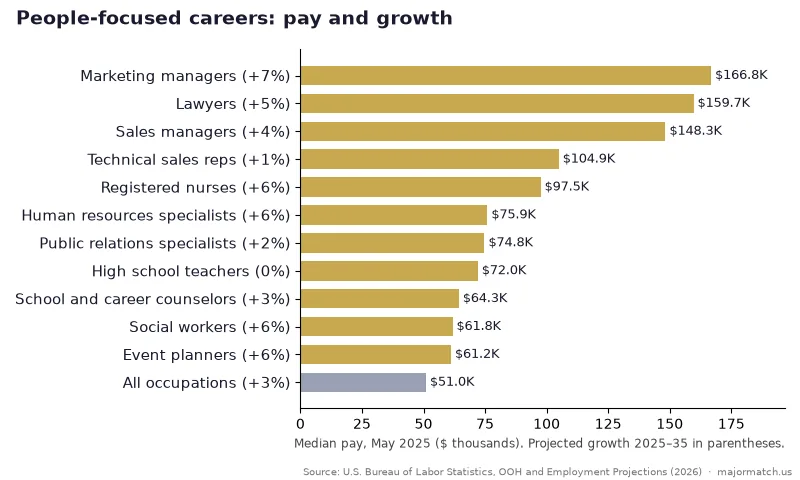
Here are common people-centered careers, with figures from the Bureau of Labor Statistics. Each career name links to its official profile.
| Career | Median pay (May 2025) | Projected growth, 2025–35 | Openings per year | Common majors |
|---|---|---|---|---|
| Marketing managers | $166,790 | 7% | 34,000 | Marketing, communications, business |
| Lawyers | $159,670 | 5% | 28,700 | Any major, then law school |
| Sales managers | $148,270 | 4% | 47,300 | Business, marketing |
| Sales reps, technical and scientific products | $104,920 | 1% | 23,600 | Business, engineering, science |
| Registered nurses | $97,550 | 6% | 180,800 | Nursing |
| Human resources specialists | $75,940 | 6% | 73,700 | Human resources, business, communications |
| Public relations specialists | $74,750 | 2% | 23,000 | Public relations, communications, business |
| High school teachers | $72,040 | 0% | 63,500 | Education or the subject you teach |
| School and career counselors | $64,330 | 3% | 27,800 | Psychology or education, then a master's |
| Social workers | $61,780 | 6% | 69,100 | Social work |
| Event planners | $61,160 | 6% | 16,800 | Hospitality, business, communications |
| All occupations | $50,980 | 3% | — | — |
Growth figures are rounded. Openings are yearly averages for 2025–35. Social workers cover all social worker types. Source: U.S. Bureau of Labor Statistics, Occupational Outlook Handbook and Employment Projections Table 1.2 (May 2025 wages, 2025–35 projections).
Two patterns stand out. First, the biggest paychecks go to people-facing roles that also carry responsibility for results: managing a sales team, running a marketing budget or representing a client in court. Second, the jobs with the most openings are in healthcare and education. Registered nurses alone are projected to have about 180,800 openings a year, and every career in the table pays above the $50,980 median for all workers.
How do these majors pay after graduation?
The job table shows careers. This one shows what recent graduates of each major actually earn, using New York Fed data. Early career means ages 22 to 27; mid-career means ages 35 to 45. Underemployment is the share of recent grads working in jobs that don't usually require a degree.
| Major | Early-career median pay | Mid-career median pay | Unemployment | Underemployment |
|---|---|---|---|---|
| Communications | $52,000 | $88,000 | 3.9% | 53.0% |
| Marketing | $60,000 | $100,000 | 4.4% | 49.3% |
| Advertising and public relations | $60,000 | $92,000 | 5.7% | 38.1% |
| Business management | $56,000 | $82,000 | 3.8% | 52.6% |
| Nursing | $70,000 | $87,000 | 2.1% | 12.8% |
| Elementary education | $45,000 | $55,000 | 1.2% | 16.2% |
| Political science | $52,000 | $100,000 | 4.5% | 48.7% |
| Hospitality (leisure and hospitality) | $45,000 | $75,000 | 2.7% | 58.1% |
| Social work (social services) | $43,000 | $60,000 | 1.9% | 30.1% |
| All majors | $58,000 | $87,000 | 4.2% | 39.4% |
Source: Federal Reserve Bank of New York, The Labor Market for Recent College Graduates (released Feb. 4, 2026).
Nursing stands out for its strong start and low underemployment, because the degree leads straight to a licensed job. Marketing and political science start near the middle but reach a $100,000 mid-career median. Communications, business management and hospitality all have underemployment above 50%, so internships and a clear plan matter more in those majors than in most.
Education and social work start lower, but unemployment for recent graduates is among the lowest of any major in the data. If you want to compare more majors, see our average starting salary by major guide.
Do employers really want extroverts?
They want the skills extroverts tend to practice, not the personality itself. In the NACE Job Outlook 2026 Spring Update, employers listed what they look for on a new graduate's resume:
- Ability to work in a team: 85%
- Verbal communication skills: 78%
- Leadership potential: 68%
- Interpersonal skills: 61%
- Friendly, outgoing personality: 28%
That last number is the useful one. Being outgoing helps, but employers want proof. NACE also reports that employers want students to show examples of their skills rather than simply list them. For an extrovert, that means turning your natural strengths into results you can point to: a club you grew, an event you ran, a sales or fundraising number you hit, or a presentation that won a competition.
Not sure which people-focused major fits you?
Take the free adaptive assessment (about 10 to 20 minutes) to see your top 3 major matches, scored with our own proprietary scoring method. The full Pathfinder report is $29 if you want the deeper plan.
Take the assessment →What if you're an extrovert who likes science or math?
You don't have to choose between people and technical work. Several paths combine both:
- Technical and scientific sales. Sales representatives who sell technical and scientific products earn a median $104,920, and BLS says they typically need at least a bachelor's degree. Engineering, chemistry, biology and business majors all lead here.
- Healthcare. Nursing, physician assistant and physical therapy careers mix science with patient contact all day. See our guide to the best majors for healthcare careers.
- Teaching math or science. BLS notes that many states require high school teachers to major in a content area, such as math or science.
- Management. Engineers and analysts who like leading people often move into management after a few years in the field.
Which majors might feel isolating for an extrovert?
No major rules you out. But some lead to jobs with long stretches of solo, focused work, such as lab research, back-office accounting or heads-down programming. Many extroverts thrive in those fields anyway, especially in team-based workplaces. The point is to know what a normal day looks like before you commit.
A quick test: look up the career you're picturing and read its daily duties in the Occupational Outlook Handbook. If most of the list is things you'd do alone at a desk, ask yourself whether that energizes you or wears you down. Our best majors for introverts guide covers the other side of the trade-off.
How do you choose the right major for you?
Personality is one piece. Interests, strengths and the kind of life you want matter just as much. An extrovert who loves biology and an extrovert who loves persuasion should probably pick different majors. Three questions help:
- Which people do you want to work with? Patients, kids, clients, customers, coworkers or the public?
- Do you want to help, teach, persuade or lead? Each points to a different major.
- How long do you want to be in school? Nursing and teaching start with a bachelor's. Law, counseling and clinical social work need graduate school.
If you can't answer those yet, that's normal. Our guide to aptitude tests vs. personality tests explains why a personality label alone isn't enough to pick a major.
The quickest next step is to take the assessment. It looks at your interests and strengths with our proprietary scoring and returns your top 3 major matches, so you can see whether communications, nursing, business or something else fits you best.
Frequently asked questions
What are the best college majors for extroverts?
Communications, marketing, business, nursing, education, political science, hospitality management, social work, and advertising and public relations. Each leads to careers built around clients, patients, students or audiences.
What are the highest-paying jobs for extroverts?
Among people-focused careers, marketing managers ($166,790), lawyers ($159,670) and sales managers ($148,270) have some of the highest median pay, according to the Bureau of Labor Statistics (May 2025). Most need a bachelor's degree plus experience, and lawyers need a law degree.
What are good jobs for extroverts without a degree?
The Bureau of Labor Statistics lists a high school diploma as the typical entry education for flight attendants (median $63,580), insurance sales agents ($62,280) and real estate sales agents ($52,830). All three involve working with people all day.
Is nursing a good major for extroverts?
For many, yes. Nurses work with patients, families and care teams all shift. New York Fed data shows recent nursing graduates earn a median $70,000 with 12.8% underemployment, one of the strongest results of any major.
Is communications a good major for an extrovert?
It can be, if you pair it with internships and a target career such as PR, marketing or sales. Recent communications grads earn a median $52,000, but 53% are underemployed, so a plan matters.
Can introverts succeed in these majors too?
Yes. These majors reward communication skills, which anyone can build. Employers in NACE's 2026 survey valued teamwork and verbal communication far more than an outgoing personality.
Sources
- U.S. Bureau of Labor Statistics, Employment Projections Table 1.2: Occupational projections, 2025–35, and worker characteristics, 2025
- U.S. Bureau of Labor Statistics, Occupational Outlook Handbook: Advertising, Promotions, and Marketing Managers
- U.S. Bureau of Labor Statistics, Occupational Outlook Handbook: Sales Managers
- U.S. Bureau of Labor Statistics, Occupational Outlook Handbook: Lawyers
- U.S. Bureau of Labor Statistics, Occupational Outlook Handbook: Wholesale and Manufacturing Sales Representatives
- U.S. Bureau of Labor Statistics, Occupational Outlook Handbook: Registered Nurses
- U.S. Bureau of Labor Statistics, Occupational Outlook Handbook: Human Resources Specialists
- U.S. Bureau of Labor Statistics, Occupational Outlook Handbook: Public Relations Specialists
- U.S. Bureau of Labor Statistics, Occupational Outlook Handbook: High School Teachers
- U.S. Bureau of Labor Statistics, Occupational Outlook Handbook: School and Career Counselors and Advisors
- U.S. Bureau of Labor Statistics, Occupational Outlook Handbook: Social Workers
- U.S. Bureau of Labor Statistics, Occupational Outlook Handbook: Meeting, Convention, and Event Planners
- Federal Reserve Bank of New York, The Labor Market for Recent College Graduates: Outcomes by Major (released Feb. 4, 2026)
- National Association of Colleges and Employers, Job Outlook 2026 Spring Update (PDF)
- National Association of Colleges and Employers, The Key Skills Employers Seek on College Students' Resumes (Apr. 20, 2026)