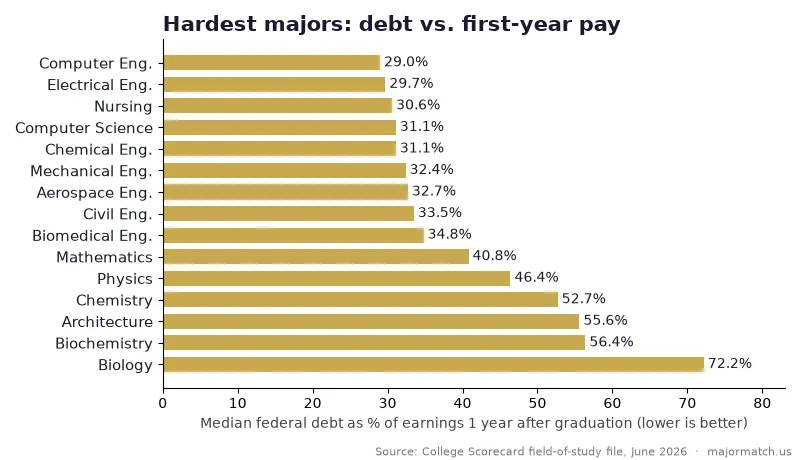
Quick answer: The hardest majors with the lowest debt-to-earnings ratios are computer engineering (29.0%), electrical engineering (29.7%), nursing (30.6%), computer science (31.1%) and chemical engineering (31.1%). Graduates in these fields owe a median of about $22,000 to $23,000 in federal student loans and earn about $71,000 to $79,000 in their first year out, per the U.S. Department of Education's College Scorecard (June 2026 file). At the other end, biology grads owe about the same but earn about $32,400 in year one, so their debt is 72% of a year's pay. The debt barely changes from major to major. The first paycheck changes everything.
There's a number that matters more to a 22-year-old than mid-career salary, and almost nobody looks at it before choosing a major: how big the student loan is compared with the first paycheck.
Mid-career pay is a long way off. The first loan bill arrives about six months after graduation. If that bill eats 4% of your income, you barely notice it. If it eats 10%, it decides where you can live, whether you can save, and how long the degree keeps costing you.
This is a companion to our hardest college majors ranking. We took all 15 majors on that list and asked a narrower question than a typical ROI ranking: if your teen picks a hard major and finishes it, how quickly does the paycheck catch up with the debt?
How did we measure debt-to-earnings for hard majors?
We used the U.S. Department of Education's College Scorecard field-of-study file (dated June 10, 2026). For each of the 15 hardest majors, we took the bachelor's-degree programs that report median federal loan debt and median earnings, then took the median across programs for each field (4-digit CIP code).
Our ranking number is median federal debt ÷ median earnings one year after graduation. Lower is better. We use year one on purpose: that's when repayment starts, and it's where majors differ most. (Our broader best-ROI majors ranking uses year-four earnings across all 115 fields.)
We also estimated the monthly payment on each major's median debt under the standard 10-year federal repayment plan at 6.52%, the fixed rate for undergraduate Direct Loans first disbursed between July 1, 2026 and June 30, 2027 (Federal Register, Sept. 2026). That payment math is ours, and it's illustrative.
Know the limits. Scorecard debt counts federal loans only (not private loans or Parent PLUS), and earnings cover federal-aid recipients who were working. It's the best national field-by-field data available, not your family's exact number.
Which hard majors have the lowest debt compared with first-year pay?
| Rank | Major (difficulty rank) | Median Federal Debt | Earnings 1 Yr After | Debt ÷ Yr-1 Pay | Est. Monthly Payment* | Payment as % of Yr-1 Pay |
|---|---|---|---|---|---|---|
| 1 | Computer Engineering (#11) | $23,000 | $79,200 | 29.0% | $261 | 4.0% |
| 2 | Electrical Engineering (#4) | $23,100 | $77,600 | 29.7% | $262 | 4.1% |
| 3 | Nursing (BSN) (#8) | $23,000 | $75,100 | 30.6% | $261 | 4.2% |
| 4 | Computer Science (#14) | $22,100 | $70,900 | 31.1% | $251 | 4.2% |
| 5 | Chemical Engineering (#2) | $22,700 | $73,100 | 31.1% | $258 | 4.2% |
| 6 | Mechanical Engineering (#7) | $22,900 | $70,700 | 32.4% | $260 | 4.4% |
| 7 | Aerospace Engineering (#3) | $23,700 | $72,400 | 32.7% | $269 | 4.5% |
| 8 | Civil Engineering (#13) | $23,300 | $69,400 | 33.5% | $264 | 4.6% |
| 9 | Biomedical Engineering (#5) | $22,600 | $64,900 | 34.8% | $257 | 4.8% |
| 10 | Mathematics (#12) | $19,900 | $48,800 | 40.8% | $227 | 5.6% |
| 11 | Physics (#6) | $21,500 | $46,400 | 46.4% | $244 | 6.3% |
| 12 | Chemistry (#9) | $22,500 | $42,700 | 52.7% | $255 | 7.2% |
| 13 | Architecture (#1) | $26,400 | $47,500 | 55.6% | $301 | 7.6% |
| 14 | Biochemistry (#15) | $21,600 | $38,300 | 56.4% | $246 | 7.7% |
| 15 | Biology (#10) | $23,400 | $32,400 | 72.2% | $266 | 9.8% |
| — | Middle of all 115 bachelor's fields | — | — | 59.5% | — | — |
Source: U.S. Department of Education, College Scorecard, Most Recent Cohorts Field of Study file (June 10, 2026). Bachelor's programs only; values are medians across reporting programs, rounded to the nearest $100. Biochemistry uses CIP 26.02 (biochemistry, biophysics and molecular biology); biology uses CIP 26.01 (biology, general), the closest Scorecard field for cell and molecular biology. *Monthly payment is MajorMatch's illustrative estimate: median debt on a standard 10-year plan at the 6.52% 2026–27 undergraduate Direct Loan rate. Ratios and ranking by MajorMatch.
Click any major in the table to open its free loan-vs-upside calculator, or compare debt and lifetime earnings with your own numbers in the degree loan vs. upside calculator. Then take the assessment to see which of these majors actually fit your teen.
What stands out when you rank hard majors by debt?
Three things jump out of the table, and none of them is about how much students borrow.
The debt is almost the same for every hard major
Thirteen of the 15 majors have median federal debt between $21,500 and $23,700. That's not a coincidence: federal loan limits cap what a dependent undergraduate can borrow (currently $31,000 in total, per Federal Student Aid). The outlier is architecture, at about $26,400, partly because many programs run longer than four years.
The first paycheck decides the ranking
Computer engineering grads earn about $79,200 in year one. Biology grads earn about $32,400. Same debt, a 2.4x difference in pay, and that's the whole story of this ranking. Every engineering major, nursing and computer science clears $64,000 in the first year.
14 of 15 hard majors beat the typical degree
The middle of all 115 bachelor's fields in Scorecard has debt equal to 59.5% of first-year pay. Every hard major on our list beats that except biology. Even chemistry and architecture, which rank low here, still come out ahead of the typical field.
Science majors catch up by year four
Look at year-four earnings and the science majors close a lot of ground. Physics jumps from about $46,400 to $78,200, and biochemistry from $38,300 to $65,100. Their slow start reflects grad school and research jobs that pay little at first. If your teen is heading that way, the debt is very manageable. If they're not, it bites.
How long does it take to pay off student loans with a hard major?
On the standard 10-year plan, it takes 10 years for everyone. The more useful question is how fast a graduate could pay it off with a reasonable effort. Here's our illustrative math: suppose a graduate puts 10% of their year-one gross pay toward the median debt for their major, at 6.52%.
- Computer engineering: about $660 a month, debt gone in roughly 3 years and 3 months.
- Nursing: about $626 a month, roughly 3 and a half years.
- Computer science: about $591 a month, roughly 3 and a half years.
- Physics: about $386 a month, roughly 5 and a half years.
- Chemistry: about $356 a month, roughly 6 and a half years.
- Architecture: about $396 a month, roughly 7 years.
- Biology: about $270 a month, nearly 10 years.
These are estimates, not quotes, and raises along the way would shorten every one of them. But the gap is real: the same effort clears an engineering grad's debt about three times faster than a biology grad's. To run it with your own school costs, use the degree loan vs. upside calculator.
Which of these majors fits your teen?
Take the free adaptive assessment (about 15–25 minutes) to see your top 3 major matches, scored with our own proprietary scoring method. The full Pathfinder report is $29 if you want the deeper plan.
Take the Free Assessment →Which hard majors leave you with the most debt for the pay?
Biology, biochemistry, architecture and chemistry, in that order. Biology is the clearest case: about $23,400 in median federal debt against about $32,400 in first-year earnings. A big part of the reason is that many biology grads are in pre-med, lab tech or research assistant roles in their first year, on the way to something else.
None of this means those majors are mistakes. It means the plan matters more. A biology major headed to nursing school, physician assistant school or medical school has a strategy. A biology major with no plan has the worst debt-to-pay ratio of any hard major. Our companion post on the hardest majors that actually pay off shows which of these fields catch up by mid-career.
Should you switch majors if it will cost you more money?
This exact question shows up in our search data, and it's a good one. The answer depends on when. Switching from a hard major to an easier one doesn't usually change how much you'd borrow per year, because federal limits cap that. What changes the bill is extra semesters. A switch in freshman or early sophomore year often adds nothing. A switch in junior year can add a semester or two of tuition and delay the first paycheck.
Before switching, compare three numbers: the extra semesters, the new major's first-year pay, and the old one's. Our guide to the real cost of switching majors walks through the math, including a two-week checklist for junior-year switches. And if your teen is drawn to a less punishing path from the start, the easiest majors that still pay well may be a better fit than surviving a hard one.
How do you pick a hard major your family can afford?
Debt-to-earnings only works in your favor if your teen finishes the degree and lands the job it's built for. So start with fit. Have your teen take the assessment; it scores their strengths and interests against 100 majors using our own proprietary scoring method. Then check the careers each top match leads to in the Major Earnings Continuum, and click any major in the table above to run it through its loan-vs-upside calculator.
The cheapest degree is the one your teen finishes on time, in a major that leads somewhere.
Frequently asked questions
Which hard major has the lowest debt-to-income ratio?
Computer engineering. Graduates owe a median of about $23,000 in federal loans and earn about $79,200 one year after graduating, so their debt equals 29.0% of first-year pay (College Scorecard, June 2026 file).
How much student debt do engineering majors have?
About $22,600 to $23,700 in median federal loan debt across chemical, electrical, mechanical, civil, aerospace, biomedical and computer engineering, according to the College Scorecard's 2026 field-of-study data.
How long does it take to pay off student loans with an engineering degree?
In our illustrative math, an engineering grad who puts 10% of first-year pay toward the median federal debt at 6.52% would finish in about 3 to 4 years. The standard federal plan runs 10 years.
Which hard major has the worst debt-to-earnings ratio?
Biology. Median federal debt of about $23,400 equals 72.2% of median first-year earnings (about $32,400), the only hard major worse than the middle of all 115 bachelor's fields.
Is nursing a good major for paying off student loans?
Yes. Nursing grads owe about $23,000 in median federal debt and earn about $75,100 in their first year, a 30.6% ratio, third-best among the 15 hardest majors.
Should I switch my major if it will cost more money?
It depends on timing. Switching early often adds little cost because federal loan limits cap yearly borrowing. A junior-year switch can add semesters of tuition and delay your first paycheck, so compare the extra cost with the new major's first-year pay.
What's the student loan interest rate for 2026–27?
6.52% fixed for undergraduate Direct Subsidized and Unsubsidized Loans first disbursed from July 1, 2026 through June 30, 2027, per Federal Student Aid's notice in the Federal Register.
Does this include private loans or Parent PLUS loans?
No. College Scorecard debt figures cover federal student loans only. Families who also use Parent PLUS or private loans should add those to their own math.
Sources
- U.S. Department of Education, College Scorecard, Most Recent Cohorts Field of Study data (file dated June 10, 2026)
- Federal Student Aid, Annual Notice of Interest Rates for Fixed-Rate Federal Student Loans (Federal Register, Sept. 10, 2026): 6.52% for undergraduate Direct Loans first disbursed July 1, 2026 to June 30, 2027
- Federal Student Aid, Subsidized and Unsubsidized Loans (annual and aggregate limits)
- University of Central Florida, How this UCF Alum Paid Off $31,679.87 of Student Loans in 6 Months (Feb. 7, 2020)
- Forbes, How This 24-Year-Old Repaid $61,000 Of Student Loans In 1.5 Years (Nov. 27, 2017)
- Federal Reserve Bank of New York, The Labor Market for Recent College Graduates: Outcomes by Major (Feb. 4, 2026 release, 2024 ACS data)